
Get all your news in one place.
100’s of premium titles.
One app.
Start reading
Windows Central
Windows Central
Technology
Daniel Rubino

People are paying $650 over MSRP for the Lenovo Legion Go 2 because it’s nearly impossible to find — and honestly, I get it, it’s the best handheld gaming PC of 2025

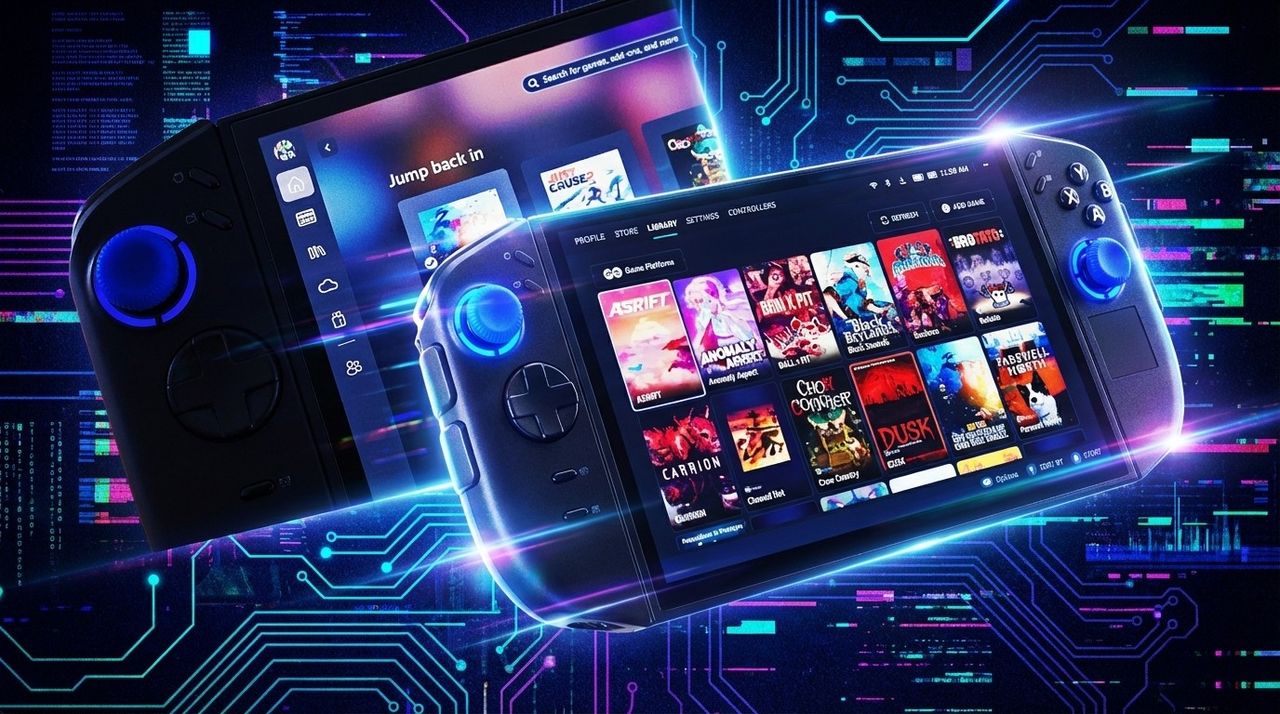
The Lenovo Legion Go 2.

Initially, I planned to just write this as a mini review of Lenovo’s high-end Legion Go 2 handheld gaming PC, as I was a big fan of the original version. I also knew that the AMD Z2 Extreme model was difficult to find (it seems like there are supply issues with AMD, but I’m not positive), so I looked it up to see that it was still unavailable from retailers, and that it was selling for $2,000 on eBay via resellers.

That’s $650 above the MSRP of the already jaw-dropping $1,350!

And yes, people are buying them at that price with multiple auctions going on and units being sold.

I also understand why — the Legion Go 2 is the gaming handheld PC of the year. I would take it over the much-lauded Xbox Ally X any day due to the better display and other unique features (we made a detailed comparison between the Xbox Ally X and the Lenovo Legion Go 2 if you want more details, including benchmarks).

Looking back, I’m confident that 2025 will be the year handheld gaming PCs finally went mainstream, and it’s about time. Too bad that the 2026 RAM shortage and price hikes are likely blunt the adoption of what is otherwise a thriving, nascent market.

Don’t get me wrong, handheld gaming PCs aren’t entirely “there” yet, as battery life still needs improvement. But to put it simply, companies like ASUS and Lenovo have taken the foundation established by Valve’s Steam Deck and have made significant improvements to the genre, expanding the options for users. Their efforts have raised the overall quality and performance to a level that truly meets and even exceeds what users expect.

Legion Go 2 is the high-end option

The Lenovo Legion Go 2 with AMD Z2 Extreme processor, 32GB of RAM, and 1TB of storage is a beast. (Image credit: Future | Daniel Rubino)

One thing I give credit to is that PC OEMs are significantly differentiating themselves, especially Lenovo. Its original Legion Go had, by comparison to existing devices, a massive 8.8-inch display, built-in kickstand, and (borrowing from Nintendo) removable joysticks, including a clever “FPS mode.”

While we gave the original Legion Go high marks in our review, its sequel, Legion Go 2, doubled on its strengths and, in my opinion, fixed all the weaknesses. I’ve been using it for the last few weeks, and I’m pretty much done with my Steam Deck OLED and ASUS ROG Ally (the original). Listen, both the Steam Deck and the ROG Ally are great devices, but Legion Go 2 is just better at everything else. The only thing you can ding it for is its price and its size, but the latter is a selling point for how I use it (mostly at home, on the couch).

For instance, Legion Go 2’s display is now OLED with 144Hz variable-refresh, making it unmatched in this space. Build quality is substantially better with fewer creaks, and it feels more premium. The Z2 Extreme AMD processor with 32GB of RAM is powerful, and dare I say, the battery life is quite satisfactory. I realize that doesn’t sound like a strong endorsement, but I’m usually surprised by how long it lasts compared to similar devices from years ago.

What about Windows 11 and gaming?

Windows 11, so far, hasn't been in my way yet for gaming and the new Xbox Full Screen Experience (FSE), pictured above, is a solid start, but needs more work to compete with SteamOS. (Image credit: Future | Daniel Rubino)

I’m in the critic’s camp of Windows 11 on handheld gaming PCs. Yeah, I get the perks, but Steam Deck set the bar for ease of use, speed, and thoughtful design. When Valve released SteamOS for other handheld PCs, I didn’t hesitate and flashed my Legion Go and ROG Ally that day, ditching Windows, and never looked back.

But hear me out: I think I’m going to keep Windows 11 on Legion Go 2.

For one, Lenovo’s software went from a D+ to a B+ in the last year. It’s still no SteamOS, but it’s not far off, either. And going by Lenovo’s forums and interactions with its fans, it’s clear the company is listening to feedback and implementing those wanted changes, giving me confidence that things will get even better.

It also turns out that when you have 32GB of RAM, 1TB storage, and AMD’s new Z2 Extreme processor … Windows isn’t half bad! Sure, I did “debloat” where I could, but I also currently don’t feel Windows getting in the way.

What about the new early-access Xbox Full Screen Experience (FSE)?

Lenovo Legion Go 2 specs

• Display: 8.8” WUXGA (1920x1200), OLED, Multi-touch, 1100nits peak brightness, 100% DCI-P3, 16:10, 30-144Hz VRR
• CPU: AMD Ryzen Z2 Extreme
• GPU: AMD Radeon RDNA 3.5
• Memory: 32GB LPDDR5x-8000
• Storage: 1TB M.2 2242 SSD, M.2 2280 slot
• Connectivity: Wi-Fi 6E (802.11ax) 2x2 with Bluetooth 5.3
• Ports: 2x USB4.0, 1x microSD card reader, 1x headphone jack
• Size: 295.6 x 136.7 x 42.25 mm (11.64 x 5.38 x 1.66 inches)
• Weight: 920g (2.03 lbs)

I had high hopes for Xbox FSE, and I love the “reboot into a purer Windows gaming experience” thing where it unloads unnecessary Windows components, but the Xbox app itself is … not bad, but far from great.

Right now, I am using a combo of Xbox FSE for optimization, but Legion Go Space for game management and launching, as well as Steam in Big Picture Mode. It’s all a bit too much, which is the problem with Windows gaming, but it all feels better than it did 2 years ago, so things are improving.

But hey, it’s early days for Xbox FSE, and if Microsoft can make its Xbox app more fluid, prettier, and more organized for my recently played games, I think it has a shot of bringing its vision together. But Microsoft needs to do the work, so let’s see if it’s up to the challenge.

I’m still tempted to flash SteamOS on Legion Go 2, or even going all in on wonder-hit Bazzite, but I’m not currently disgruntled enough by Windows to go down that path, and I want to see where Microsoft goes with this FSE thing.

Is Legion Go 2 (Z2 Extreme) worth $1,350 or even $2,000?

Some very recent auctions of the Lenovo Legion Go 2 with AMD Ryzen Z2 Extreme processor selling for $650 over MSRP. (Image credit: Future | eBay | Edited with Gemini)

Full disclosure: Lenovo sent me a review sample for this article, so no, I didn’t pay what is an eye-watering $1,349.99 for Legion Go 2, let alone $2,000 on eBay.

But would I? I’ve been struggling these last few years, like many, with various complexities in life, and one of those was trying to get back into gaming. I can say for the first time in many years that it’s finally starting to happen, and a lot of it is due to Legion Go 2.

For one, I’m rapidly approaching 50, and my eyes sure do like an 8.8-inch higher resolution OLED display! The other is that I simply don’t play on consoles or even my desktop PC anymore, because it’s a bit anti-social if you live with someone else and want to spend time together. With gaming handhelds, we can both be on the couch, watching TV, hanging with the dogs, playing games, and talking to each other.

Yeah, it’s all very brain-rot 2025, but it’s better than locking myself in my home office to game a bit, making the dogs think I don’t like them anymore (anyone with dogs knows how important TV couch time is with the “pack” at the end of the day).

Top and rear shot of the Lenovo Legion Go 2 with its combo power button and improved fingerprint reader, venting, and built-in kickstand. (Image credit: Future | Daniel Rubino)

It all comes back to what I started this article about: Handheld gaming finally meeting my expectations thanks to improved silicon and things like AMD Super Resolution. I’m playing full-on AAA shooters at 60+ FPS, enjoying side-scrollers, the latest “survivor” copy-cat, and getting what I feel is a non-compromised gaming experience (at least for more chill gaming).

Fan noise is not a concern, speakers deliver solid audio, and those smooth Hall Effect joysticks keep me happy. These are all huge advantages we didn’t have just 2 years ago.

So yeah, while I sure hope pricing becomes more accessible, we’re entering a new era where these devices are legit good. We can thank Nintendo and especially Valve for laying the groundwork, but I’m excited to see where OEMs like Alienware, Razer, HyperX OMEN (HP), take things while ASUS and Lenovo continue to set the bar.

As to the price, I think it’s fine, because we have devices starting at $499 and everything in between, up to $1,350. Consumer choice, especially with gaming, is sorely needed in this new genre, and companies are filling that gap, testing the waters, and making unique creations. (Personally, I’d like to see a $399 option, especially since Valve just canned its LCD Steam Deck.)

I’m all for it and can’t wait to see what happens in 2026 and 2027, especially if Qualcomm enters the field, which has been rumored for years. Let's see what happens!

Have OEMs done a great job with handheld gaming PCs? Is the hardware finally “there” for you, or do you need to see some other changes? Finally, which PC maker should make the next handheld gaming PC and why? Let me know in the comments!

Sign up to read this article
Read news from 100’s of titles, curated specifically for you.
Already a member? Sign in here
Related Stories
Top stories on inkl right now
One subscription that gives you access to news from hundreds of sites
Already a member? Sign in here
Our Picks
Fourteen days free
Download the app
One app. One membership.
100+ trusted global sources.







