Get all your news in one place.
100's of premium titles.
One app.
Start reading
The Times of India
The Times of India
World
TOI World Desk

Pemuteran Biorock Project: Electric reefs revive a Bali village; scientists debate benefits

Reefs of corals seldom recover from the ravages of dynamite fishing and cyanide. The explosion destroys the limestone platform that any new coral would need as a base. By the late 1990s, this is how things stood in Pemuteran, a little fishing village on Bali’s northwest coast. Years of harmful fishing practices had decimated local fish stocks, driven away the few tourists that used to visit to dive, and the bay's reefs resembled debris rather than live ecosystems. A local diving shop owner who had heard about an unusual restoration procedure got in touch with the two scientists who had developed it and asked them to attempt it in front of his shop.

Get breaking news anytime, anywhere. Download the TOI app now!

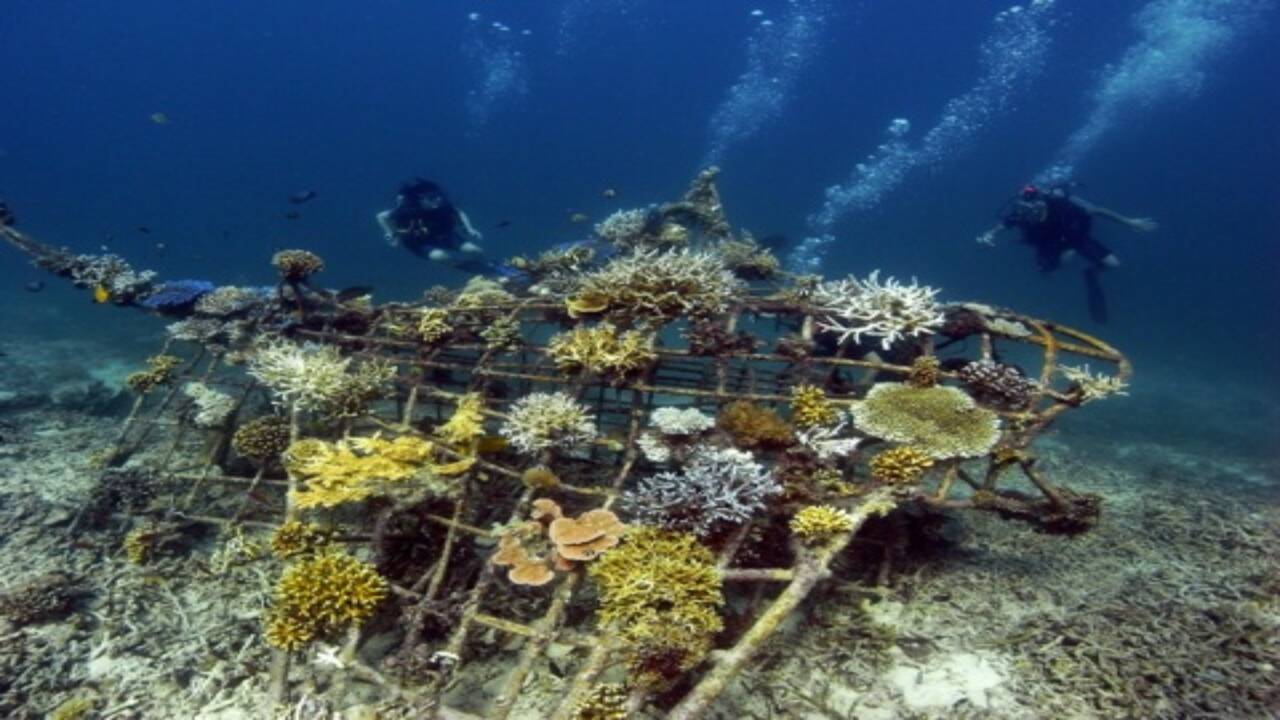
The approach, termed Biorock, uses a mild electrical current passing through a submerged metal frame to speed up a natural mineral building process. In 2000, residents in Pemuteran welded together scrap metal they could find, including old bicycle frames and wheels, rebar, and wire mesh, and lowered the resulting structures into the bay. Cables run from the shore to a low-voltage power source, and pieces of living coral are attached to the metal frames to begin growing. To understand why a simple electrical current can affect coral growth, we need to look at what the process actually does underwater.

When a weak stream flows through saltwater and a submerged metal frame, it starts a chemical process that takes dissolved minerals like calcium from the water and deposits them on the metal as a hard white crust, like limestone. The Global Coral Reef Alliance reports that corals on Biorock structures can grow up to three to five times faster than on untreated reefs under favourable conditions. That energy released seems to go towards growth of tissue and resistance to stress, not only skeleton building, which is part of the reason why the structures in Pemuteran filled in so fast after the initial frames were put in the water. Faster coral growth was only one part of the project's effect on Pemuteran.

From a bike trash to a thriving reef

In just a few years, the handful of ramshackle frames constructed from bicycles and welded rebar had mushroomed into dozens of structures throughout the bay, all filled with living coral and teeming with fish that hadn’t been seen in years. The UNWTO later documented how the reef restoration became closely tied to Pemuteran’s tourism economy and community-based environmental efforts. Divers today may still see portions of recognisably old hardware buried under decades of coral development, a reminder that practically any metal frame, however simple its original function, can become the skeleton of a new reef with enough time and current. But some marine scientists are not certain the technique warrants the kind of attention it gets.

Why some scientists remain skeptical

Some scientists have questioned whether Biorock has been tested at a large enough scale to establish that its benefits consistently exceed those of conventional reef-restoration methods. Much of the published work has focused on individual electrified structures or relatively small restoration sites, making it difficult to compare performance across entire reef systems.

Advocates say a method doesn’t have to be scalable to a whole ocean to be worth applying to a single threatened bay, especially when it also provides a community a direct investment in protecting the reef it helped to establish. That debate continues two and a half decades after the first bicycle frames went into Pemuteran Bay. At the same time, the reef itself continues to grow. Today it is thriving with far denser fish life than anyone in the village could have imagined when the whole idea still sounded like little more than a rumour passed around a struggling fishing town.

Local scuba-diving companies, who saw tourism plunge sharply before the project began, now built entire businesses around taking guests out to see the charged frames up close, often pointing out the strange bicycle wheel or bed frame still faintly visible under the crust of coral. That mix of ecological renaissance and revived livelihoods is undoubtedly what has kept Pemuteran’s Biorock project going nonstop since 2000, long after several smaller pilot projects elsewhere had quietly fizzled.

Sign up to read this article
Read news from 100's of titles, curated specifically for you.
Already a member? Sign in here
Related Stories
Top stories on inkl right now
One subscription that gives you access to news from hundreds of sites
Already a member? Sign in here
Our Picks
Fourteen days free
Download the app
One app. One membership.
100+ trusted global sources.