
Get all your news in one place.
100’s of premium titles.
One app.
Start reading
T3
T3
Technology
Rik Henderson

Peak retro – I tested Fujifilm's Instax Mini Evo Cinema camera and instantly fell in love

Fujifilm's retro-style Instax Mini Evo Cinema camera being tested.

There's no doubt about it, retro gadgets are having their day in the sun. That includes products that utilise modern technologies but with one foot very much in the past.

Retro gaming handhelds are great examples – they run classic games from yesteryear, even with CRT style effects overlayed, but on current operating systems and chips, like Android and Snapdragon CPUs.

(Image credit: Rik Henderson / Future)

And let's not forget the vinyl resurgence, with modern day records being more robust than their aged counterparts, but with the same tangible feel and sound.

Now cameras are getting in on the act. Photography has never really gone out of fashion – you can still pick up a 1970s stills camera and get amazing results from it. There have also been countless smartphone apps offering picture and video filters that ape classic styles.

But Fujifilm's latest Instax model isn't just giving you a few filters. It has the look and feel of an old school video camera, and having tested it in a hands-on session in London, that extra physical element adds something way beyond the scope of an app.

(Image credit: Rik Henderson / Future)

Crazy cool design

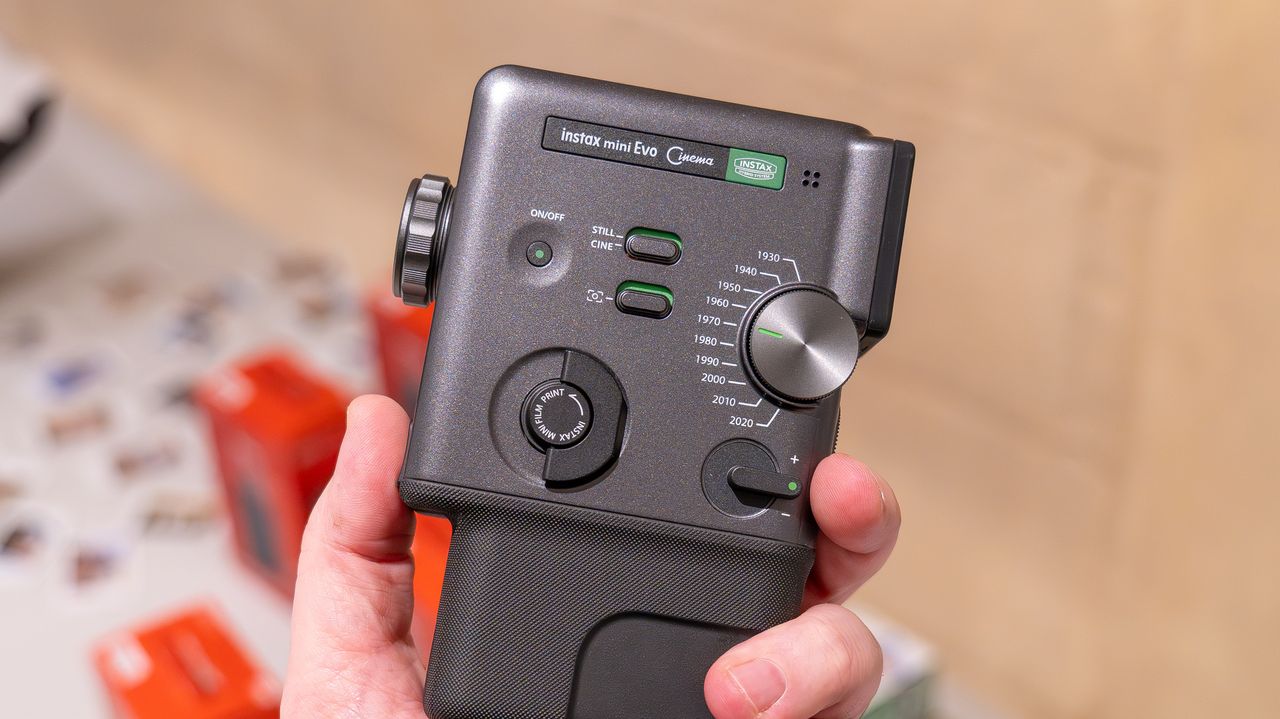
In many ways, the Instax Mini Evo Cinema is bonkers. Its design is purposefully reminiscent of a Super 8 camera, with a small lens jutting out from a body designed to be held vertically.

There are dials and switches you don't find on modern cameras, yet it is a digital device with an Instax instant photo printer built into the top. And there's a digital display on the rear that can be used with an eyepiece you get in the box, giving the experience a sense of analogue.

There's a wonderfully dichotomy about it.

(Image credit: Rik Henderson / Future)

Of course, for all its physicality, the camera is really designed for social sharing. It records a maximum of 15 seconds of video at a time, which can be edited in up to 30 second clips (in camera and through the iOS and Android app). But as well as post them online, users are encouraged to print a still from their short stories with a QR code.

Handing this physical copy to someone then allows them to see the video stored in Fujifilm's dedicated cloud service – bringing the stills back to life.

That's similar to the Mini Liplay+ – another recent hybrid camera from the brand – but it makes a lot more sense when housed in such a cinematic form factor.

(Image credit: Rik Henderson / Future)

Dialling up the past

Easily the biggest and most fun feature of the Instax Mini Evo Cinema camera is the Eras Dial on the side. This enables you to easily switch between different styles of video capture, based on the last 100 years of cinematography.

You can record digital clips that look like early 1930s film, give your footage a 60s vibe, or even take clean, modern footage inspired by the 2020s. Each has its own distinct visual language, with frame jumps, VHS-style artefacts, blurring and such like. And there are multiple strengths and filter types available per era too, allowing for even more customisation.

(Image credit: Rik Henderson / Future)

There's also the option to add related overlays – such as timestamps on 1990s footage – and you can choose to take stills in each style, not just video. Then, once captured, you can print a selected frame (or photo) via the included Instax printer, which uses the same cartridges as other camera models in the range. With or without the aforementioned QR code.

I found the whole experience to be remarkably simple to use, even without checking the manual once. There's a big button on the front that you press down to shoot, release to stop, and that's about it.

(Image credit: Rik Henderson / Future)

I haven't yet had the chance to edit recordings in camera or on a phone yet, but we're expecting a review sample soon, so will be able to elaborate more when we've had more time with one.

I'll also be able to assess the 800 x 600 video quality more. You can record in up to 1080 x 1440, but that's only available on the 2020 setting. Considering the effect supplied most filters, that might well be enough anyway.

(Image credit: Rik Henderson / Future)

First impressions

In all honesty, the Instax Mini Evo Cinema is not going to be to everyone's tastes. It looks like a Super 8 camera but only records in 15 second clips, so is more for those who like to share visual messages and ideas on social media.

It's also not cheap. The camera is priced at £329.99 / $409.95, so is a considered purchase. It does, however, directly appeal to me.

Having used a Super 8 camera in my childhood, and grown up through the VHS, Super-VHS, and 3CCD video camera eras, I love being able to replicate the different looks in a creative sense. And the form factor allows me to do so without feeling like I'm just slapping a digital skin over phone footage.

There's also something refreshing in recording in a style that cannot be altered afterwards. It makes you think far more about composition and which era to opt for.

I certainly can't wait to put it to the test in multiple real-world settings. For now, maybe because I'm so retro myself that it initially ticks my boxes.

Sign up to read this article
Read news from 100’s of titles, curated specifically for you.
Already a member? Sign in here
Related Stories
Top stories on inkl right now
One subscription that gives you access to news from hundreds of sites
Already a member? Sign in here
Our Picks
Fourteen days free
Download the app
One app. One membership.
100+ trusted global sources.