Get all your news in one place.
100’s of premium titles.
One app.
Start reading
T3
T3
Technology
Matt Kollat

Peak Design Travel Backpack 45L review: the most organised carry-on bag I’ve tested

Peak Design Travel Backpack 45L review.

Peak Design is one of those brands that has built a reputation for thoughtful, design-led products, whether it’s tripods, camera straps or, in this case, carry-on luggage that's also a travel backpack. There’s a clear expectation around build quality and attention to detail before you even get hands-on with its gear.

That said, expectations only go so far without real-world use, which is why I spent time travelling with the 45-litre version of the Travel Backpack. I received the Ocean colourway shortly after Peak Design announced it was expanding its range with more expressive colour options, and it has since become my go-to travel backpack for longer trips.

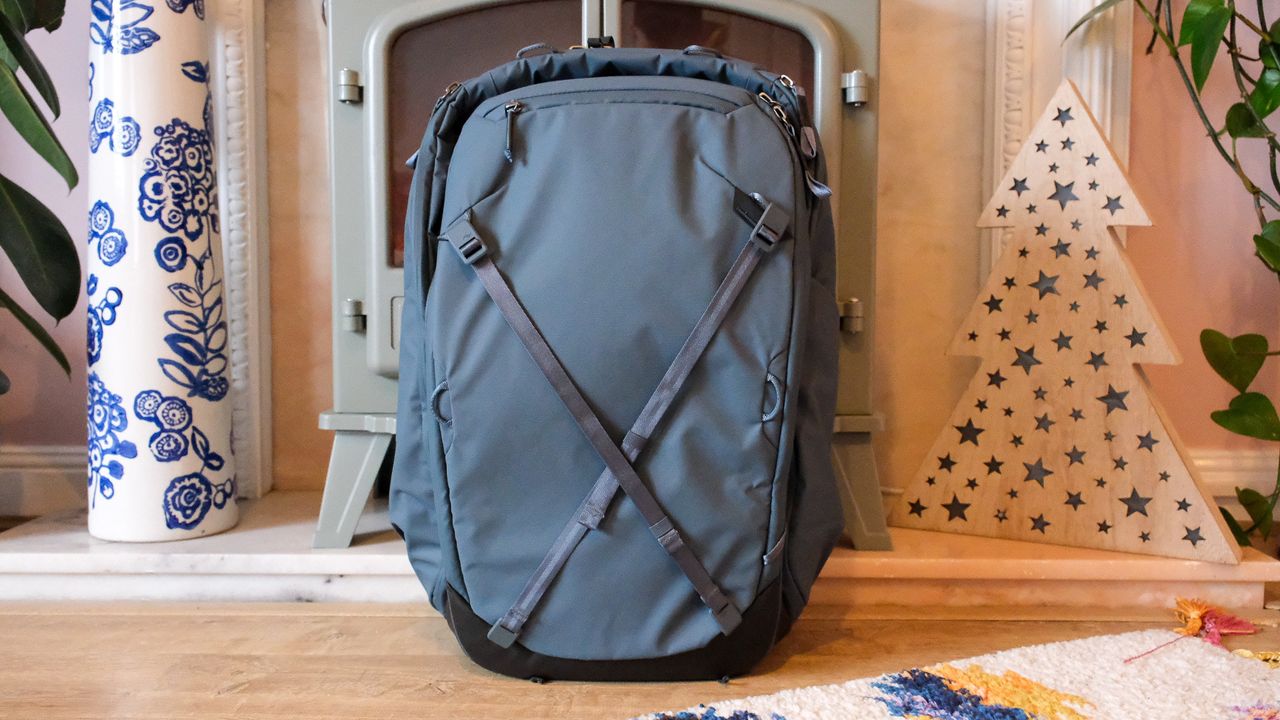
Visually, the bag is unmistakably Peak Design. It shares a design language with the brand’s Everyday Backpack and Everyday Messenger, but the Travel Backpack has been reworked specifically for travel. The result is a more structured, more modular pack that prioritises access, organisation and flexibility over minimalism.

Made for the long haul

As expected, the Travel Backpack is packed with design-led solutions. Features such as the compression buttons that slim the bag down when travelling light, and the shoulder straps that can be tucked away behind the magnetic back panel, are clearly aimed at frequent travellers, particularly those familiar with airline carry-on restrictions and bag sizer cages.

Where the weight comes from

The Travel Backpack’s core shell is made from weather-resistant, 100% recycled 400D nylon canvas, giving the bag a durable, hard-wearing feel while keeping sustainability in mind.

The fabric is treated with a DWR (durable water repellent) finish and double-coated with polyurethane to help repel moisture and light rain. That said, it’s worth noting that the bag isn’t fully waterproof without the included rain cover.

The base is reinforced with a heavier 900D nylon, a denser weave that improves abrasion resistance in the area most likely to see wear over time. This contributes to the bag’s overall sturdiness, though it also plays a role in its relatively high weight.

Compressed (Image credit: Matt Kollat)
Decompressed (Image credit: Matt Kollat)

Peak Design hasn’t compromised on zippers and closures either. The Travel Backpack uses oversized, weather-resistant zips throughout, and the expansion and compression panels are integrated cleanly into the overall structure rather than feeling like add-ons.

Secret pockets everywhere (Image credit: Matt Kollat)

Inside, there are padded sleeves for laptops and tablets, along with a rigid internal structure that helps the bag hold its shape even when partially empty. There are also numerous attachment points designed to work seamlessly with Peak Design’s packing cubes and camera inserts.

Zips doing the heavy lifting

The 45L Travel Backpack relies heavily on its zip system. Oversized, weather-resistant zips are used across the main clamshell opening, expansion panels and external pockets. These zips feel deliberately stiff out of the box, largely due to the water-resistant coating and tight tolerances, but loosen up with use.

The divider pockets can be accessed from both sides (Image credit: Matt Kollat)

The expansion system is almost entirely zip-driven, allowing the bag to scale down for carry-on use or expand for longer trips. Two buttons at the top help pull the upper section inward, making the bag easier to fit into tighter spaces. There’s also a degree of built-in theft deterrence, with zipper pulls that can be interlocked or secured with a small lock.

Hidden in plain sight

One of the more distinctive design features is the use of magnetic flaps. On the back panel, these hide the shoulder straps and hip belt, leaving just the central grab handle exposed. This neatly solves a common issue with travel backpacks, where unused straps tend to dangle or catch when not needed.

Magnetic flaps to tuck away that shoulder straps (Image credit: Matt Kollat)

At the front, a third magnetic flap conceals the rain cover or a jacket, as well as the straps used to attach items externally. The anchor points here feel solid and well-reinforced, in keeping with the rest of the bag’s construction.

Zippered pocket integrated into the water bottle pocket (Image credit: Matt Kollat)

Another small but useful detail is the zippered pockets integrated into the water bottle flaps on either side of the bag. These are well-suited to smaller essentials such as keys or passports and are easy to access without opening the main compartment.

(Image credit: Matt Kollat)

The main compartment can be accessed from the front, the back and both sides. The side access points, borrowed from Peak Design’s camera bags, are particularly practical. Having entry points on both sides also makes the system equally usable for left- and right-handed users.

The divider can be fully unzipped from the front (Image credit: Matt Kollat)

The mesh organisational pockets dividing the front pocket and the main compartment can be accessed from either side, and there are two additional zippered pockets on the inside of the front flap. There’s also a smaller external pocket at the top centre of the front panel.

A system that needs learning

It’s worth noting that the sheer number of pockets, zips and flaps can feel slightly overwhelming at first. It’s easy to grab the wrong zip and expand the bag instead of opening a pocket, particularly during early use. Over time, the layout becomes more intuitive, but there is a learning curve.

At 56cm x 33cm x 24cm (22" x 13" x 9.5"), the 45L Travel Backpack sits at the upper end of what budget airlines will accept as carry-on luggage. I often kept the compression buttons fastened and stayed mindful of the added depth created by the stowed shoulder straps, particularly when passing through bag sizers.

The side pockets are game-changers (Image credit: Matt Kollat)

Even with the compression system engaged, there’s ample room inside. The organisational layout makes it easy to separate clothing, tech and souvenirs, and the multiple access points are especially useful when carrying camera gear that benefits from quick side access.

The main drawback of the Travel Backpack is its weight. At 2.05kg (4.5lb), it’s far from lightweight, and combined with its size, it may feel unwieldy for people of shorter stature or those planning to carry it fully loaded for extended periods. That said, the weight is a direct result of the materials and structure used.

Verdict

Ultimately, the strengths of the Peak Design Travel Backpack outweigh its weaknesses for the type of traveller it’s aimed at. The emphasis on durability, organisation and modularity will appeal to those who prioritise structure over minimal weight savings. The ability to integrate Peak Design’s packing cubes and accessories also makes it easier to move between different bags within the same ecosystem.

Shoulder straps out... (Image credit: Matt Kollat)
... And tucked away. (Image credit: Matt Kollat)

The Peak Design Travel Backpack 45L is available now from Peak Design UK, Peak Design US, Peak Design AU and Peak Design EU, with a recommended price of £260 / $300 / AU$600 / €300. It sits firmly in the premium end of the travel backpack market, but its pricing is broadly in line with other high-end, design-focused travel bags.

Sign up to read this article
Read news from 100’s of titles, curated specifically for you.
Already a member? Sign in here
Related Stories
Top stories on inkl right now
One subscription that gives you access to news from hundreds of sites
Already a member? Sign in here
Our Picks
Fourteen days free
Download the app
One app. One membership.
100+ trusted global sources.