Get all your news in one place.
100's of premium titles.
One app.
Start reading
Guitar World
Guitar World
Entertainment
Chris Jisi

“Paul played a lot of terrific bass with Wings that’s still under-appreciated. I don't think he even recognizes it himself”: Paul McCartney’s greatest post-Beatles bassline

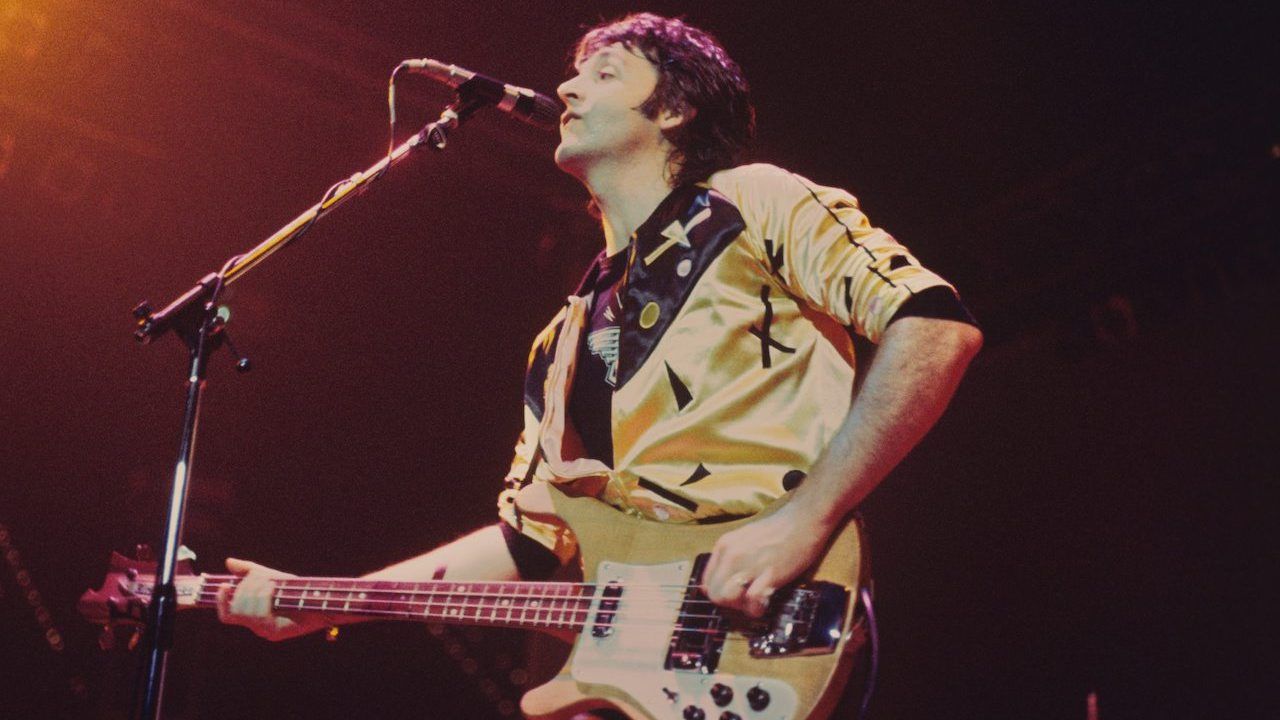
Paul McCartney performs live on stage with Wings at Ahoy on 25th March 1976 in Rotterdam, Netherlands. He plays a Rickenbacker 4001S bass guitar.

In his 1995 Bass Player cover story, Paul McCartney said his prize period on bass guitar was around Rubber Soul and Sgt. Pepper, where he could put all his energy into the song and bassline, as opposed to his “okay” bass playing in Wings, due to his having numerous hats to wear, ranging from bandleader to business manager.

Guitarist Laurence Juber, whose career as a London and then Los Angeles session musician is separated by his two-year stint with Wings, begged to differ.
“Paul wrote a lot of great music and played a lot of terrific bass with Wings that is still under-appreciated,” said Juber in the October 2013 issue of Bass Player. “Some of it I don't think he even recognizes himself, yet.”

McCartney’s bassline for Silly Love Songs, which spent five weeks at No. 1 on the U.S. charts, is a case in point.

The track, from the album Wings at the Speed of Sound, was recorded at Abbey Road Studios in January and February 1976. Criticized and taunted by the music press and John Lennon alike for writing “lightweight” songs, McCartney wrote it as a biting response, later cutting a more techno-oriented version featuring Louis Johnson on bass for the 1984 film Give My Regards to Broad Street.

(Image credit: vCaem/Gijsbert Hanekroot/Redferns)

Based on his later studio experience with Wings, Juber confirmed that Paul played his flatwound-strung Rickenbacker 4001S with a heavy-gauge pick, likely both direct and through a miked Fender Bassman, with a Fairchild Compressor on all bass tracks.

Denny Laine and Jimmy McCulloch on guitars, and drummer Joe English on drums rounded out the rhythm section, with keyboards, vocals, a four-piece horn section, and strings all added later.

What stands out about Silly Love Songs as compared to McCartney's Beatle bass anthem, Come Together, where the one-bar bass figure snakes around the vocals, or his 1979 Wings bass tour de force, Goodnight Tonight, where the busy bassline answers and fills in between the sparse vocal line, is that the vocal and bassline run together in counterpoint.

That's a key aspect to Juber, who covered Silly Love Songs on solo guitar for his 2005 album, One Wing.

“Paul's gift for singing and playing a bassline in counterpoint is remarkable. One of my favorite Paul McCartney bass parts is on his first solo single, Another Day, where at times the bass and vocals move in parallel sevenths. When counterpoint is done well like that it can drift outside of strict church harmony, and that's where the personality really emerges.”

Silly Love Songs begins with eight bars of a simulated assembly line, perhaps a symbolic precursor to the driving, repetitive bassline and four-on-the-floor drum pulse that lie ahead. Four more bars of intro allude to the bassline shape, which takes its full four-bar form at the first verse.

Interestingly, McCartney’s vocal is a three-bar phrase, leaving the fourth bar open for bass; however, the bar 4 bassline is actually finishing a two-bar phrase that begins under the Fmaj 7 chord in bar 3.

Two key elements are McCartney's use of chromatic passing notes, which help the melodic flow of the line (a device he has always employed, as a fan of Tin Pan Alley songs), and his interesting application of short and long notes.

“Paul plays with a very hard touch onstage, but he has a real sensitivity to dynamics and note duration in the studio. Even though the basic sequence of C Em7 Fmaj7 repeats in both the verses and choruses, the ear doesn't tire of it because he doesn't use a heavier, final-sounding, dominant V chord cadence.”

For the first chorus, at 01:02, McCartney keeps the same driving bassline, while the vocals pare down to whole notes. His use of up-and-down strokes with a pick is revealed via his 16th-note pickup at 01:32.

The bridge arrives with a unison riff that answers the vocal before building over the last five bars. The horn soli gives way to the breakdown at 03:12. As the vocals get more contrapuntal, the bass builds to a root-5th-octave pattern.

(Image credit: Getty Images)

The horn soli reprises at 03:42, leading into a more minimal breakdown at 04:13, without bass for a bit (listen around 04:43 for bass panned way left and in the distance). The buildup involves McCartney's Latin bass figure again and a trick horn soli that lasts only four bars.

Finally, the song returns to a verse at 05:22, ending exotically on the III minor chord – “the most bittersweet chord in the C major scale,” noted Juber.

Sign up to read this article
Read news from 100's of titles, curated specifically for you.
Already a member? Sign in here
Related Stories
Top stories on inkl right now
Our Picks
Fourteen days free
Download the app
One app. One membership.
100+ trusted global sources.