
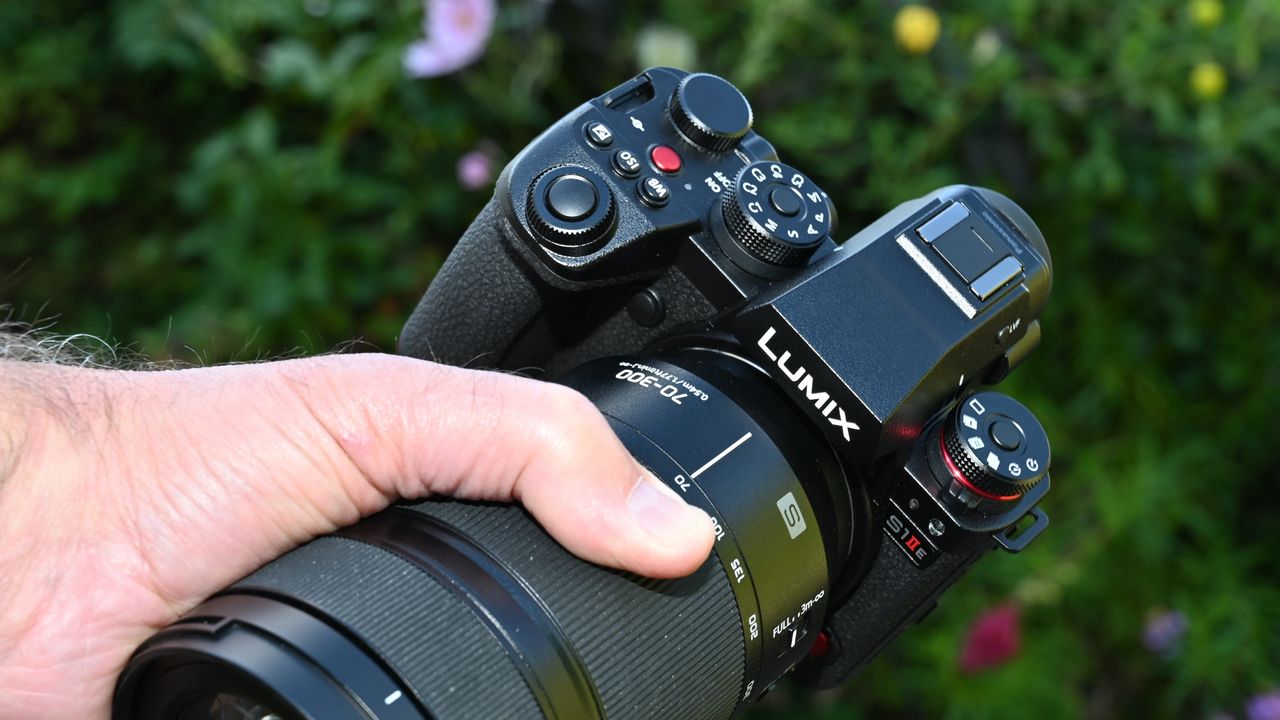
Jump in your time machine and nip back to late 2018. It seemed the whole world was going full-frame mirrorless, with the original Canon EOS R, Nikon Z6, and Nikon Z7 following a precedent that the Sony A7 had set about five years earlier. Panasonic followed suit in February 2019, with the launch of the original 24.2 megapixel Lumix S1 and 47 megapixel Lumix S1R. The former was superseded in May 2025 by two new models, the Lumix S1 II and the Lumix S1 IIE, which I’m reviewing here.
Both have a very similar megapixel count of approximately 24 megapixels, the crucial difference being that the S1 II has a partially stacked image sensor, whereas the S1 IIE doesn’t. As featured in the Nikon Z6 III, the advantage of the S1 II’s partially stacked sensor equates to fast readout speed, in Panasonic’s case, with a stills burst rate of up to 70fps (frames per second), and super-high frame rates for high-resolution video, with minimal rolling shutter effect.