
Get all your news in one place.
100's of premium titles.
One app.
Start reading
Fit & Well
Fit & Well
Health
Jennifer Rizzuto

Over 60 and can’t get on the floor? A personal trainer shares her favorite standing core exercises for beginner-level seniors

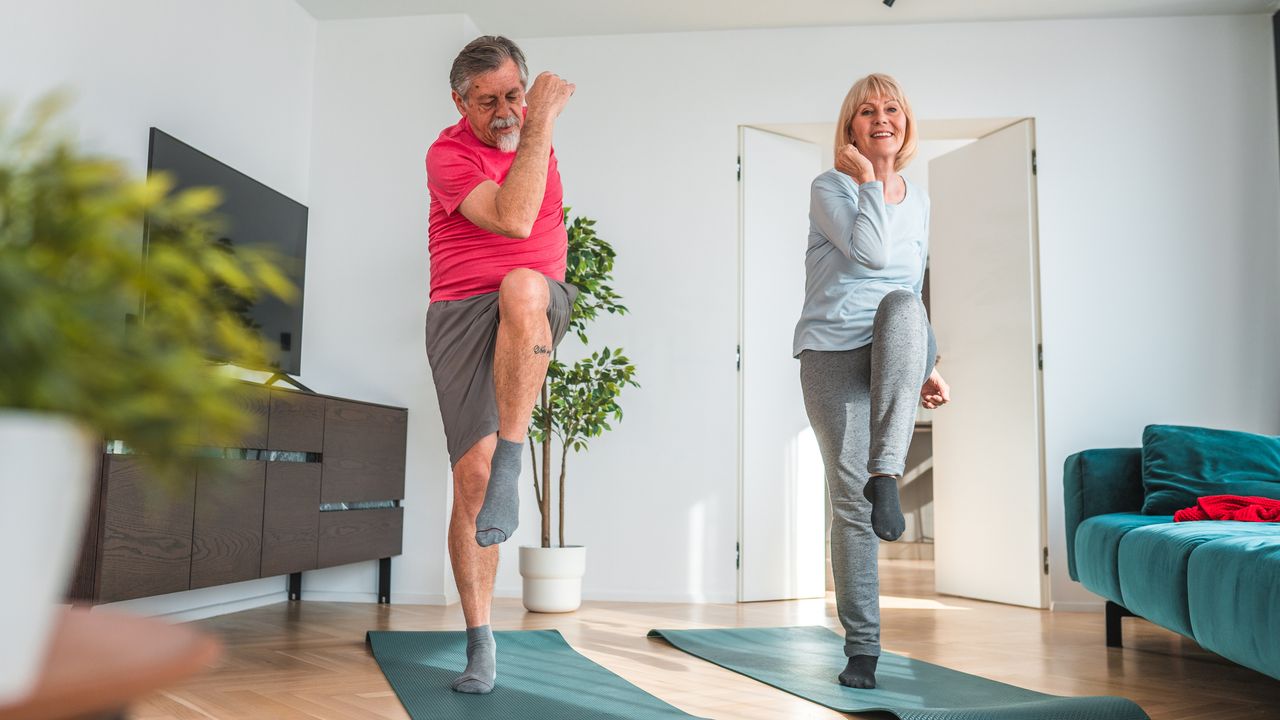
Man and woman exercising in living room, lifting their knees to their elbows.

Strengthening your core is important at any age. However, a strong core becomes even more vital to our health and longevity in our senior years. The core muscles help to keep us stable, upright, and supported through everyday movement.

Certain age-related changes, like vision loss or vestibular system deterioration in the inner ear, can begin to affect our balance as we get older. While falls become much more common for those over 60, strong core muscles can help improve balance and reduce the chances of serious injury.

Unfortunately, many seniors have mobility concerns that make popular exercises like bird dogs, side planks, and dead bugs off-limits. That doesn’t mean that core training is off the table, though.

When I start working with a beginner-level senior client who can’t get onto the floor safely, I always teach them the following three standing moves instead.

You don’t need any equipment to do them, and they’re accessible for most fitness levels.

How to do the standing core exercises for seniors

These exercises are safe for almost everyone, but you should still get clearance from your medical team before attempting them.

As with any exercise, proper form is crucial. If you’re unsure of how to correctly perform these movements, consider meeting with a certified personal trainer. They can give you feedback and modify or progress the exercises as needed.

Be sure you know how to engage your core before trying this workout.

Start by doing eight to 10 reps of each exercise for one or two sets, do this three times a week. Once you’re feeling stronger, slowly increase the reps to 12 to 15 and the sets to three.

These exercises can be performed every day if desired, but four or five times a week is sufficient enough to yield benefits.

You just need a section of bare wall for this workout. If you currently struggle with poor balance, you may also want a chair in reach for additional support.

1. Standing march

Sets: 1-3 Reps: 8-15 each side

  • Stand with your feet hip-width apart.
  • Engage your core.
  • Lift your left knee to hip height and bend it to 90°.
  • Pause briefly.
  • Lower your left foot back to the floor.
  • Repeat on the other side, alternating sides with each rep.

Trainer tips: Keep your hips as still as possible as your legs move.

Don’t rush and focus on engaging your abdominals as you lift your leg. If balance is an issue, try this exercise while holding onto a chair.

2. Wall shoulder tap

Sets: 1-3 Reps: 8-15 each side

  • Stand facing a wall, an arm’s length away, with your feet hip-width apart.
  • Place your hands on the wall, in line with your shoulders, and take one step back so you are leaning into the wall.
  • Engage your core.
  • Lift your left hand off the wall and tap your right shoulder.
  • Place your left hand back onto the wall.
  • Repeat on the other side, alternating sides with each rep.

Trainer tips: Like the standing marches, keep your hips as still as possible.

Go slowly and be sure to keep your head, shoulders, hips, and ankles in a straight line.

The further away you are from the wall, the more challenging the exercise will be. Step closer to the wall if you’re unable to keep your body still as you move your arm, or step away from the wall if the exercise feels too easy.

3. Glute kickback

Sets: 1-3 Reps: 8-15 each side

  • Stand facing a wall with your feet hip-width apart.
  • Place your hands on the wall.
  • Engage your core muscles.
  • Keeping your left leg straight, squeeze your left glute and lift your left heel behind you.
  • Slowly, lower your left foot back to the starting position.
  • Do all your reps on one side, then switch sides.

Trainer tips: Many people think of the core as just the abdominals, but the glutes are an important core muscle group as well.

You don’t have to lift your leg very high, even a slight lift off the ground will activate the appropriate muscles.

Avoid arching your lower back as you lift the leg, and keep the rest of your body as still as possible.

Sign up to read this article
Read news from 100's of titles, curated specifically for you.
Already a member? Sign in here
Related Stories
Top stories on inkl right now
One subscription that gives you access to news from hundreds of sites
Already a member? Sign in here
Our Picks
Fourteen days free
Download the app
One app. One membership.
100+ trusted global sources.