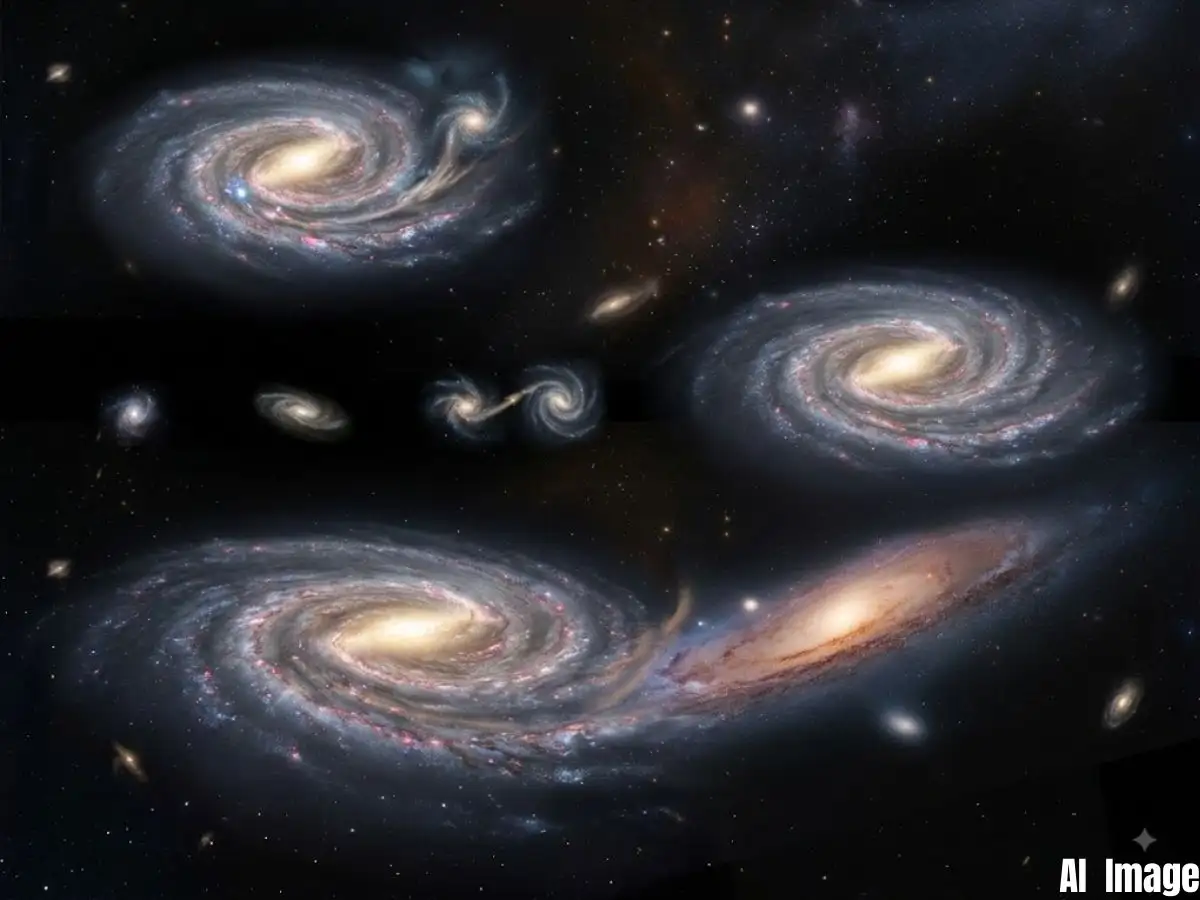
The Milky Way grew through more than just the birth of new stars. A new research has found evidence that our galaxy swallowed a smaller dwarf galaxy about 11.8 billion years ago, making it the earliest known merger in the Milky Way's history. The finding also adds to the story of how our galaxy evolved through repeated encounters with other galaxies.

Milky Way's earliest known merger
The merger happened roughly 2 billion years after the Big Bang, when the universe was less than 15% of its current age. The smaller galaxy, now identified as Low-energy-Kraken-Heracles, or LKH, was a dwarf galaxy. Researchers estimate that it contained stars with a combined mass equal to about 500 million Suns when it merged with the young Milky Way.
That was roughly one-quarter of the Milky Way's mass at the time.
The discovery helps scientists understand how the Milky Way reached its present size. The galaxy did not simply build itself by producing stars. It also grew by pulling smaller galaxies into its gravitational field and absorbing them.
Hubble and Gaia helped trace the merger
Researchers examined groups of stars near the center of the Milky Way using observations from the Hubble and Gaia space telescopes. They studied stellar clusters containing hundreds of thousands of stars across the galaxy's innermost 20,000 light-years. The scientists compared the ages, chemical composition and movements of these stars to identify clues about their origins.
A light-year is the distance light travels in one year, equal to about 5.9 trillion miles (9.5 trillion km) .
The researchers found that some of these stars had characteristics and trajectories consistent with having originated in the dwarf galaxy before becoming part of the Milky Way.
What happened when the galaxies merged?
The merger did not mean that stars from the two galaxies crashed directly into one another.
"I would say that from the point of view of stars, the merger was rather peaceful, with no star-to-star crashes. But from the point of view of the gas, the merger was more 'explosive', likely, the collision between the gas from LKH and that from the Milky Way triggered the formation of many stars," Massari said.
The encounter also brought large amounts of interstellar gas and dark matter into the young Milky Way. The gas could have supplied material for the formation of new stars.
Scientists believe some stars that originally belonged to LKH could still exist in the inner parts of the Milky Way. Finding them individually is difficult because large amounts of interstellar dust obscure this region.
Milky Way has swallowed other galaxies too
The LKH merger was not the last major galactic encounter involving the Milky Way. The galaxy later absorbed another dwarf galaxy known as Gaia-Sausage-Enceladus, about 1.8 billion years after the LKH merger. The Milky Way has also been interacting with the Sagittarius dwarf galaxy for roughly the past 6 billion years. That process is still continuing.
These mergers have helped shape the structure and contents of the galaxy that exists today.
Another galactic crash may come
The Milky Way's history also raises questions about its future. Our galaxy is expected to have a major encounter with the Andromeda galaxy, although newer research has challenged the idea that a collision is certain. The commonly cited timeline puts a possible Milky Way-Andromeda merger at around 4.5 billion years from now.
If it happens, it would be another major chapter in the long history of galactic mergers that have shaped the Milky Way.
What the ancient merger means for Earth
The effects of these enormous cosmic events extend far beyond the galaxies themselves. "Every single one of these mergers had an influence on the events that have led to the formation of our own solar system, and ultimately of Earth. This is why I think that reconstructing the pieces of the Milky Way's past effectively contributes to answering the big question about, 'Where do we come from?'" Massari said.
The new evidence gives scientists another piece of that history, one that began billions of years before the Sun, Earth and the rest of our solar system existed.