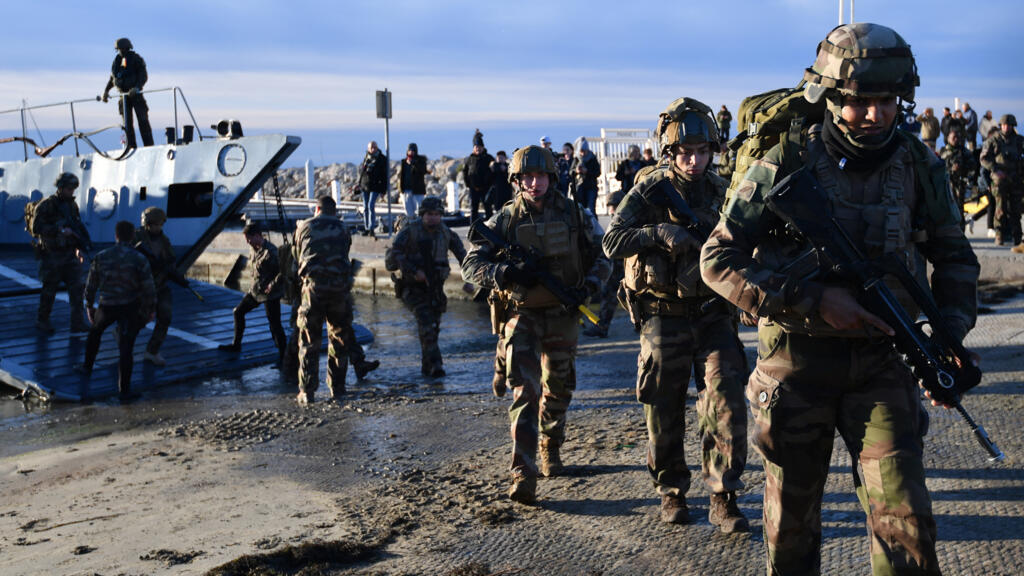
France's armed forces will launch phase two of their flagship Orion 26 military exercises in Saint-Nazaire, on the country's west coast, on Sunday. As war rages in Ukraine, more than 10,000 military personnel are preparing for high-intensity warfare in drills designed to ready France to defend European territory from a hostile state.
Orion – which stands for "large-scale operation for resilient, interoperable, high intensity combat-oriented and innovative armies" – was conceived in 2021. Two years later, France carried out its largest military exercises to date with Orion 23 – an operation involving 12,000 troops, including NATO allies.
The "ongoing deterioration of the international landscape and the evolution of threats" has made Orion 26 even more relevant, according to the Ministry of the Armed Forces.
Bringing together land, air, naval, cyber, space and special forces, it demonstrates "France's determination to protect the nation, its citizens and its interests in the long term by preparing for the most demanding military challenges", the ministry said.
The three-month drills will be based on a "fictional but credible scenario" in which an expansionist country in the East, known as Mercury, is seeking to destabilise its neighbour Arnland in order to maintain its influence in the region and prevent the latter from joining the European Union.
Geographically, Arnland is located on French territory – but with Ukraine and Russia at war on Europe's doorstep, the exercise also reflects what a reinforced version of the "Coalition of the Willing" for Ukraine might look like, should Kyiv need urgent reinforcement.

France now supplies most of Ukraine’s intelligence, Macron says
In the invented scenario, throughout 2025 Mercury has multiplied hybrid actions and increased its support for militias in Arnland. At the request of Arnland – an ally – France takes the lead of the Orion coalition on 6 January 2026, to ensure its defence and preserve balance in Europe.
The exercises include seizing entry points on contested territory, gaining the upper hand in the field, then conducting amphibious and airborne operations to secure a broader deployment zone.
From 8 February to early March, 10,000 troops will conduct amphibious and airborne operations in the Saint-Nazaire area, supported by 350 vehicles and 400 drones.
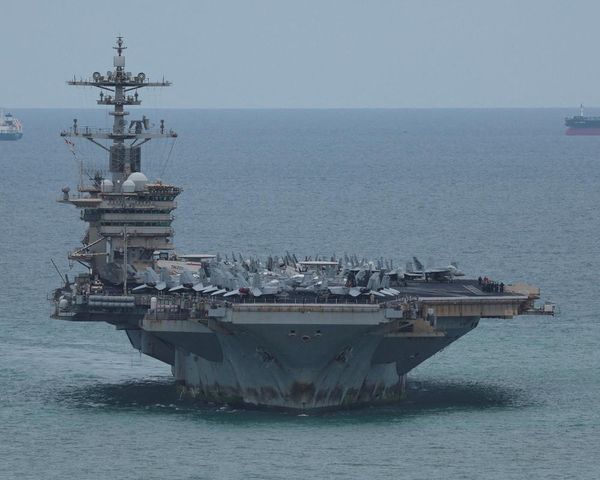
For the amphibious phase, the French Navy will be present with the carrier strike group, while the Air and Space Force will deploy around 20 Rafale fighter jets and two surface-to-air defence systems.
In April, the exercise will come under NATO command and will focus on France’s role as a host nation, supporting allied forces transiting through its territory.

Vice-Admiral Xavier de Véricourt, commander of the Joint Force Command expert centre, told RFI more about the drills.
RFI: What's the scenario for Orion 26?
The scenario was inspired by NATO. I'm not going to reveal all its secrets, firstly because there are confidential elements, and also because it would reveal everything to the players on all sides. It would diminish the intensity of the exercise. But, broadly speaking, it involves a country calling on a coalition, whose framework nation is France, and this coalition intervenes under French leadership. Then the situation evolves, NATO intervenes and the operation and its forces are transferred to NATO command.
The exercise begins in France and has four phases. How will they be structured?
There are three successive phases and then one phase that runs across the entire timeline. The first phase is taking place right now. It's the planning phase, staff work. Then there's a so-called field phase within the coalition, and finally a last field phase, but this time under NATO command.
Throughout this timeline, you have an interministerial crisis management component for the entire duration of the exercise. This involves, on the one hand, managing repercussions on French territory while our troops are supposed to be deployed abroad in support of the country calling on the coalition, and on the other hand, managing the support that would transit through French territory.

Russia sees France as its 'chief enemy' in Europe, says head of French army
So with Orion 26, will French forces move from national command to a broader command structure?
A NATO command, and that's one of the challenges. But in fact there are multiple issues at stake with Orion 26. There's the training issue, because if an army doesn't train, it loses skills and operational performance. So the aim for us is to remain at the highest possible level of operational performance. There is also the challenge of training to deal with modern threats, in a context marked by innovation. So we inject innovation. And then there's the issue of validating the reforms that we've carried out in our command structure.
This articulation between French command and NATO command is well known, since this isn't the first exercise we've conducted in this context. French forces regularly train in NATO exercises; these are familiar arrangements. But nevertheless, it's good to practise and oil the machinery regularly so that, when the time comes, if it were to happen for real, everything is as smooth as possible.
The aim is to work on interoperability with our allies. Which other nations are taking part in the exercise?
There are 24 in total. There are 14 European countries, three Asian countries, three from the American continent and two from the Middle East. They include our close allies – the British, Germans, Italians and Spaniards. I can't list them all, but there are many partners.

Is the carrier strike group, built around the nuclear-powered aircraft carrier Charles de Gaulle, integrated into the exercise?
Absolutely. In modern operations, across multiple environments and domains, we draw on land, air, maritime and cyber assets, in order to be as effective as possible in dealing with the threats we face.
This interview, adapted from the original version in French, has been edited for clarity.