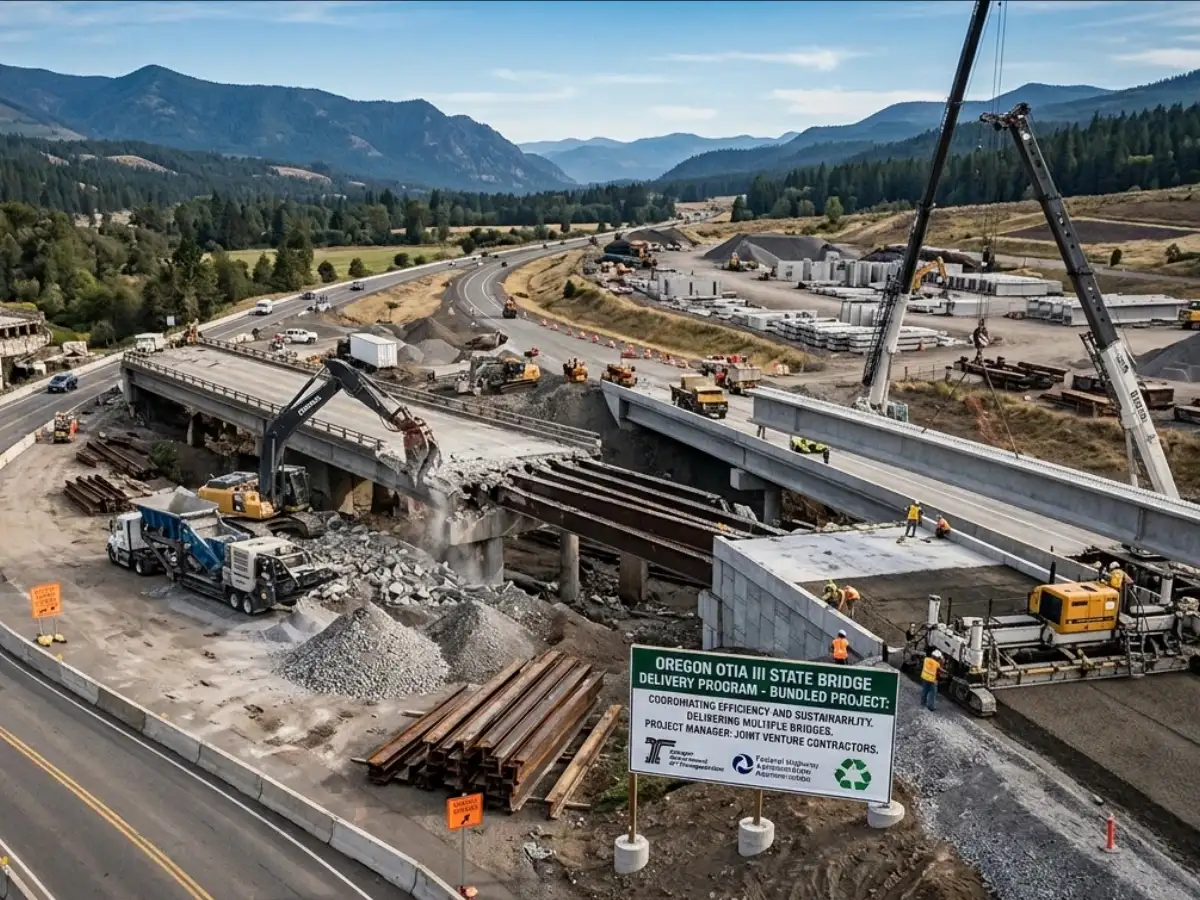
Massive civil engineering projects often bring traffic jams, dust clouds, and piles of concrete debris, but transportation agencies have also used project bundling to make bridge work more efficient. Rather than procuring every bridge project separately, agencies can group multiple structures into larger contracts, often based on geographic proximity, bridge type, or construction needs. The Federal Highway Administration’s Lessons Learned from State Bridge Bundling Programs documents how several states used this approach to improve project delivery, manage construction resources, and reduce inconvenience for motorists.
Oregon’s OTIA III State Bridge Delivery Program provides one example of how bundling was used alongside material-recovery measures. Approved by the Oregon legislature in 2003 as part of a 10-year transportation package, the programme repaired 122 and replaced 149 state-owned bridges. FHWA says the programme was completed on schedule and $45 million under budget. Over its life, 640,162 tons of material were recycled, while the estimated value of diverting materials from landfills was $21.3 million. FHWA separately notes that 208 bridges received permits over six years, so those figures should be understood as programme-wide results rather than an average applied to each permitted bridge.
The Oregon programme also illustrates why agencies may bundle projects along the same travel corridors. FHWA says grouping bridges allowed contractors to gain economies of scale in design, material ordering, equipment mobilisation, and other resources. The programme also reused 30,000 cubic yards of rubble from one bridge as aggregate on another OTIA III project, showing how material recovery could be incorporated into a broader construction programme.
How contract bundling improved bridge projects
The benefits documented by FHWA extend beyond material management. Bundling can allow agencies to coordinate work across several structures instead of managing each project independently, potentially reducing duplication in design, procurement, mobilisation, and project administration. Grouping bridges by location or type can also give contractors a more predictable workload and allow equipment and crews to be deployed across multiple sites.
Several of the programmes highlighted by FHWA were designed specifically to accelerate bridge repairs. Missouri’s Safe and Sound Bridge Improvement Program, for example, bundled 802 bridges into two procurement packages and completed the work in three and a half years, more than a year ahead of its expected schedule. FHWA says the revised approach also saved more than $500 million compared with the cost of an earlier design-build-finance-maintain concession proposal. The programme reduced the average closure period for 493 bridges to 42 days.
Massachusetts provides a separate example of accelerated delivery rather than the same type of documented financial saving. Its Accelerated Bridge Program, established in 2008, used design-build delivery, extended work hours, prefabricated bridge components, rapid-strength-gain concrete, and other measures to speed construction. FHWA also highlights the I-93 FAST 14 project, where 14 bridges were replaced as part of the accelerated approach. These examples show that bundling and related delivery methods can support faster construction, but the programmes should not be treated as evidence that every bundled project produces the same cost or schedule results.
The historical programmes also demonstrate how bundling can support local construction industries. In Oregon, 86% of programme contracts were awarded to Oregon-based firms, according to FHWA, while the programme supported thousands of jobs over its lifespan. Missouri likewise reported that more than 90% of the work was performed by Missouri workers. These outcomes show how large, coordinated infrastructure programmes can create opportunities for local contractors and suppliers while delivering multiple projects through a common procurement strategy.