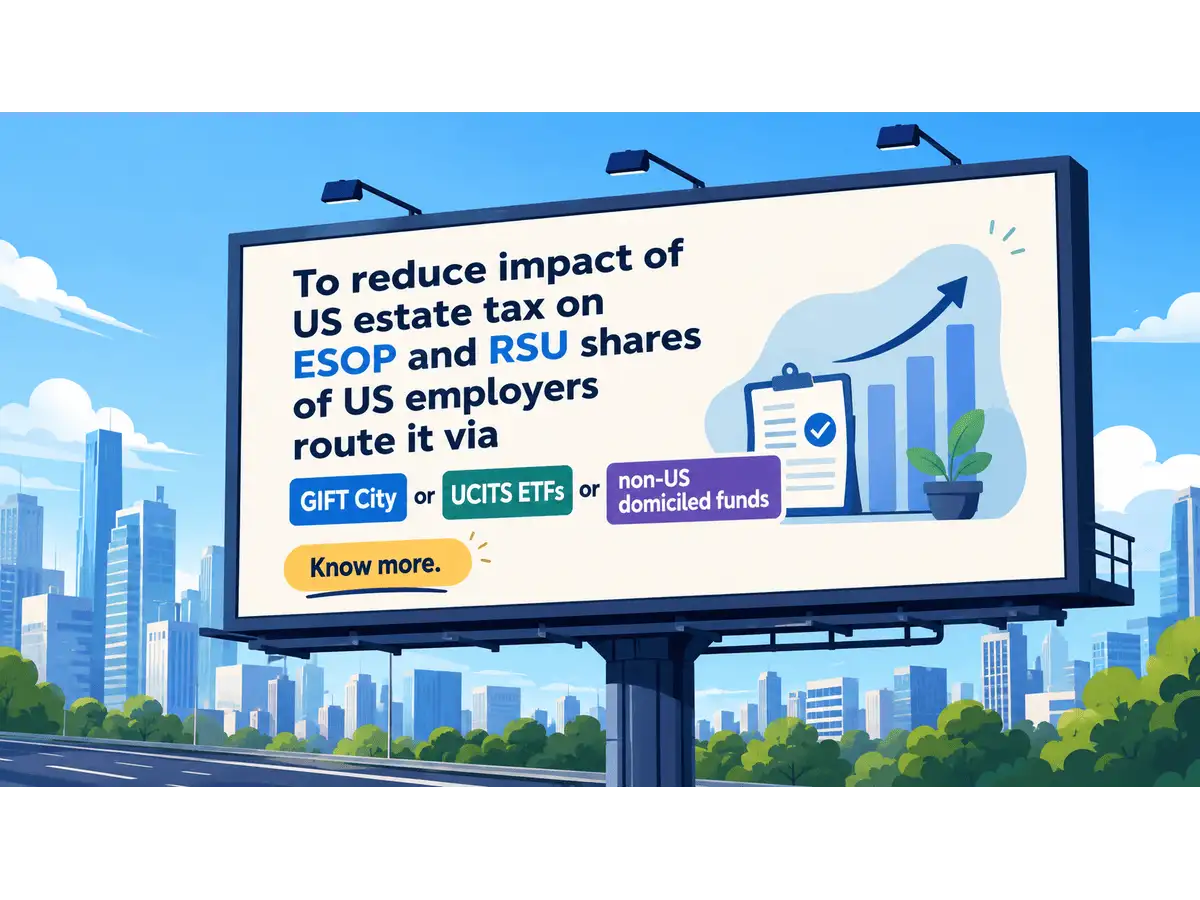
Many Indians working in higher positions at US-based companies like Alphabet, Meta, Snap, and others often receive employee stock options (ESOP) or restricted stock units (RSUs) as part of their salary even while working in India. These shares are listed on US stock exchanges, classifying them as US assets according to the US tax law.
Hardik Mehta, Lead- Tax, Ionic Wealth, said to ET Wealth Online that even if the said employees have never lived in the United States, their US-based shares could still be liable for US estate tax after they pass away, provided the total value of their US-based assets is over $60,000 (for non-US citizens/ non-US residents).

US tax laws can levy estate tax up to 40% upon death of the holder even when they are not US residents. When someone who owns assets in the United States dies, the Internal Revenue Service (IRS) imposes a steep estate tax of up to 40%, which needs to be settled within nine months to avoid penalties.
Also read: Failed to report US stocks gained via ESOP? Use this one-time Amnesty scheme; Know how it works
A primary risk for Indians is the only USD 60,000 tax exemption
According to Mehta, US citizens and legal residents get an exemption of $13.99 million. But if you're a non-resident alien, the estate tax exemption is just $60,000, and your US assets could be taxed at up to 40% if you do not plan accordingly.
Vikas Sharma, Lead-Personal Tax, AKM Global, a tax and consulting firm, told ET Wealth Online : "A primary risk for Indian employees is the restrictive USD 60,000 exemption. This means if the value of your vested ESOPs or RSUs exceeds this limit, it is subject to US estate tax rate ranging from 18% to 40%."
According to Sharma, this presents a significant liquidity challenge for Indian beneficiaries, who have to pay the US tax before the shares can be legally transferred.
Also read: Employee fined Rs 10 lakh over lack of ESOP disclosure in ITR; here's why ITAT Chennai cancelled it
How can this tax problem faced by Indians working for US or other foreign companies be solved?
Experts have come up with multiple solutions to this problem including GIFT City and UCITS ETFs. Here are the options that you have:
Directly owning US stocks mainly adds to the risk of US estate tax; so consider GIFT City
According to Mehta, one option to consider is holding international equity through structures that may not be characterised as "US-situs assets" under US estate tax rules, like outbound GIFT City Alternative Investment Funds (AIFs) or non-US domiciled funds.
Gradually reduce US ESOP/RSU exposure by gifting the shares during your lifetime
Sharma says that Indian employees holding US ESOPs/RSUs can manage potential US estate tax exposure through structured lifetime planning and diversifying their portfolio.
Sharma says: "One approach is lifetime gifting of shares, wherein vested RSUs or US-listed shares are transferred during the individual's lifetime."
According to Sharma, for non-resident persons, such US-based intangible assets are generally not subject to US gift tax subject to a certain threshold, enabling a gradual reduction of estate exposure.
Sharma says: "However, the recipient inherits the original cost basis, which may result in capital gains tax upon subsequent sale in India."
Reinvest the sale proceeds from RSUs into UCITS ETFs
Another strategy suggested by Sharma involves investment restructuring where sale proceeds from RSUs can be reinvested into non-US domiciled funds such as UCITS ETFs. These are typically not treated as US-situated assets, thereby reducing estate tax exposure while maintaining US equity market participation.