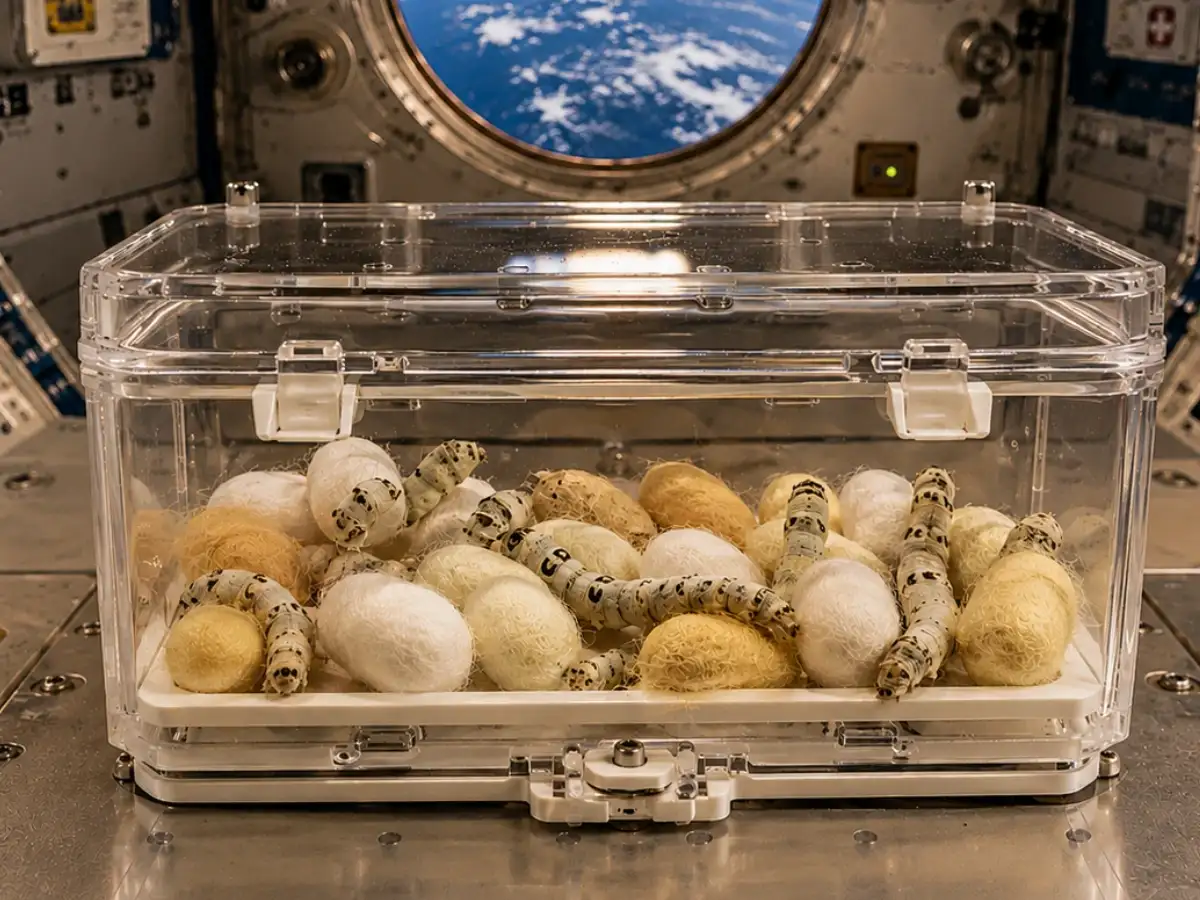
Silkworms are one of the oldest domesticated insects on the planet, yet they are still teaching scientists new things; this time about surviving space. According to the study, ‘Space flight experiment on Chinese silkworm on board the Russian 10th Biosatellite,’ published in Advances in Space Research by researchers at the Institute of Space Medico-Engineering in Beijing, seven varieties of the silkworm Bombyx mori were sent to space aboard a Russian biosatellite for 12 days. Amongst the passengers on the spacecraft were separate batches of silkworms at every stage of the life cycle, eggs, larvae, pupae, and adult moths, plus cocoons already forming, so that different groups could reach different milestones in parallel during the short flight, rather than any single batch racing through the entire cycle alone. Across these groups, silkworms in orbit successfully spun silk, formed cocoons, mated, laid eggs, hatched, pupated, and emerged as moths.
A biosatellite built for biology
The mission behind this experiment was Bion 10, also called Cosmos 2229. It was launched by Russia on December 29, 1992, and recovered near Karaganda, Kazakhstan, on January 10, 1993, after thermal-control issues forced the spacecraft to return two days ahead of its planned 14-day mission, having spent 12 days in orbit. Bion 10 belongs to a longer series of missions conducted by the Russians since the Soviet era, where monkeys, insects, plants, and other living things have been sent into orbit to study the effects of zero gravity and radiation on their physiology. NASA's own technical document notes that Cosmos 2229 is the eighth of the series of collaborative US and Russia biosatellite missions, with experiments sponsored by various countries, including the US, France, Germany, Canada, and Kazakhstan alongside the Chinese silkworm project.