
Get all your news in one place.
100’s of premium titles.
One app.
Start reading
TechRadar
TechRadar
Stefan Ionescu

Omnisend Review: Pros & Cons, Features, Ratings, Pricing and more

Omnisend dashboard.

Omnisend is a platform for e-commerce business owners to market to their customers. You can use it to send bulk messages via email or SMS to entice subscribers to buy your product.

Omnisend began in 2014 as an email marketing platform named Soundest. Three years later, it changed its name, and in 2018, it added SMS marketing features. In 2019, Omnisend became one of the top-five marketing apps on Shopify and in 2020, the company opened a U.S. office.

This platform serves over 100,000 customers worldwide and employs over 180 people at three offices.

Omnisend: Plans and pricing

Plan

Starting Rate

Free

$0/month

Standard

$16/month

Pro

$59/month

Custom

Contact sales

Omnisend offers four tiers: Free, Standard, Pro, and Custom. The Free plan lets you send up to 500 emails per month to a maximum of 250 contacts, and includes access to the full Omnisend feature set — a generous offering for new or small stores. However, all outgoing emails carry the Omnisend branding until you upgrade.

The Standard plan starts at $16/month for up to 500 contacts and scales automatically as your list grows. It gives you 12x your contact count in monthly email sends, unlimited web push notifications, and live chat support. The Pro plan starts at $59/month and unlocks unlimited email sends, a monthly SMS credit equal to your plan cost (e.g., $59/month gets you roughly $59 in SMS credits), advanced reporting, and priority support. Larger teams with high-volume needs can also reach out for a custom enterprise quote.

Pricing at Omnisend is contact-based rather than email-volume-based, which means your monthly cost will rise automatically as your subscriber list grows. New subscribers can save 30% on their first three months by paying upfront at signup.

How does Omnisend use AI?

In 2025, Omnisend launched a comprehensive AI suite aimed at reducing the manual workload of email marketing while improving personalization at scale.

Their centerpiece is the AI Email Writer, a generative tool that drafts complete, branded email campaigns based on a short prompt. The system draws on your brand's tone of voice, logo, fonts, and colors to produce output that feels consistent with your existing marketing without requiring manual style configuration.

Alongside the Email Writer, Omnisend introduced a Subject Line Generator that produces multiple high-converting subject line options based on historical performance data from millions of campaigns. There's also a Preheader Generator that works in tandem, helping you optimize the short preview text that appears alongside subject lines in email clients. Both tools support A/B testing.

On the personalization side, Omnisend added an AI-Powered Product Recommender that analyzes each subscriber's browsing and purchase history to automatically insert relevant products into emails. Initially available for automation workflows, the feature is being extended to standard campaign sends. It works with Omnisend's existing Dynamic Content Personalization system, which already supported showing or hiding content blocks based on subscriber attributes.

Perhaps the most useful AI addition for growing teams is the AI Segment Builder, currently in beta. Rather than building audience segments by manually configuring filters, you can describe the audience you want in plain language. For example, "customers who bought jeans last winter" or "subscribers who haven't opened an email in three months" will generate the corresponding segment automatically.

AI tools are available across all plans, including the free tier.

Omnisend: Features

(Image credit: Omnisend)

Omnisend is one of the more feature-complete marketing platforms in the ecommerce space, covering email campaigns, SMS, web push notifications, automation workflows, segmentation, forms, and landing pages — all from a single dashboard. Its depth is especially apparent for Shopify, WooCommerce, and BigCommerce users, who benefit from native one-click integrations that automatically pull in product catalogs, order data, and customer behavior without any manual setup.

Email marketing sits at the core of the platform. You get a drag-and-drop builder with roughly 350 pre-made templates, a Product Picker that lets you insert store items directly into emails, and built-in discount code generation that syncs automatically with your connected store. Omnisend also supports campaign A/B testing, a Campaign Booster that automatically resends to non-openers with a fresh subject line, and a click map that visualizes engagement by geography.

Moreover, Omnisend ships with a solid library of pre-built workflows like welcome series, cart abandonment, browse abandonment, post-purchase follow-ups, birthday messages, and more. All of these workflows can be customized via a no-code editor. Each workflow also supports multi-channel branching, so a single automation can send an email, wait for a response, then trigger an SMS or push notification depending on how the subscriber behaves.

But the platform could stand to improve its reporting flexibility for Standard plan users, who have less access to segment-level analytics and historical data compared to higher tier subscribers. The template editor also has some design constraints that more experienced marketers may find limiting.

Omnisend: Interface and in use

(Image credit: Omnisend)

Getting started with Omnisend is straightforward. You can register using an email address, a Shopify account, or a Google login. Then the onboarding flow walks you through connecting your ecommerce store right away. Once connected, Omnisend begins pulling in your product catalog and customer data automatically, so you can start building campaigns without any manual data entry.

This platform also received a notable interface refresh in May 2025, with a redesigned sidebar, updated icons and typography, and a general reduction in the number of clicks required to complete common tasks. Now, the experience feels cleaner and more modern than it did at launch.

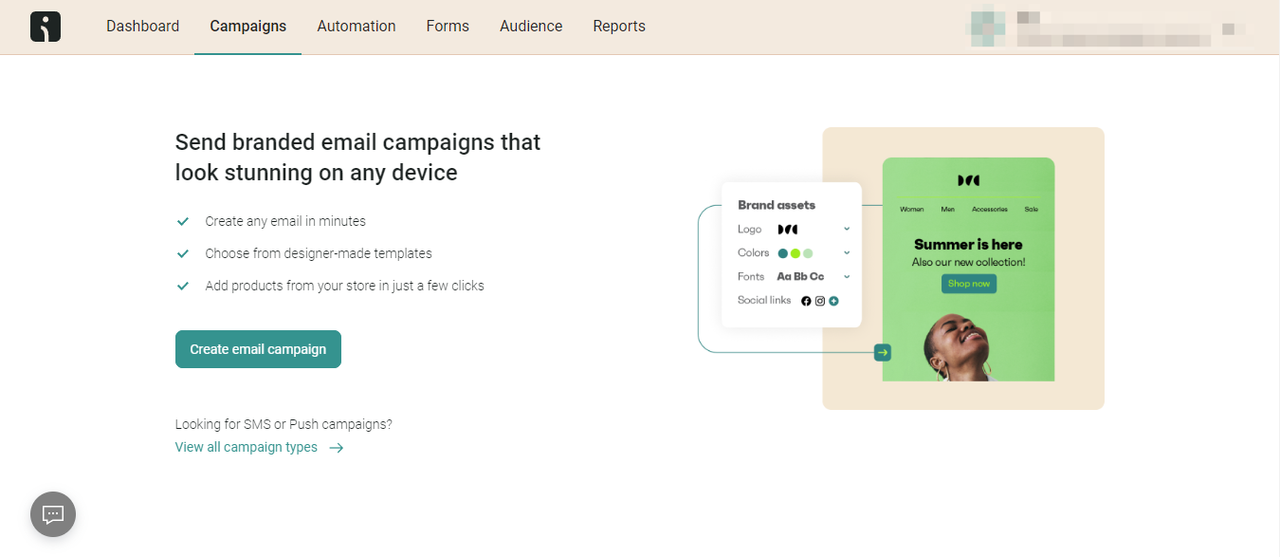
Navigation is divided into logical sections like Campaigns, Automations, Audience, Forms, and Reports — with most features discoverable without consulting documentation. That said, the email editor can still feel a little rigid for users who want to build highly custom layouts, as some content blocks limit design flexibility.

For new users, the learning curve is fairly gentle. Pre-built automation templates and guided setup flows do most of the heavy lifting, and the platform's help documentation is thorough.

More advanced features like dynamic content personalization and custom segmentation take a bit more time to master, but they don't require technical skills. Overall, Omnisend strikes a reasonable balance between being approachable for beginners and capable enough for growing ecommerce teams.

Omnisend: Support

One of Omnisend's most frequently praised qualities is the accessibility of its customer support. Unlike many competing platforms that restrict live support to paid subscribers, Omnisend offers 24/7 live chat support to all users, including those on the free plan. This is a meaningful differentiator for small stores or early-stage businesses that want a safety net while they're learning the platform.

For paid users spending $400 or more per month, Omnisend assigns a dedicated Account Expert who can assist with onboarding, migration from other platforms, and ongoing campaign strategy. This tier of support is primarily relevant to larger operations, but it's a reassuring option to know exists. Standard and Pro subscribers also get priority access to the support queue and access to a growing library of on-demand video training, live workshops, and email marketing guides.

Beyond direct support, Omnisend maintains a comprehensive help center, an active community forum, and a blog that frequently covers best practices, platform updates, and ecommerce strategy. User reviews across platforms like G2 and Capterra consistently highlight the support team's responsiveness as a standout feature, which is a useful signal for businesses that depend on fast resolution when something goes wrong.

Omnisend: The competition

There’s no shortage of email and SMS marketing platforms competing with Omnisend, but two notable examples are MailChimp and Klaviyo.

MailChimp is an effective email marketing platform tailored for broad usage, while Omnisend is designed primarily for e-commerce users. Klaviyo is built primarily for e-commerce businesses like Omnisend and offers similar features, but it's more expensive.  

Omnisend: Final verdict

(Image credit: Omnisend)

If you own an online store and want to market products to existing customers or potential customers as easily as possible, Omnisend is an ideal tool. You can create different types of campaigns and send them using email, SMS, or push notifications. Afterward, you can get detailed reports to monitor the performance of your campaigns and make adjustments where needed.

Yet while the 2025 update helped modernize the interface, we still think Omnisend's editor needs some UI improvements to compete with other modern no-code tools in this space.  

We've listed the best online marketing services.

Sign up to read this article
Read news from 100’s of titles, curated specifically for you.
Already a member? Sign in here
Related Stories
Top stories on inkl right now
One subscription that gives you access to news from hundreds of sites
Already a member? Sign in here
Our Picks
Fourteen days free
Download the app
One app. One membership.
100+ trusted global sources.