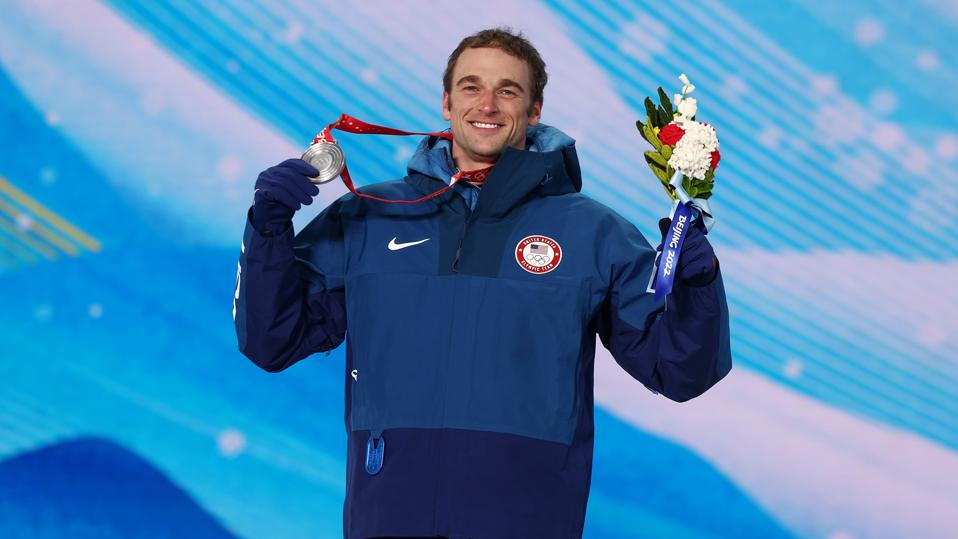
Of the three Olympics freestyle skier Nick Goepper has competed in, he’s come home with a medal every time—winning bronze at the 2014 Sochi Games, silver at the 2018 Pyeongchang Games and, now, another silver at the 2022 Beijing Games, all in slopestyle.
Goepper’s success is, indeed, indicative of a larger trend. Since ski slopestyle made its debut at the 2014 Games, the U.S. men have landed on the podium every time. In fact, in 2014, the U.S. swept the podium, with Joss Christensen taking gold, Gus Kenworthy taking silver and Goepper, bronze.
In 2018, Goepper was the lone American on the podium when he took silver.
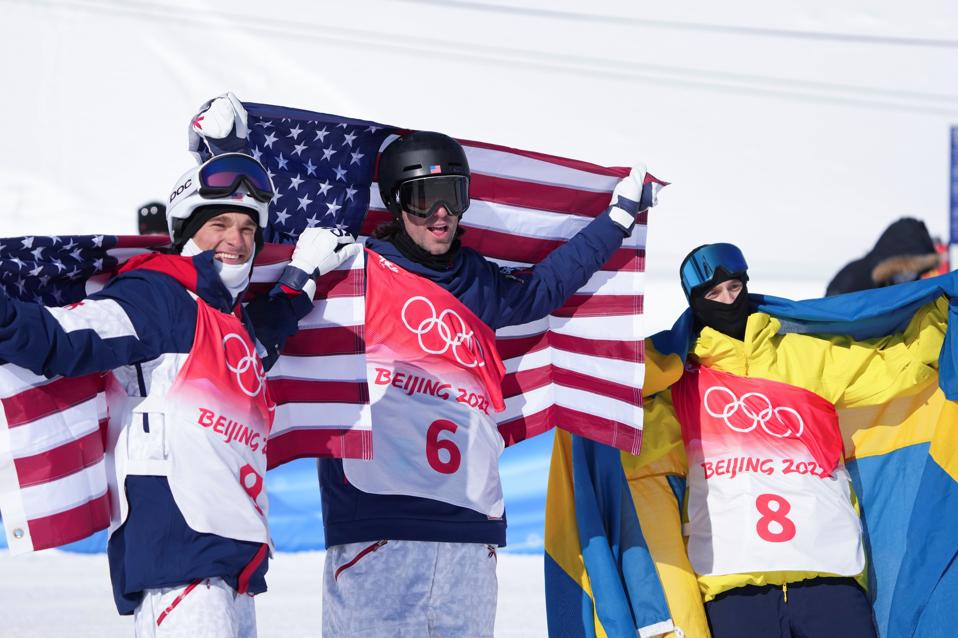
But this time around, Alex Hall and Goepper went 1-2 with their gold and silver, sending a message to the rest of the world that the U.S. is still the nation to beat in slopestyle.
Goepper called the Beijing Games his “most fulfilling Olympics, and at the same time the most predictable.” He knew what he was getting into and knew what people expected of him; there was more room in his psyche to relax and enjoy it all.
Now 27 and the oldest Olympic medalist in men’s slopestyle at the Olympics, Goepper’s staunchest competition at this point in his career comes from within Team
The 12-skier final in Beijing featured three U.S. athletes; only one of the four athletes competing in slopestyle at these Games, Mac Forehand, didn’t qualify. Colby Stevenson, who was the first American to qualify for the Beijing Games in December thanks to his world No. 2 ranking, came in seventh in the final.
As ski slopestyle has progressed rapidly following its Olympic debut in 2014, skiers have upped the ante with bigger spins and more flips. Hall landed the first-ever 2160 (six full rotations) in competition at X Games Aspen in January, just before the Olympics. The trick is called a “future spin” because the degree of rotation is higher than the current year.
And yet, in Beijing, it was Hall’s and Goepper’s individual style and creative use of the slopestyle course, not a tornado of future spins, that landed them on the podium.
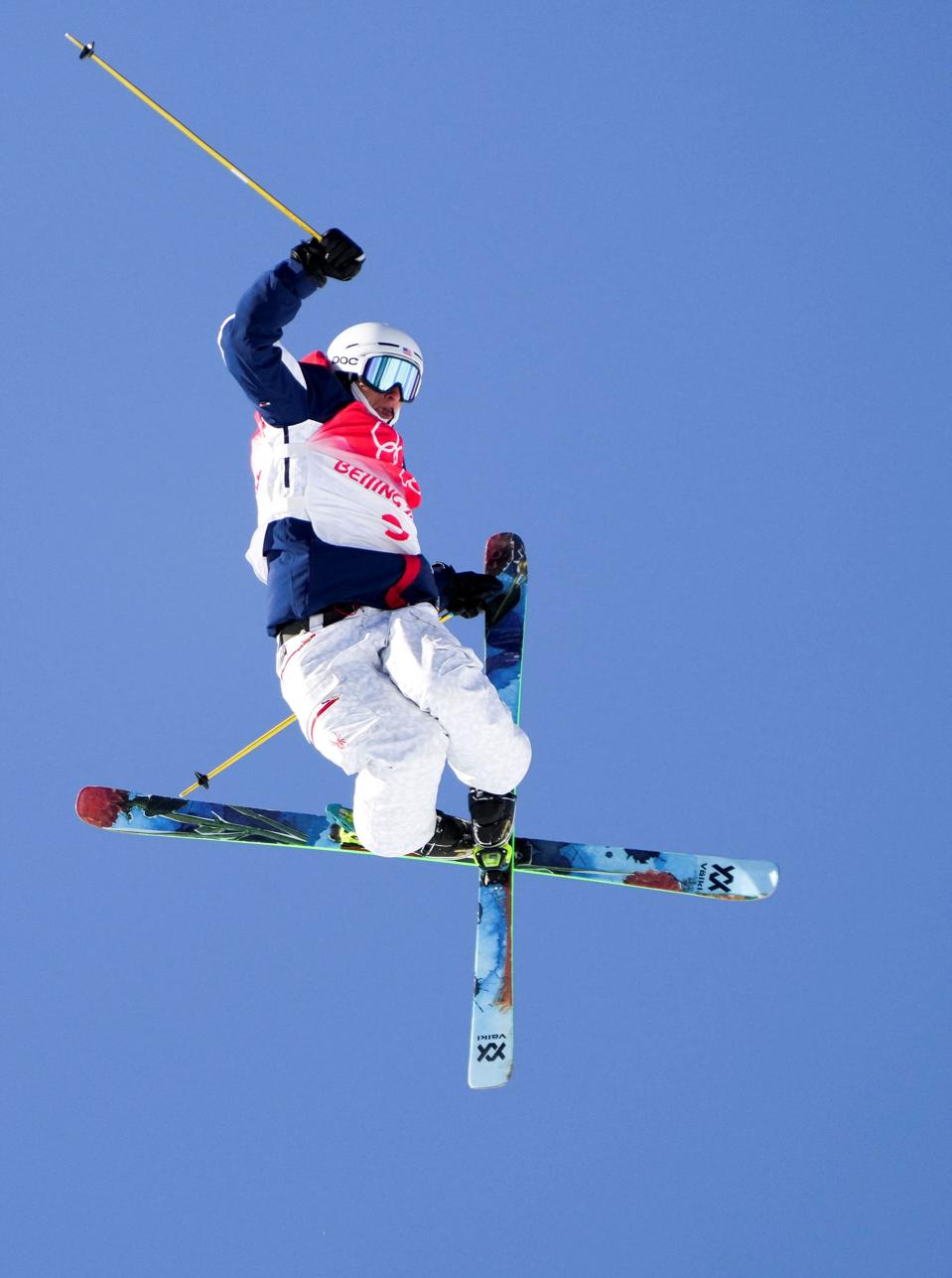
Hall wowed with his signature right double cork 1080 pretzel 180 on the third jump—a trick that requires him to “rewind” his 1080 spin back to a 900. It was a risk, but it paid off with his top score of 90.01.
And Goepper was the only skier in the field to take advantage of the quarterpipe takeoff on the second jump, with a left double cork 1440, leading to his score of 86.48 on his second run.
“My strategy was doing the kind of skiing that was the most genuine to me and fun to me, but make it technical and difficult so you get the points,” Goepper told me by phone after returning home from the Games. “On the course in Beijing, there were two features in particular—the house with the rail on top, what we were calling the ‘shred shed,’ and the quarterpipe second jump feature—that were features I would love to ride in a regular park everyday. They were just super challenging and fun.”
The judges’ rewarding Goepper for making creative use of the course validated his approach. “It kind if reiterated to me to do what you’re good at and have fun doing it and that will usually take you the farthest,” Goepper said.
Goepper’s rails prowess and creative flair are by design. Growing up in Lawrenceburg, Indiana, his home mountain, Perfect North Slopes, features a top elevation of 800 feet and 400 vertical feet. But the 100 acres of skiable area is where Goepper cut his teeth as a young skier, starting out at five years old and competing by age 11.
Always drawn to going big and fast, Goepper landed his first double backflip by the age of 13.
And while the Midwest did for Goepper what it does for many professional freestyle skiers—forces them to hone their style early and excel at rails and other street-style features, Goepper’s professional career has seen him chase every kind of feature he didn’t have available to him growing up in Indiana.
“Growing up hitting smaller jumps, smaller rails, on a 400-foot-hill in the Midwest, when I get the chance to go on something massive I’ll take it every single time,” Goepper said with a laugh. “I never had that growing up, could never hit a rail 10 feet off the ground or a crazy quarterpipe-style jump. As a result of skiing smaller stuff in the Midwest, I’m drawn to big, gnarly stuff now because it’s just so fun and out of the box for me.”
That’s what makes Goepper the ultimate competitor—he loves to go big on big features, but he’ll never leave a creative feature on a course untouched. “In skiing, the judges really love it when you use something that’s there that’s meant to be a hit,” he said.
But it’s not just their stylish flair and arsenal of spin tricks that contributes to the U.S. freestyle ski team’s success in international competition. It’s baked into their DNA.
“Our success has a lot to do with the individuals that are on the team,” Goepper said. “It all comes down to culture; whatever sort of culture you foster on a sports team or in business or whatever is gonna shape the mindset and the results that come out of that. Within our team, we have a mixture of personalities that are super innovative and hardworking and progressive but also work together really well and are super competitive. We have rockstar individuals on our squad.”
The U.S. ski team also employs what Goepper describes as an “entrepreneurial mindset,” which separates it from many of the world’s other dominant national ski teams, like Norway’s or Japan’s.
Because the United States does not fund the USOPC at the federal level, instead relying on support from private donors and individuals, American athletes are particularly dependent upon securing sponsors who will help them travel the world for training and contests.
“That mindset is what has made us so dominant and so good over the years,” Goepper said. “In America, the culture is vastly different than, say, Norway. If we play to our strengths, we’re gonna be the best we can be. By trying to do it someone else’s way you can run into issues; I’ve seen it play out over the years.”
Goepper has always relied “heavily” on private sponsorship and finds it rewarding to earn that support through his skiing success; his major brand partnerships are with Red Bull, Kulkea and Völkl.
“I love having this on my head,” Goepper said, pointing to his Red Bull hat. “Biggest ego boost ever.”
In addition to helping athletes get around the world to compete, sponsors also pay out podium bonuses, which can top five figures.
Another crucial element behind any successful Olympian? Supportive parents, Goepper says. From his earliest days skiing, his parents encouraged his dream, building permanent jumps on the family’s property.
He returned to his hometown resort of Perfect North Slopes along with fellow Lawrenceburg Olympian Justin Schoenefeld (aerials) for a homecoming celebration, where he took photos with local fans and signed autographs—and showed off his latest medal to his parents.
The resort has awarded the Olympians lifetime passes.
At 27, Goepper’s career is in a transitional period. Fellow freestyle skier Gus Kenworthy, who competed with Goepper for Team USA in slopestyle in 2014 and 2018 but represented Team Great Britain in halfpipe in Beijing, just announced his retirement at age 30.
And Goepper has been finding a lot of fulfillment off the slopes. After a recent divorce, he’s dating someone and looking forward to spending time with her once his competitive skiing season is over. In the summer, he cross-trains on his bike and in skateboarding.
As he gets older, “I want to just hang out with my best friends and be more of a best friend, be more of a brother, be more of a son,” Goepper said. “I’ve had to put all that on the back burner for a little while, and I want to get back to being a sociable person.”
Goepper also bought some property in Utah last summer and would like to set himself up for a career after skiing by investing in Airbnbs.
Throughout his career, Goepper has dreaded being asked about what he might do after skiing. Now, he finds himself looking forward to what that future might hold.
“I would be okay if my career ended tomorrow,” Goepper said. “People always ask me what I would do after skiing, and I used to think, ‘I have no idea, stop asking me that question.’ Now I finally feel like I could figure something out and I’d be okay.”
But the hunger is still there. Goepper has earned a bronze and two silver medals at the Olympics; he’d really like to add that elusive third color to his collection before his career is out.
That’s not his single-minded focus anymore...but don’t count him out of the 2026 Winter Games.
“I’d definitely do this again in four years,” Goepper said. “I really wanted that gold this time. But I feel like it’s less about the gold now; if I was gonna keep doing this, it’d be for different reasons.
“Earlier in my career, skiing was all I cared about and what I lived and breathed. Now I’ve got other things going on. I have a new roadmap for skiing, how to get through it, how to be successful, and what’s fun; how much energy I want to put into it and how much sacrifice I want to make to get to the end of it. The next four years would be really rewarding and exciting. I’ve got options; it’s just an option of whether I want to do it again.”