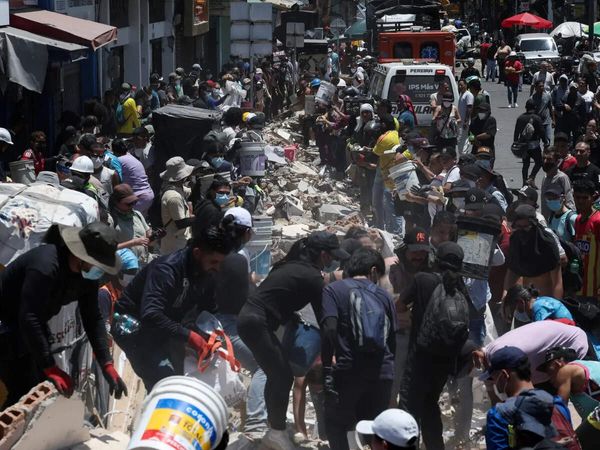
Analysis: This was Wright St in Wellington’s Mt Cook, two months ago, after a terse yet torrential downpour. It’s also where Emeritus Professor Jonathan Boston lives.
“Roughly five houses and 11 cars were damaged in our street alone, during that storm,” he says. “Just down the road from us, more houses and more cars.
“And of course, for those of you who live in Auckland, you will remember vividly the Auckland Anniversary flooding, just three-and-a-half years ago, followed two weeks later by the impact of ex-Cyclone Gabrielle. And many, many other towns and cities around New Zealand have been affected by flooding in recent years.”
Life in towns like Westport is becoming less sustainable, he warns, and even the CBDs of cities like Wellington could become “unviable and inoperable” in storm surges. “If we don’t accept the reality of climate change and the unprecedented impacts it will have, then we’re not going to prepare well for the future.”
Boston was speaking to a Helen Clark Foundation webinar, marking the launch this month of his book ‘Insuring the Future’. It’s been followed by the publication today of the findings of insurance company IAG’s annual climate change survey.
Both conclude that New Zealand needs to work quickly to find a new way to finance climate adaptation. “It is clear we cannot continue as we are,” warns Phil Gibson, chief executive of New Zealand’s largest general insurer. “New Zealand must take stronger action to reduce the impacts of climate hazards.”
Most New Zealanders agree – to an extent: 80 percent of survey respondents say home and contents insurance is becoming less affordable; 61 percent agree insurers should raise premiums for homes and businesses that face more risk. But only 20 percent are prepared to pay more to subsidise the cost of insurance for people who live in high-risk locations.
IAG characterises that as a tension at the heart of how insurers respond to a growing risk. But I’d argue it’s also a tension for how govt and councils respond.
Three out of five New Zealanders think the Govt should prioritise reducing climate risks. As well as taking precautionary actions to avoid future exposure, 70-80 percent want the Govt to protect existing buildings and infrastructure, and local councils to invest in protective infrastructure and natural defences like wetlands.
Yet those costs would ultimately come out of tax and rates revenues – which of course means New Zealanders subsidising costs for people who live in high-risk locations, the very thing to which so many people object.
“New Zealand is fast approaching a fork in the road,” the IAG report says. “One path leads to better managed risks, a more insurable future and greater economic resilience. The other does not. New Zealanders sense we are veering toward this second path and want change.”
Over the past 15 years, IAG says disasters have cost at least $4.2 billion a year. Nearly all this spending has been put into response and recovery rather than reducing the impact of hazards.
Over the past 25 years, Jonathan Boston says home insurance costs have increased tenfold, or 400 percent when adjusting for inflation. That’s been concentrated in more vulnerable areas like Westport and Wellington.
IAG is urging the Govt to quickly establish “senior political ownership of risk reduction” across all natural hazards, and an ongoing approach to Crown investment in, or co-financing of, risk reduction infrastructure.
That plea touches only very lightly on how this financing might work, and implies a heavy reliance on the taxpayer.
But at the same time, the Insurance Council has proposed repurposing the existing Fire and Emergency NZ levy, which from tomorrow rises to 10.74 cents on every $100 of your house and contents sum insured. The insurers propose that becomes a new “Community Protection Levy” to fund natural disaster resilience.
The Fire and Emergency Levy presently sits alongside the Natural Hazards Insurance levy, both collected by insurers on behalf of the Govt.
As things stand, homeowners pay a Natural Hazards Insurance levy of 16 cents on every $100 of private insurance they have, up to a cap of $300,000. This isn’t enough; the NHCover fund has been drained by the Canterbury and Kaikōura earthquakes, and the 2023 storms. Its liabilities outstrip its assets. But there’s no political appetite to follow Treasury’s urgent advice and increase the annual levy to 24 cents (or by $464 million) … not this side of the election, at least.
Finance Minister Nicola Willis’ officials have written to insurers, saying the levy won’t be increased before mid-2027 at earliest. “It’s a major cost of living pressure,” she’s said. “That’s not good for the resilience of the economy.”
Amid this mess of half measures – insurance, the Fire and Emergency Levy, NHCover – none covers the gradual loss of land to sea-level rise and coastal inundation, and of course none covers those who are uninsured.
Boston, one of the country’s leading public policy experts, has turned much of his attention to this rising crisis in the past few years, alongside an expert working group and interested groups like the Helen Clark Foundation.
The problems are well documented. But Boston has probably gone furthest in designing a financing solution.
“We could either adopt a so-called market model in which we emphasise individual responsibility, actuarial fairness and risk rated premiums,” he says. “Or we could adopt a solidarity or social model in which we emphasise mutual responsibility, collective risk pooling, solidarity, fairness in the face of divergent risks with flat rate or community based premiums.”
Both models have strengths and weaknesses.
The market-based model – essentially the direction New Zealand is taking at present – limits govt’s role to ensuring there is good risk information and risk governance. Land-use planning, phasing out property buyouts over the next 20 years, and relying on insurers’ risk-based pricing to manage risk.
This is politically saleable. “Electorally, it is unlikely to lose many votes, at least in the short to medium term,” Boston writes in his new book. “Administratively, it avoids disruptive and time-consuming legislative and institutional reforms…. For ‘bean-counters’ fixated on narrow, short-term fiscal goals, any political bias for the status quo doubtless provides welcome relief.”
But he warns that pathway leads to under-insurance (as is arguably already happening) and the complete loss of insurance from many properties. Relocations will happen in an unplanned way after damage has already occurred. More hardship, less social cohesion, ultimately higher fiscal costs.
It’s no surprise, to those who know Boston’s work, that he prefers the so-called solidarity model, providing assistance for planned relocation (or managed retreat) and rethinking property insurance.
He proposes extending the Natural Hazards Commission’s role beyond cover for earthquakes, slips and eruptions, to also covering floods and storms. It could provide temporary last resort insurance for properties zoned for relocation, because they can’t be cost-effectively protected, he argues.
Similar to France, Spain, Iceland or Switzerland, this country could adopt a new model for natural hazard insurance. It could substantially increase the Natural Hazards Insurance levy and its cover, and maybe introduce a separate compulsory flat-rate levy to cover some of the planned relocation. This would build a prepaid fund, rather than relying so much on govt bailouts, after the fact.
“The basic message of the social model is that you’re not on your own,” Boston says. “This is a collective endeavour to protect society over the long haul in the most cost-effective and fair way possible.”
So, as we draw near to another election, what is the public appetite for pooling the risks and rewards in this manner?
If today’s IAG survey is any indication, it’s not great. I come back to one metric in particular: only 20 percent of us are prepared to pay more to subsidise the cost of insurance for people who live in high-risk locations. Most of us (56 percent) are not.
Once, people could comfortably imagine those people living in high-risk locations to be the wealthy owners of coastal holiday homes. But that’s no longer a sustainable caricature. We’ve seen in the disasters of the past few years that those worst hit are often those on the lower incomes, whether in Westport, or Wairoa, or south Dunedin.
The existing model leaves our more vulnerable communities to sink or swim in the rising waters. Courageous public and private sector leadership, driving better central and local govt planning and a prepaid natural hazards fund, might at least throw them a lifeline.
This analysis was first published in the Newsroom Pro subscriber newsletter. If you’re interested in seeing more content like this, you can subscribe here.