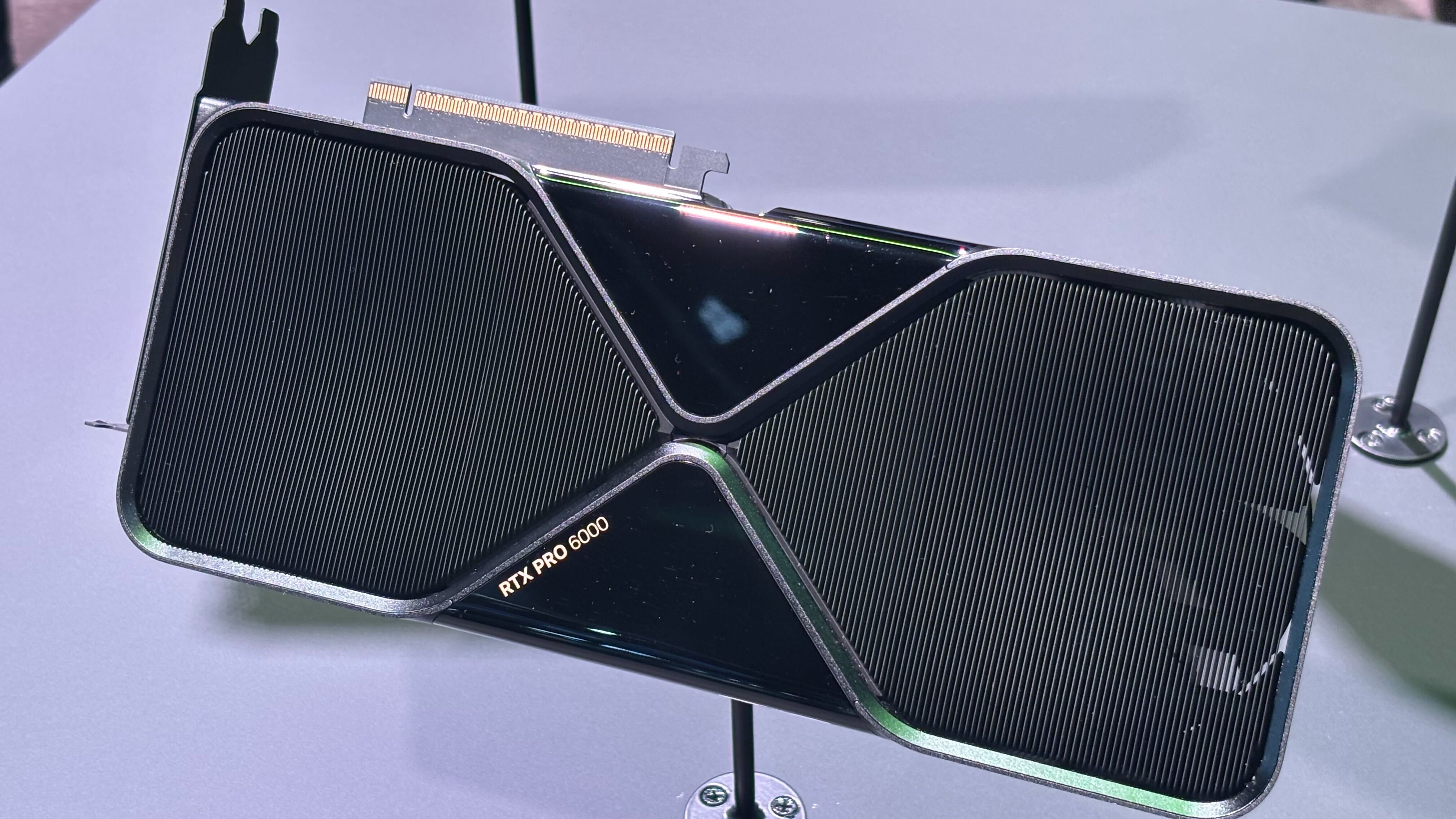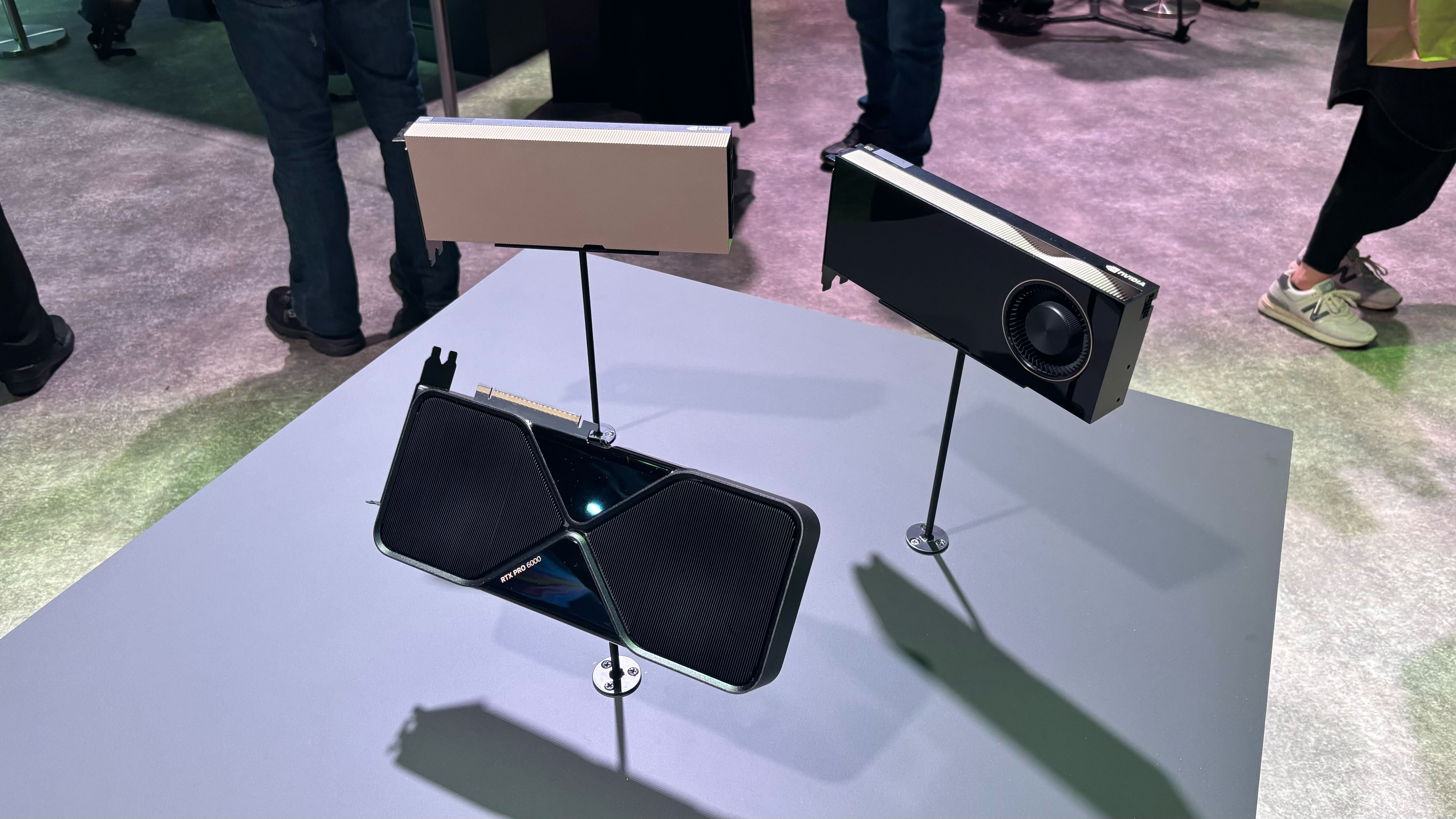
The Nvidia Blackwell RTX Pro 6000 GPU was announced during the GTC 2025 keynote. These will use the same GB202 die that goes into Nvidia's RTX 5090 graphics card, but with some significant changes in some of the other aspects. There will be three variants of the RTX Pro 6000: the Blackwell Workstation Edition, Max-Q Workstation Edition, and Blackwell Server Edition.
The core specifications for the RTX Pro 6000 are the same across all three models. You get 188 SMs enabled, out of a potential 192 maximum from GB202. That's 10.6% more SMs, shader cores, tensor cores, RT cores, etc., relative to the RTX 5090. Clock speeds weren't given, but Nvidia does list up to 125 TFLOPS of FP32 compute via the shaders, and 4000 AI TOPS from the tensor cores. That works out to a boost clock of around 2.6 GHz, but that won't be the same for all three variants.
The RTX Pro 6000 features the full 128MB L2 cache of GB202, along with four NVENC and four NVDEC video blocks. RTX 5090 only has 96MB of L2 cache and three each for NVENC/NVDEC. It's very close to a fully enabled chip, with only 2% of the SMs disabled.
The memory configuration is the same for all three variants. As discussed in the initial RTX Pro 6000 announcement, Nvidia uses 24Gb (3GB) GDDR7 chips rather than the 2GB chips used on the consumer GeForce RTX 50-series cards. That increases the memory capacity to 48GB per PCB side, and with chips on both sides of the PCB in 'clamshell' mode, there's 96GB total. The memory has the same 28 Gbps clocks as most of the 50-series parts, with 1792 GB/s of total bandwidth.