
Get all your news in one place.
100’s of premium titles.
One app.
Start reading
Tom’s Hardware
Tom’s Hardware
Technology
Hassam Nasir

Nvidia claims 1 million times better path tracing performance is coming in future gaming GPUs — says current GPUs are already 10,000x faster than Pascal

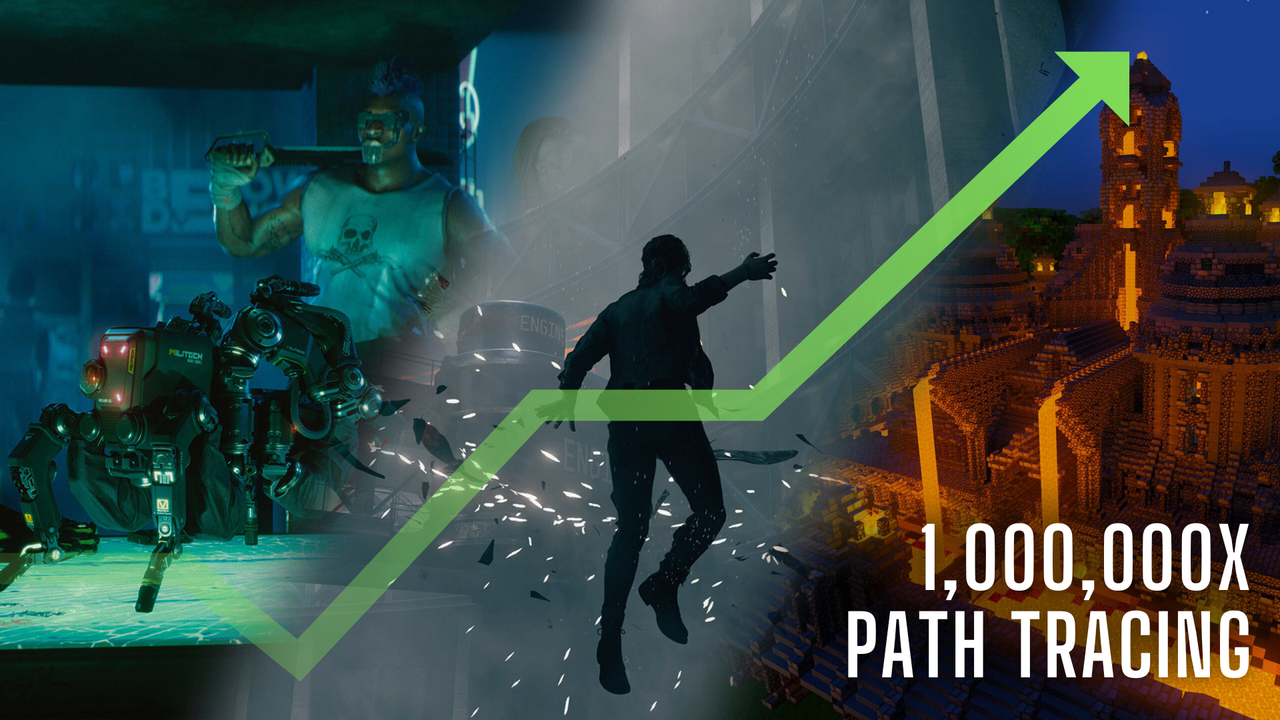
Nvidia claims 1 million times better path tracing performance in future gaming GPUs.

Despite increasing competition from Intel and AMD, Nvidia's RTX lineup remains the best hardware for ray tracing and path tracing in games. Ever since Turing, RTX 20 series, the company has made significant strides — mostly leveraging AI and neural rendering — to increase graphical fidelity without compromising performance. Now, at GDC 2026, it's claiming that the future holds an even more impressive milestone.

During the presentation, John Spitzer (Dev & Performance VP) presented a line graph that plotted the progress of ray tracing and path tracing performance in Nvidia's gaming GPUs. At the far-left corner, we see Pascal, aka the legendary RTX 10 series, which came out a decade ago. Comparing that to today's Blackwell GPUs (RTX 50), the path tracing performance has apparently improved by 10,000 times already.

That's largely due to a focus on hardware-accelerated neural rendering enabled by dedicated RT and Tensor cores that handle machine learning inside Nvidia GPUs. Features like DLSS are entirely reliant on AI; the ability to piece together frame data more accurately in both upscaling and frame-gen situations is only possible due to models trained on Nvidia's supercomputers.

Spitzer says that Moore's Law is dead and that silicon advancements alone wouldn't be enough to generate photorealistic visuals in his lifetime. Nvidia wants to achieve a level of graphical fidelity that's indistinguishable from real life, but that would require a "hundred or thousand times more computational power" — this is where AI becomes the catalyst.

(Image credit: Nvidia)

In the future, AI advances will take gaming GPUs to 1,000,000 times better path tracing performance when compared to the RTX 10 series. Newer, faster, more efficient hardware blocks will basically make neural rendering the default going forward, as already claimed by Nvidia CEO Jensen Huang. Games would "look like a film" while still running smoothly due to multiple frames being interpolated in real-time by AI.

None of this is a revelation — of course, things are supposed to get better over time — but the wait might not be too long. The next-gen Rubin GPUs from Nvidia, slated to launch sometime between 2027 and 2028, could usher in this 1-million-times better path tracing reality. The list of games supporting path tracing is already growing at a rapid pace, with Resident Evil Requiem being the latest addition.

As such, the presentation also included some bits about new path tracing technologies, such as ReSTIR (recent spatiotemporal resampling algorithms) and RTX Mega Geometry. To showcase this, Nvidia brought a tech demo for Witcher 4 with over two trillion triangles in the scene, depicting realistic foliage and lighting simultaneously. Make sure to check out the video linked above for more details.

Sign up to read this article
Read news from 100’s of titles, curated specifically for you.
Already a member? Sign in here
Related Stories
Top stories on inkl right now
One subscription that gives you access to news from hundreds of sites
Already a member? Sign in here
Our Picks
Fourteen days free
Download the app
One app. One membership.
100+ trusted global sources.







