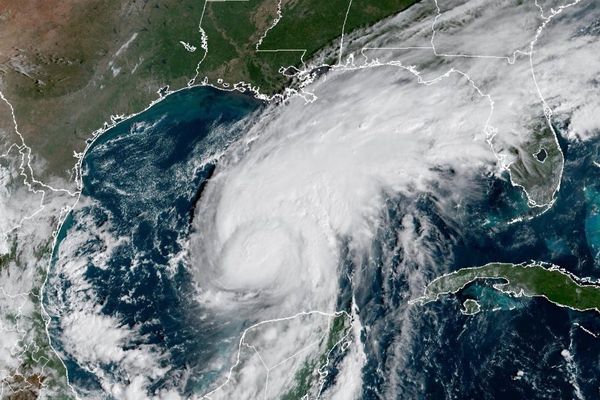
A man has been killed by a falling tree during surging storms that have left tens of thousands of people without power.
The 76-year-old died on Wednesday afternoon after being struck by the tree at Glenworth Valley on the New South Wales Central Coast.
Another man in Orange suffered multiple injuries when a tree fell on his car.
More than 1,000 calls for help have been made in NSW alone after wild weather left multiple roofs torn from buildings in the state’s central west.
Power outages have resulted in train delays or replacement buses operating on some routes in Sydney.
Temperatures in parts of the state soared into the 30s on Wednesday, prompting authorities to raise bushfire alerts to their highest levels in more than two years.
The town of Nevertire, west of Dubbo, felt some of the worst of the major storms blasting eastern Australia, with lightning causing wall collapses on one property and six others losing their roof.
At least 120,000 homes in NSW were without power on Wednesday afternoon following gusts of up to 119 kilometres per hour, according to the Bureau of Meteorology.
Tens of thousands were also without power in Queensland as two consecutive days of superstorms were declared a catastrophic event.
The damage bill from the storms is expected to surge into the millions, as the Insurance Council of Australia confirmed claims have reached 27,800 and continue to climb.
Crews were working around the clock to repair the damage on Wednesday evening but almost 29,000 people were still without power, with the worst-affected areas including Moreton Bay, Noosa and the Sunshine Coast north of Brisbane.
Brisbane bore the brunt of Tuesday night’s second wave of damage from the storm system as up to 110mm of rain was dumped on some areas.
Large parts of Queensland also continue to swelter under heatwave conditions, with temperatures six to 10 degrees above the November average.
By 3.30pm on Wednesday, 1,145 calls for help had been made to the NSW State Emergency Service, with 622 in metropolitan Sydney alone.
“These incidents relate mainly to trees down, taking down power lines and also damaging roofs,” the assistant commissioner of the NSW SES, Sean Kearns, said.
Ex-tropical cyclone Fina was downgraded overnight and was impacting the northern parts of Western Australia’s Kimberley region with heavy rainfall and the risk of flash flooding.
“We’re going to continue to see the impact of this ex-tropical cyclone over the next day or two, even though it’s lost that cyclonic category,” the Bureau of Meteorology’s Miriam Bradbury said.
The clean-up continues in the Northern Territory after Fina felled trees, caused power outages and damaged buildings as it swept through on the weekend as a category three system.
More than 20 public schools across central NSW were closed on Wednesday after the state’s rural fire service issued a warning for catastrophic fire danger.
Temperatures were forecast to reach a top of 36C in Sydney, and pass 40C in Bourke, in the state’s north-west. By 1.17pm, the town of Walgett in northern NSW had reached 41C.
Earlier in the day, the lower central west plains – including the regional hubs of Dubbo, Parkes and Forbes – were warned of the highest level of bushfire conditions, meaning people there should consider leaving fire risk areas and stay out of paddocks and bushland.
No region of NSW has had a catastrophic fire danger forecast since September 2023.
Extreme danger warnings were also declared for millions of residents, including those in metropolitan Sydney, as wind gusts of more than 90km/h were expected on Wednesday in southern NSW and Victoria.
Trangie research station, an hour’s drive west of Dubbo, recorded wind gusts of 111km/h at midday.
Sign up: AU Breaking News email
Greg Allan, a spokesperson for NSW rural fire service, said the combination of strong winds, high temperatures and low humidity, together with dry vegetation, meant fires could start quickly and spread rapidly.
For those living or working in the lower central west, where catastrophic conditions were forecast, he said: “It’s important to know that homes could be lost if a fire takes hold.”
Two bushfires caused emergencies and more than 20 blazes remained uncontained on Wednesday evening, as wild weather kept firefighters battling into the night.
Residents were advised to seek shelter in northern Corowa, on the Victoria-NSW border, after a grassfire ignited on Wednesday afternoon.
Another fire at The Rock township, south of Wagga Wagga in the NSW Riverina, also escalated to emergency levels after burning through more than 100 hectares.
Both emergency warnings have now been downgraded to advice by the NSW rural fire service but more than 1,000 firefighters were still working to fight 69 fires at 6pm, with 26 uncontained.
Elevated fire conditions would extend into Thursday, a BoM spokesperson said, while the storm risk would contract into the north-east.
Country fire service member and 30-year firefighter Peter Curtis died on Sunday while battling a scrub fire on the Eyre Peninsula in South Australia. Another bushfire in north-east Tasmania has burned since Saturday, with authorities advising people in the Curries River reservoir area to monitor conditions.