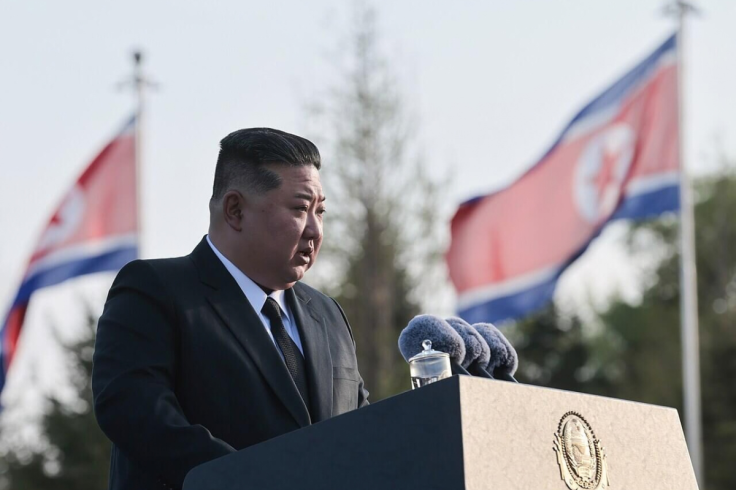
North Korea has warned that South Korea could become a 'decisive target' for collective retaliation if it develops into a central hub for a US-led collective defence system, accusing Washington of turning its ally into a platform for overseas military operations.
The warning, issued on Friday, 25 September, came in a commentary carried by North Korea's state-run Korean Central News Agency, or KCNA. It cited recent remarks by Gen. Xavier Brunson, commander of US Forces Korea, about the evolving US-South Korea defence structure.

North Korea Targets US Strategy
Kang Chol Su, an official at North Korea's Institute for Enemy State Studies, accused Washington of using South Korea as a base for pursuing what Pyongyang describes as global hegemony.
Kang also accused the US of using South Korea as a platform from which it could deploy first in overseas conflicts. He criticised joint US-South Korean military drills and US deployments, portraying the alliance's expanding role as a direct security threat to North Korea.
North Korea says South Korea a target if it becomes US collective defence hub https://t.co/oRRz5LSTGb https://t.co/oRRz5LSTGb
— Reuters (@Reuters) September 25, 2026
The KCNA commentary said Pyongyang had prepared countermeasures and would 'ruthlessly' crush challenges to its security. It did not spell out what those countermeasures would involve.
Why South Korea Is a Defence Hub
The dispute centres on how Washington and Seoul are developing their combined military capabilities.
At the 16 September Combined Warfighting Forum in Yongsan, Seoul, Brunson delivered the keynote address as military leaders examined Combined Joint All-Domain Operations, or CJADO. The US military describes CJADO as a concept for integrating capabilities across land, maritime, air, space, cyberspace and the electromagnetic spectrum.
🇰🇵🇺🇸 Kim’s government is telling Seoul not to become Washington’s forward base
— Mario Nawfal (@MarioNawfal) September 25, 2026
Pyongyang is ANGRY about talk from the U.S. commander in Seoul that the South is a center for collective defense.
The line is old and new at once.
The U.S. already keeps 28,500 troops there, and… pic.twitter.com/KYJ36MugrC
The forum brought together about 200 senior military leaders and experts to discuss combined warfighting and capability development. The focus on interoperability gives context to Pyongyang's concern about South Korea's role within a broader US-led defence network.
For North Korea, that growing integration is evidence that South Korea could become a central point in a collective defence structure extending beyond the peninsula.
28,500 US Troops in South Korea
The US military presence gives the warning an immediate strategic backdrop.
About 28,500 US military personnel are stationed in South Korea, where their presence is intended to help deter aggression from North Korea. Washington and Seoul also maintain a longstanding military alliance and conduct joint exercises to maintain readiness.
North Korea has repeatedly condemned those exercises and deployments, viewing the American presence as a threat rather than a deterrent.
The latest statement goes further by focusing on what Pyongyang sees as a changing role for South Korea itself, not simply the presence of US troops.
Brunson's Defence Vision
Brunson's remarks at the 16 September forum focused on making CJADO an operational concept and strengthening the ability of US and South Korean forces to operate together across multiple domains.
Yonhap also reported that Brunson described the ROK-US alliance as a cornerstone of peace and stability in Northeast Asia and the Pacific. His comments were subsequently cited by Kang as evidence of a broader US security strategy.
That interpretation belongs to Pyongyang. The US and South Korea describe their military cooperation in terms of combined defence, readiness and deterrence.
Missile Activity Adds Tension
The warning arrives days after North Korea launched two short-range ballistic missiles from its east coast on 20 September, according to South Korean authorities and Reuters. The launches were part of a wider period of weapons activity by Pyongyang.
Reuters also reported that North Korea separately tested a new missile system on the same day in an exercise overseen by leader Kim Jong Un. KCNA did not specify the weapon's exact type, although imagery indicated what appeared to be an upgraded short-range ballistic missile.
What the Warning Means
North Korea's language is striking, but the threat is conditional.
Pyongyang said South Korea would become a 'decisive target' for collective retaliation if it served as a central hub in a US-led collective defence system. It did not announce an imminent attack or identify specific military countermeasures.
US Forces Korea had not immediately responded to Reuters' request for comment.
The clash is therefore centred on the future shape of the alliance. Washington and Seoul are pursuing deeper military integration, while Pyongyang says that same architecture could turn South Korea into a platform for wider US operations and make it a target for retaliation.