Get all your news in one place.
100's of premium titles.
One app.
Start reading
Euronews
Euronews
Jeremiah Fisayo-Bambi

North Korea fires intermediate-range missile, claiming evasive flight and AI features

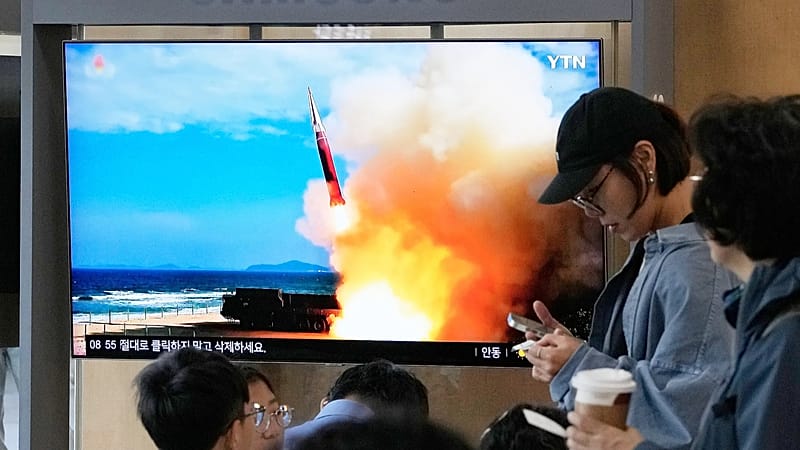
North Korea announced Saturday that it had test-fired an intermediate-range ballistic missile, claiming the weapon can manoeuvre in flight to evade missile defences in South Korea and Japan.

The launch comes as tensions between the two Koreas run high over landmine explosions along their border.

Kim Yo Jong, the influential sister of leader Kim Jong Un, said her brother oversaw the test. She called the missile "strategic", a term that suggests it is meant to carry nuclear warheads. She also claimed it can alter its trajectory at low altitudes and has unspecified artificial intelligence capabilities, which she said would make it extremely hard to intercept.

Japan’s military said the missile landed in waters outside its exclusive economic zone, while the South Korean military, which often accuses North Korea of exaggerating its military capabilities, said the missile travelled more than 700 kilometres.

North Korea claims new missile capabilities

According to South Korea's Joint Chiefs of Staff, the North Korean missile was fired early Saturday from the eastern coastal Wonsan area. Japan's Defense Ministry later put the distance at roughly 680 kilometres.

In her statement, Kim Yo Jong pointed to the gap between the two US allies' figures as proof that they could not follow the missile in flight.

"Whenever we applied the wavelike trajectory mode to missiles, the enemy failed to track the targets from their first skip points," she said. "There is no way to avoid this attack."

The launch followed a day after she mocked Seoul's demand that Pyongyang apologise for the 21 September landmine explosions. The blasts went off about 10 metres south of the military demarcation line and wounded three South Korean soldiers.

South Korean army soldiers patrol along the barbed-wire fence near the border with North Korea, in Paju, South Korea, Tuesday, Sept. 29, 2026. (AP (AP Photo)

A joint inspection by South Korea and the US-led United Nations Command concluded that North Korea had planted the mines, and the command later found that Pyongyang had breached the armistice that halted the 1950-53 Korean War.

Seoul has also asked the North to stop fortifying the border with mines and anti-tank barriers. That work has sped up since Kim Jong Un dropped the goal of reconciliation in 2024 and branded Seoul a permanent adversary.

Kim Yo Jong, who may be the second most powerful person in Pyongyang, called Seoul's demands "utterly pathetic" on Friday and rejected any North Korean responsibility for the blasts, warning of retaliation if the South fires on troops working along the border.

Pyongyang's weapons tests are piling up

The Wonsan launch is the newest in a string of recent military displays, which also include missile tests, live-fire drills and the commissioning of a new warship. Kim Jong Un is showing off his expanding nuclear programme even as Washington urges a return to diplomacy.

Wonsan also hosted the Sept. 20 test of what state media described as a hypersonic missile system. It belongs to a family of weapons built to overwhelm missile defences in South Korea and Japan, including solid-fuel intermediate-range missiles first revealed in 2024.

South Korea's military said it had raised its surveillance level for further launches and was sharing information closely with Washington and Tokyo. The US Pacific Command said the launch "does not pose an immediate threat to American personnel or territory or to our allies."

Kim has mostly turned his back on diplomacy with the US and South Korea since his nuclear talks with President Donald Trump broke down in 2019. He has shifted his focus to Moscow, sending thousands of troops and large shipments of weapons to back Vladimir Putin's war in Ukraine. After years of heavier testing, his arsenal of nuclear-capable missiles now includes long-range systems that could potentially reach the U.S. mainland and shorter-range ones that threaten South Korea and Japan.

In August, Trump scaled back a large joint exercise with South Korea, apparently hoping to restart talks.

North Korea has brushed off the overture, insisting that Washington first end its "hostile policy", a phrase Pyongyang uses to describe US-led sanctions and joint military drills with South Korea.

Sign up to read this article
Read news from 100's of titles, curated specifically for you.
Already a member? Sign in here
Related Stories
Top stories on inkl right now
One subscription that gives you access to news from hundreds of sites
Already a member? Sign in here
Our Picks
Fourteen days free
Download the app
One app. One membership.
100+ trusted global sources.