Get all your news in one place.
100's of premium titles.
One app.
Start reading
The Economic Times
The Economic Times
Nikhil Agarwal

Non-AI Nifty suddenly beating Nasdaq, South Korea & Taiwan bourses: Is the global tech trade finally reversing?

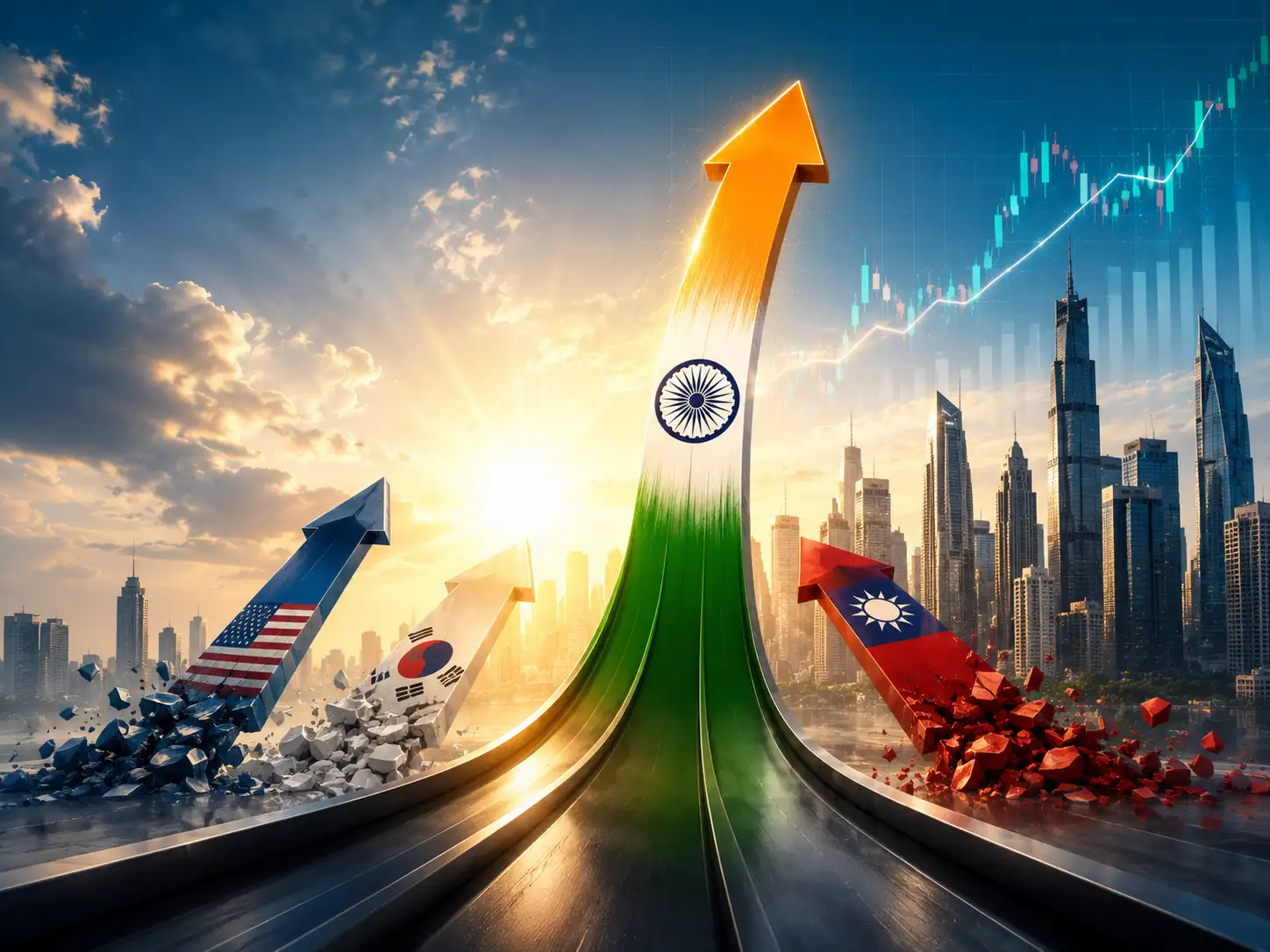
For months, India's stock market was the laggard everyone loved to ignore, dismissed as the “anti-AI trade” while Wall Street’s Nasdaq, South Korea's Kospi and Taiwan's chip-heavy bourses roared ahead on the artificial intelligence (AI) boom. That script has just started to show flipping signs.

Over the past month, Nifty is up 3.3%, outpacing Nasdaq, which has slipped 3%, and Taiwan, which has gained a more modest 1.2%. The starkest reversal is in Korea, where the Kospi has tumbled 13% in the same period — a market that, until recently, was the poster child of the global AI trade.
The shift is showing up in flows too. Foreign institutional investors, who had been relentless sellers of Indian equities, have turned net buyers to the tune of Rs 7,000 crore between June 15 and July 1, according to cash market data from Sebi.

On the other hand, FIIs have been trimming exposure to Korea's AI-heavy semiconductor leaders, especially Samsung Electronics and SK Hynix. Even as the Kospi remained the world’s hottest market, FIIs are net sellers in Korea so far in 2026.

Also Read | The AI boom won't burst all at once. It will pop in 'rolling bubbles': Macquarie

AI trade is fizzling out

Dr. VK Vijayakumar, Chief Investment Strategist at Geojit Investments, argues the unwind is structural, not incidental. The AI trade, he says, "is fizzling out," and was "largely a cyclical trade anyways." Companies like Samsung, SK Hynix and TSMC "will continue to make huge profits in this year and next year," he said, but warned of a potential decline in demand for their products.

That demand, he noted, has been driven by huge investments made by hyperscalers, but there's no guarantee that it will sustain for some time and it may not last more than 2 years.

By contrast, he said India's growth can be counted on because it is powered by domestic factors rather than a single global theme.

Vijayakumar also flagged a concentration problem building in Korea. Until a couple of years ago, foreign institutional investors barely touched the market and valuations were low. "For 10 years there were no buyers," he said. Now, he warned, "the concentration risk is very high in Korean markets as it is largely driven by only 2 stocks — Samsung and Hynix."

He pointed to another red flag: retail investors in Korea, "blinded by excessive profits being made recently," are taking loans to buy stocks. Such behaviour is often treated as a classic sign that a bull market is ending. "Retail sentiment can be a good contra indicator," he said, adding that no theme lasts forever.

The scale of Korea's reversal has been striking. The Kospi corrected 11.5% last month alone, which analysts say is positive for non-AI markets like India. For June specifically, the Nifty rose 2.5% even as the Kospi fell 11.5% and Nasdaq slipped 3%.

Adding to India's tailwinds, crude oil continues to slide, with Brent now around $70 a barrel — a trend expected to strengthen India's macroeconomic position by supporting growth while keeping inflation in check.

Also Read | Chris Wood’s big warning: The specific risk that will finally trigger the end of AI trade

How will the AI ‘bubble’ burst?

Macquarie argues the AI investment boom is unlikely to end in a single dramatic crash. Instead, it will deflate through a series of "rolling bubbles" as different parts of the AI ecosystem surge and then lose steam. "AI is a bubble that could suddenly derate, with considerable consequences for markets and economies," the brokerage cautioned in a note, framing the current cycle as historically extreme in both scale and speed.

Jefferies' Global Head of Equity Strategy, Chris Wood, is warning that the AI trade will eventually be broken not by a sudden collapse in demand for chips, but by a market-wide realisation that hyperscalers and leading AI labs cannot earn an adequate return on the vast capex they are undertaking. He sees concerns over "malinvestment" as the specific risk that will finally trigger the end, or at least a painful pause, in the AI boom.

"GREED & fear is personally convinced that concerns about malinvestment will be the most likely trigger for an end to the AI trade, or at least for a protracted pause to refresh," Wood wrote in his newsletter last week.

The danger, in his view, lies in circular funding arrangements and aggressive capacity expansion built on optimistic monetisation assumptions. He points to structures such as Nvidia financing OpenAI so that OpenAI can in turn buy more Nvidia chips — a feedback loop that works as long as investors are willing to bankroll the ecosystem, but could unwind sharply once doubts over long-term returns take hold.

Domestic brokerage firm Nuvama's Prateek Parekh went furthest in calling out froth in the AI trade, describing clear signs of excess.

“The AI mania now exhibits clear signs of excess—melt-up of hardware stocks, high valuations, retail euphoria and IPO boom. While it is certainly backed by strong cash flows (unlike the dot-com era), it isn’t shock proof. Chip shortage (prices up 2.5x YoY) now risks stalling it. As hyperscalers’ capex costs balloon while early adoption stage of AI limits pass-through—eroding free cash flow,” he said.

Shareholders, he added, are likely to dissent forcing hyperscalers to reassess their capex plans.

Unlike the dot-com era, he noted, the rally is "certainly backed by strong cash flows," but "isn't shockproof."

Still, Parekh does not call this the end of the AI story. "A slowdown in AI capex does not imply the end of AI, rather the contrary," he said, noting technology adoption typically rises after capex booms as costs fall, and that a supply-led drop in commodity prices could help offset rising chip costs and sustain the rally.

Mathieu Racheter, Head of Equity Strategy Research at Julius Baer, said that "while we remain constructive on the long-term AI opportunity, the correction highlights the risks associated with increasingly concentrated market leadership." He added: "In our view, this reinforces the case for broader diversification across regions and sectors."

After trailing the world's hottest AI-driven markets for the better part of the year, India's "anti-AI" Nifty is suddenly the outperformer — helped by a cooling AI trade in Asia, slowing FII selling, falling crude prices, and a Kospi correction born of dangerously concentrated, increasingly leveraged retail positioning in just two stocks. Whether this is a durable rotation or a temporary pause in the AI supercycle is the question strategists are now racing to answer.

(Disclaimer: Recommendations, suggestions, views and opinions given by the experts are their own. These do not represent the views of The Economic Times)

Sign up to read this article
Read news from 100's of titles, curated specifically for you.
Already a member? Sign in here
Related Stories
Top stories on inkl right now
One subscription that gives you access to news from hundreds of sites
Already a member? Sign in here
Our Picks
Fourteen days free
Download the app
One app. One membership.
100+ trusted global sources.