Get all your news in one place.
100's of premium titles.
One app.
Start reading
Times Life
Times Life
Aishwarya Kapoor

No Dung Beetles in India's Pastures Means More Flies, Parasites and Ruined Soil

What a Dung Beetle Actually Does in a Day

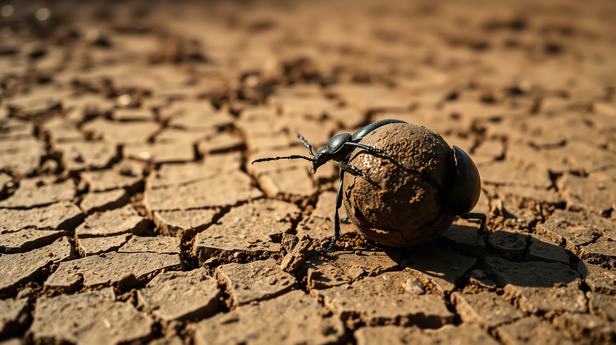
A single dung beetle can bury a ball of manure up to ten times its own body weight within twelve hours of locating it. Scarabaeidae, the family that includes most of India's dung beetle species, operate as tunnellers, rollers, and dwellers, each guild processing the pat differently but all arriving at the same outcome: the dung goes underground. Once buried, it fertilises soil, its moisture is retained by the earth rather than evaporated, and the surface of the pasture is cleared. In Australia, where native dung beetles could not process introduced cattle dung, the government ran a formal Dung Beetle Project from 1965 onward, importing species from South Africa and Europe to manage the problem. India has its own native beetle fauna and has never needed such an intervention, but that baseline is quietly eroding.

The Dewormer Problem Nobody Talks About

The most direct threat to dung beetles in Indian livestock systems is the widespread use of macrocyclic lactone dewormers, ivermectin being the most common. Ivermectin passes through cattle largely intact and remains active in dung for weeks after treatment. Studies published in journals including Veterinary Parasitology have documented significant beetle mortality and reproductive failure in dung from ivermectin-treated cattle. In India, ivermectin use in cattle, buffalo, and sheep has expanded substantially as commercial dairy and meat operations scale up. The dung from a treated animal is, for a beetle, a chemical trap. Beetles that enter it to breed lay eggs that do not hatch. Beetles that feed on it die early. The pasture around treated herds becomes a dead zone for the very insects that keep it functional.

What Flies Gain When Beetles Leave

The arithmetic of flies and beetles is direct. A single cowpat left unburied can produce between 3,000 and 80,000 flies depending on species and temperature. Dung beetles, when present in healthy numbers, can eliminate a pat entirely within 48 hours, collapsing that reproductive window to near zero. When beetles are absent, the pat sits for days or weeks. House flies, buffalo flies, and stable flies, all significant pests of Indian livestock, use surface dung as their primary breeding medium. Buffalo fly alone causes hide damage, weight loss, and secondary bacterial infections in cattle. The fly populations that emerge from unburied dung do not stay in the field. They move into animal shelters, into homes near farms, and onto food. The beetle's absence is felt far beyond the pasture edge.

Parasites That Survive Because the Dung Stays

Gastrointestinal parasites, roundworms, lungworms, liver flukes, complete part of their life cycle in dung or in the soil immediately beneath it. Infective larvae migrate out of the pat and onto surrounding grass, where grazing animals ingest them. Dung beetles interrupt this cycle in two ways: by burying the dung below the depth at which larvae can migrate to the surface, and by physically disrupting the pat structure so that larvae dry out and die. Research from pasture systems in Europe and South America has shown measurably lower worm burdens in livestock grazing fields with active beetle populations. In India, where gastrointestinal parasitism already costs the livestock sector billions of rupees annually in lost productivity and treatment costs, the loss of beetle-mediated suppression means farmers lean harder on dewormers, which then kill more beetles. The cycle tightens.

What Happens to the Soil and the Grass

Dung left on the surface does not simply decompose slowly and eventually vanish. It forms a crust. That crust blocks sunlight from the grass beneath it, killing the sward in irregular patches. Rain runs off a crusted pat rather than soaking through it, reducing the moisture that reaches roots. The dung's nitrogen, instead of being drawn into the soil profile by beetle tunnelling activity, volatilises as ammonia, lost to the air rather than feeding the pasture. In heavily grazed Indian grasslands, where soil compaction is already a problem, the absence of beetle tunnels removes one of the few mechanisms that naturally aerates the top 20 centimetres of earth. Pasture carrying capacity drops. Farmers respond by grazing more animals on the same degraded ground, which compounds the compaction, which reduces beetle habitat further.

The dewormer, the fly, the parasite, and the exhausted pasture are not four separate problems. They are one problem expressed in four places simultaneously, and the missing variable in each of them is the same insect. Managing livestock health without accounting for what that management does to the dung beetle is a calculation with a hidden cost, one that accumulates in the soil long before it shows up in the herd.

Sign up to read this article
Read news from 100's of titles, curated specifically for you.
Already a member? Sign in here
Related Stories
Top stories on inkl right now
One subscription that gives you access to news from hundreds of sites
Already a member? Sign in here
Our Picks
Fourteen days free
Download the app
One app. One membership.
100+ trusted global sources.