
Good morning, I’m Mared Gwyn writing in the early hours from Brussels.
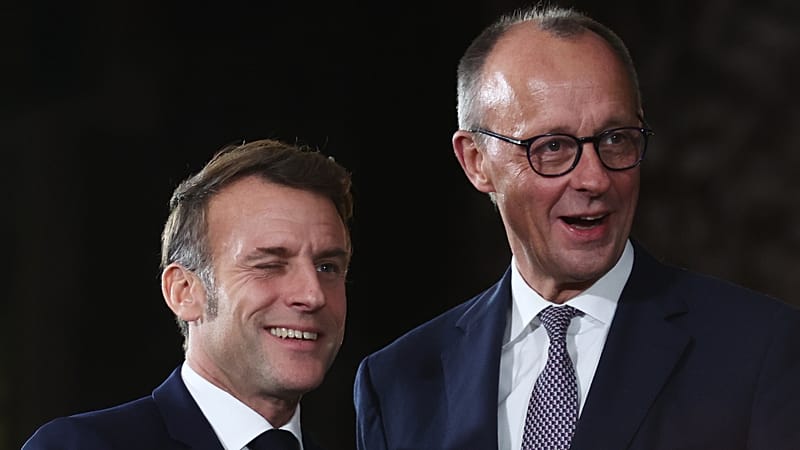
The real heavyweights steering EU policy – top industry chiefs – will join political leaders including the French President and German Chancellor at an annual industry summit in Antwerp later today, in what is set to be a taster session before EU leaders gather to talk competitiveness on Thursday.

Corporate leaders called on the bloc to streamline and simplify its industrial policy in a statement at the same summit two years ago. Geopolitical upheaval, fiercer global competition and a lagging European economy are now adding an immense sense of urgency to those calls. My colleague Marta Pacheco has the details.
But the nitty-gritty details of how Europe should fix its competitiveness problem are set to expose fault lines among leaders on Thursday.
In Antwerp, European Commission President Ursula von der Leyen is expected to repeat her industry-friendly pledges to strike further major free trade deals with world nations, slash red tape and roll back ‘gold plating’, a practice where EU member states add more requirements when transposing EU laws, pushing up regulatory costs for smaller businesses.
Rome and Berlin have thrown their weight behind that ‘simplification’ agenda.
But French President Emmanuel Macron is calling for a more radical European “industrial revolution” to face up to China and the US. He wants Europe to issue common debt to fund strategic investments – a proposal already rejected by Germany’s Merz – and roll out a “Made in Europe” strategy that would prioritise European-made content in manufactured goods.
Italy, Germany and the Nordic countries have already cautioned that the French ‘Made in Europe’ vision could scare off investors, advocating instead for a focus on deregulation and free trade. While no specific decisions are expected tomorrow, it’s set to be a consequential – and divisive – debate on the future of Europe’s economy.
Von der Leyen has also acknowledged the possible inevitability of a so-called ‘two-speed’ European Union, where a group of countries willing to integrate their economies further do so without the 27 members moving as a bloc. In a must-read this morning, my colleague Jorge Liboreiro breaks downhow a two-speed Europe in fact already exists (the Eurozone and the Schengen areas being prime examples), and has been gaining additional momentum in recent weeks.
In other news: US Undersecretary of War Elbridge Colby is expected to tell European NATO allies in a Brussels meeting tomorrow that only a limited number of US troops will be withdrawn from NATO territory as part of any posture review, our correspondent Shona Murray reports this morning from the NATO headquarters.
Sources familiar with the matter told Shona that Colby – who is deputising for US War Secretary Pete Hegseth in tomorrow’s NATO ministerial – is poised to commit to keeping the vast bulk of US troops stationed in Germany, Italy and along Europe's eastern flank.
There are currently approximately 80,000 to 90,000 US troops stationed in Europe at any given time depending on rotations, the highest since the Cold War. The number surged in response to Russia's full-scale invasion of Ukraine four years ago.
The move will come as welcome relief, and also surprise, as European allies had been bracing themselves for a substantial drawdown of US troops as the Trump administration prioritises security theatres elsewhere in the world.
We have more from Shona below on the new NATO mission to bolster security in the High North and Arctic.
Also in today’s newsletter: How EU leaders are agreeing to disagree on who should pick up the phone and call Russia’s Putin; and Hungary’s centre-right Tisza party breaks ranks with its European political group (again) to shake off the “Brussels puppet” label.
NATO launching Arctic Sentry mission to counter Russia and China
NATO is due to launch a new mission named Arctic Sentry to strengthen security in the High North and Arctic, with military planning already at an advanced phase, our correspondent Shona Murray writes this morning.
The mission comes weeks after serious divisions erupted within the alliance over US President Donald Trump’s claim he would “take” Greenland, a semi-autonomous Danish protectorate in the Arctic. A détente negotiated by the NATO Secretary General Mark Rutte with Danish, Nordic and US partners agreed to significantly step up Arctic security.
NATO defence ministers are meeting on Thursday for the first time since Trump’s demands nearly imploded the alliance, and are expected to confirm the contours of the new mission. Yet US Secretary of War, Pete Hegseth, will skip the meeting and send his undersecretary instead.
Arctic Sentry is designed to enhance NATO presence in the Arctic against rising Russian threats and persistent Chinese efforts to influence the region, according to several allies.
“The Arctic is a critical region in face of growing competition in China,” the US ambassador to NATO Mathew Whitaker told journalists in a briefing on Tuesday.
He said the alliance needs to be “clear as to what's happening in the Arctic” and understand present and future capability needs required to secure the region, as the “Arctic becomes more and more relevant.” A senior NATO diplomat said that “although there is no immediate crisis, our threat assessment indicates that both Russia and China have demonstrated ambitions in the region".
"Deterrence requires early and visible action: signalling our presence, vigilance and readiness to defend the territory whenever necessary," they added.
Should the EU speak directly with Putin? Leaders agree to disagree – for now
Should the European Union pick up the phone and call Vladimir Putin? It depends on who you ask, my colleague Jorge Liboreiro writes.
The prospect of re-engaging diplomatically with the Kremlin as part of efforts to end the war in Ukraine has sharply divided the EU’s 27 member states, with some in favour, others against and most on the fence. The debate has taken on new salience after both French President Emmanuel Macron and Italian Prime Minister Giorgia Meloni endorsed the idea in back-to-back public statements last month.
Austria, the Czech Republic and Luxembourg have expressed support for the idea.
But Germany, Estonia, Lithuania and Cyprus have voiced strong opposition, pointing to Putin's maximalist demands and Russia's continued bombardment of Ukrainian energy facilities during gruelling sub-zero temperatures, as evidence that Moscow is not willing to offer any concessions towards peace.
The stark discrepancies have not gone unnoticed in Brussels, with the EU institutions keeping a close eye on the succession of public statements and treading carefully to avoid picking sides before the two sides reconcile. Privately, EU officials and diplomats say the debate has become serious, but warn that it is still unfolding at an abstract level, without a clear structure or direction. The sharp divide among capitals weighs heavily on the discussions behind the scenes.
Certain names are already being casually floated for the prospective special envoy position, such as Alexander Stubb, the president of Finland, and Margrethe Vestager, the former two-term European Commissioner for competition policy.
Another Nordic name making the rounds is Sauli Niinistö, the former president of Finland, who authored an EU report on civil and military preparedness. Niinistö has some proficiency in the Russian language and met with Putin several times while in office.
Hungary's Tisza Party breaks ranks with EPP in bid to counter Brussels puppet claims
EU lawmakers from Hungary's centre-right Tisza party defied their European political group's stance for the third time in a month on Tuesday to counter Prime Minister Viktor Orbán’s claims that a Tisza-led Hungarian government would be a Brussels “puppet”, our correspondent Sándor Zsiros reports.
Led by former Orbán ally Péter Magyar, Tisza is currently topping polls ahead of April’s Hungarian election and mounting what is set to be the greatest challenge to Orbán’s fifteen uninterrupted years in government.
Tisza lawmakers broke ranks with the European People’s Party (EPP) in a vote on safeguards related to the EU-Mercosur free trade deal, a move it said was necessary to protect Hungarian farmers. The EPP has responded with sanctions.
"Tisza stands by Hungarian farmers even when it means going against the mainstream in Brussels," a party statement said after the vote in Strasbourg.
"We accept the sanctions. Because Hungarian interests are more important than any compromise in Brussels," the party statement said.
In January, Tisza supported a resolution to refer the Mercosur agreement to the European Court of Justice. Tisza MEPs also failed to appear at a vote supporting fellow EPP politician Ursula von der Leyen during a motion of censure initiated by the far right.
An EPP source who spoke to Euronews on condition of anonymity said that the fact that Tisza does not want to be associated with EPP chairman Manfred Weber or Commission chief Ursula von der Leyen was "worrying".
More from our newsrooms
Nearly half of Europeans would back banning Musk's X if it keeps breaking EU law, new poll finds. A new YouGov survey across Germany, France, Spain, Italy, and Poland suggests 47% of Europeans would support the move. Theo Farrant has more.
Russia restricts Telegram over alleged law breaches as it supports state-backed rival. Russia's internet watchdog said on Tuesday that it was throttling the Telegram messaging platform over alleged legal violations, as Moscow steps up efforts to steer people toward a more tightly controlled domestic online service. More.
Vatican Bank launches 'Catholic-based' stock indices. The Vatican Bank has announced this Tuesday the launch of two equity indices, both in the US and in the eurozone, selecting stocks from firms that purportedly respect and adhere to Catholic principles. Quirino Mealha has more.
We're also keeping an eye on
- European Commission President Ursual von der Leyen to address the European Parliament, before travelling on to Antwerp for the European Industry Summit
- European Commission to unveil new action plan on drone security
- EU defence ministers meet in Brussels
That’s it for today. Shona Murray, Jorge Liboreiro, Sandor Zsiros, Marta Pacheco, Vincenzo Genovese, Maria Tadeo and Eleonora Vasques contributed to this newsletter. Remember to sign up to receive Europe Today in your inbox every weekday morning at 08.30.







