Get all your news in one place.
100's of premium titles.
One app.
Start reading
Euronews
Euronews
Nela Heidner

Up to 1km-thick ice: Swiss meteorite offers new insight into the Ice Age

In the canton of Bern, above Lake Biel on Twannberg and Mont Sujet, lies one of Europe’s most important meteorite strewn fields. Fragments of an extraordinary celestial body have been discovered there time and again for decades.

The number of known finds has now risen to more than 2,200. This means the scale of the meteorite discovery is significantly greater than initially assumed.

The Twannberg meteorite did not hit the Earth as a single large block but exploded as it entered the atmosphere. Its debris was scattered over an area of around six kilometres in what is now the Bernese Jura.

Scientists estimate that the celestial body struck the Earth around 175,000 years ago. It was originally between four and 20 metres across and weighed at least 250 tonnes.

First discovery in 1984

The story of the meteorite find began on 9 May 1984. At that time, a Swiss farmer discovered an unusual block weighing around 15 kilograms in a field. At first it was not clear what it was. Later examinations showed that the find consisted of iron and did in fact come from space.

In the following decades, further fragments were discovered. Above all, systematic searches with metal detectors led to a sharp increase in the number of known pieces.

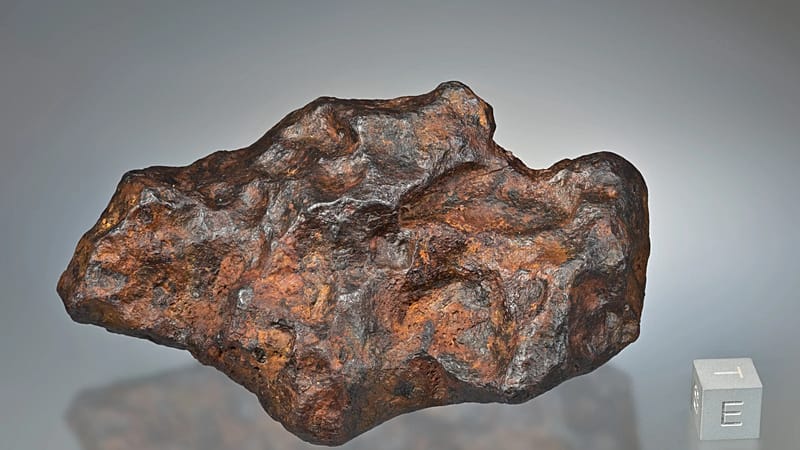
New finds from 2026: decades after the first discovery, fragments of the meteorite are still being recovered. (ZVG/NMBE)

"Ten years ago there were 400 fragments, now there are more than 2,200 fragments," explained geologist Beda Hofmann from the Natural History Museum of Bern to Swiss public broadcaster SRF.

Extremely rare meteorite

The Twannberg meteorite belongs to the group of iron meteorites and is classified as belonging to the extremely rare IIG type. It is so far the only known IIG iron meteorite in Europe. This type of meteorite is characterised, among other things, by an unusually low nickel content and a high phosphorus content. Only a few representatives of this class are known worldwide.

For science, the fragments are particularly valuable: they can provide clues about the composition and development of celestial bodies and also offer a glimpse into the early history of our solar system.

Glaciers helped to spread the fragments

The finds are also of interest for research into the history of the Swiss landscape.

According to experts, some of the newly discovered fragments were moved by glaciers. Around 175,000 years ago, massive glaciers covered large parts of the Swiss Plateau – in places the ice sheet was more than one kilometre thick. Because the new finds have been discovered at higher altitudes than previous fragments, they can offer fresh insights into the vast masses of ice during the penultimate ice age.

This makes the finds, in a sense, double witnesses of time: they originally came from space but later became part of Earth’s history and were shaped by ice-age landscape processes.

Search continues

The search on Twannberg and Mont Sujet is far from over; researchers and meteorite hunters are still using metal detectors to look for new remnants.

This is, however, more difficult than it sounds at first, because the soil also contains metal objects that have nothing to do with meteorites, such as aluminium foil or nails. Incidentally, anyone wishing to search needs a permit from the competent archaeological service.

The discoveries show the potential that the Swiss meteorite field still holds: with every additional fragment, researchers learn more about the original celestial body and the story of its impact.

A note of our own: watch the latest Euronews exclusive report:

Where the Bundeswehr trains with live ammunition: Euronews reporter on NATO’s eastern flank

This text was translated with the help of artificial intelligence. Report a problem : [[email protected]].

Sign up to read this article
Read news from 100's of titles, curated specifically for you.
Already a member? Sign in here
Related Stories
Top stories on inkl right now
One subscription that gives you access to news from hundreds of sites
Already a member? Sign in here
Our Picks
Fourteen days free
Download the app
One app. One membership.
100+ trusted global sources.