Get all your news in one place.
100's of premium titles.
One app.
Start reading
Medical Daily
Medical Daily
Dorothy Brooks

Nearly Three in Four Americans 50 and Older Say They Would Take a Dementia Vaccine, Though None Exists

Most middle-aged and older Americans say they would roll up their sleeves for a vaccine that cut their risk of dementia. In a survey of 1,529 adults aged 50 and older published Sept. 21 in JAMA Network Open, 72% said they would be likely to get a low-cost, multidose vaccine that cut dementia risk in half for people at high risk.

There is an important catch: no vaccine to prevent dementia has been approved. Respondents were answering a hypothetical question about a product that does not exist, according to the USC Schaeffer Center for Health Policy & Economics, which led the research.
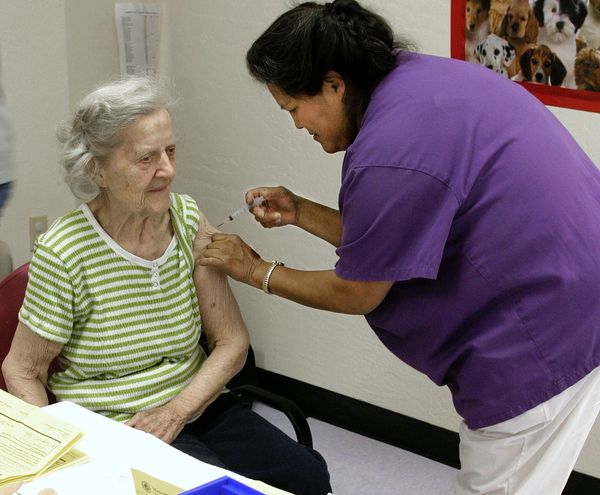
The findings still matter to families. Dementia is among the most feared parts of aging, and adult children often help parents weigh health choices. The survey suggests that most people would welcome prevention, but it also shows who remains unsure, which could shape how any future vaccine reaches the people who need it most.


Uncertainty Outweighs Opposition

Only 7% of respondents said they were unlikely to take the vaccine or would definitely refuse it. Another 21% were unsure. The authors wrote that "uncertainty rather than opposition may be the principal barrier to adoption."According to CIDRAP, 34% answered "definitely yes," 21% "very likely," and 17% "likely."

Interest rose with age. The share who said they would definitely get the vaccine climbed from 31% of people in their 50s to 35% of those 70 and older. That pattern tracks with risk, since dementia becomes more common with each decade of life.

Sharp gaps appeared between groups. Women were more hesitant than men (23% vs. 19%) and less likely to say "definitely" (29% vs. 39%). Black adults had the highest hesitation of any racial or ethnic group at 26%, and were nearly half as likely as white adults to say they would definitely get the vaccine (20% vs. 36%).

"Older adults are highly interested in receiving a preventive dementia vaccine, while relatively few are opposed," said lead author J. Felipe Montano-Campos, a postdoctoral researcher at USC Schaeffer. "As vaccine options emerge, efforts may be needed to address hesitancy among some groups, including those at higher risk for dementia."


Survey Answers Are Not Shots in Arms

The study measured stated intentions, not behavior. Gretchen Chapman, a Carnegie Mellon University psychologist who studies vaccine decisions and was not involved in the research, cautioned that survey responses can be "cheap talk." She told CIDRAP, "We don't know how many would actually get such a vaccine."

The design also shaped the answers. Participants were told to imagine a low-cost vaccine that cut risk in half for high-risk people. Real candidates may cost more, work less well, or carry side effects, and each of those factors could change the numbers.

In plain terms, this was a cross-sectional survey of 1,529 U.S. adults. It found strong stated interest in a hypothetical vaccine. It did not show that people would actually get one, that such a vaccine will work, or when one might arrive.

Much of the public interest comes from vaccines already on the market, especially the shingles shot. USC Schaeffer notes growing evidence that the shingles vaccine is linked to roughly 15% to 20% lower dementia risk. These are largely observational findings, and Gavi, the Vaccine Alliance, which has summarized several vaccines linked to lower dementia risk, notes that such links do not prove cause and effect.


Guidance for Families Weighing Brain Health Now

Age is the strongest risk factor. A National Center for Health Statistics report based on 2022 data found that 13.1% of adults 85 and older had a dementia diagnosis. People caring for parents in their 70s and 80s are the group most likely to face these decisions soon.

What families can act on today are vaccines that are already recommended for their primary purpose. The shingles vaccine is recommended for adults 50 and older to prevent shingles and its painful nerve complications. Any dementia benefit is a possible bonus, not a proven reason to get it. Since 2023, Medicare Part D has covered recommended adult vaccines, including the shingles shot, with no out-of-pocket cost.

In large metro areas such as Los Angeles, Chicago, and Houston, the shingles vaccine is widely available at retail pharmacies. People without insurance can ask their county health department about low-cost adult vaccine programs, which vary by location.

Families should be wary of supplements, clinics, or online products marketed as dementia "vaccines" or brain protection shots. No such product has FDA approval. Anyone noticing memory loss that disrupts daily life, repeated confusion about time or place, or trouble handling money or familiar tasks should schedule an evaluation with a primary care clinician.

Vaccine candidates targeting the biology of Alzheimer's disease are in development, and those under study require multiple doses, according to USC Schaeffer. None has an approval date. The authors argue that outreach plans, especially for women and Black adults, should be built before any product arrives rather than after.

The survey's message is hopeful but limited. Most older Americans say they want a dementia vaccine, a sizable minority is unsure, and no approved option exists. For now, the most useful step is a conversation with a clinician about recommended adult vaccines and any early memory concerns.


Key Questions Answered

What did the survey find? Among 1,529 U.S. adults aged 50 and older, 72% said they would be likely to take a vaccine that cut dementia risk in half for high-risk people.

Is there a dementia vaccine available? No. The survey asked about a hypothetical vaccine. No vaccine to prevent dementia has been approved.

Who was most hesitant? Women and Black adults reported more hesitation than other groups, according to the study.

Does the shingles vaccine prevent dementia? Studies link it to lower dementia risk, but they have not proven that the vaccine prevents dementia.

Who should get the shingles vaccine now? It is recommended for adults 50 and older to prevent shingles. Medicare Part D covers it without cost-sharing.

When should someone see a doctor about memory? Memory loss that disrupts daily life, confusion about time or place, or trouble with familiar tasks should be evaluated by a clinician.

What kind of study was this? A cross-sectional survey measuring stated intentions about a hypothetical vaccine, not actual vaccination behavior.

Published by Medicaldaily.com

Sign up to read this article
Read news from 100's of titles, curated specifically for you.
Already a member? Sign in here
Related Stories
Top stories on inkl right now
One subscription that gives you access to news from hundreds of sites
Already a member? Sign in here
Our Picks
Fourteen days free
Download the app
One app. One membership.
100+ trusted global sources.