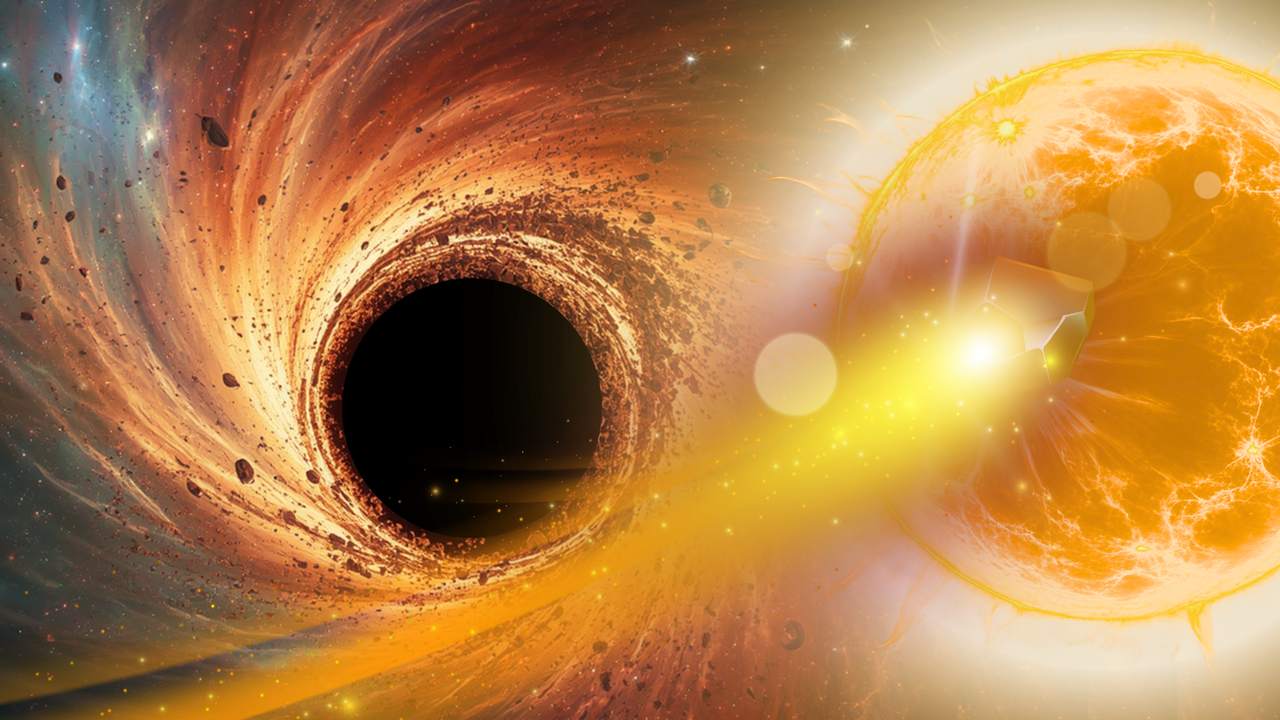
The launch of NASA's next super telescope, the Nancy Grace Roman Space Telescope (Roman), may mean there is nowhere left for violent black holes to hide.
In fact, these cosmic cannibals may not even be able to hide from Roman at "cosmic noon," a period of the universe's history that occurred around 11 billion to 12 billion years ago. The study of these gory stellar events so early in the history of the universe could help reveal how supermassive black holes grew so big, so rapidly.
Occurrences of black holes ripping apart stars are called tidal disruption events (TDEs), and they happen when an unfortunate star's orbit brings it too close to the immense gravitational influence of a supermassive black hole. This simultaneously squashes and squeezes the star in a process called "spaghettification," with plasma pasta wrapping around the black hole and being fed gradually to it.