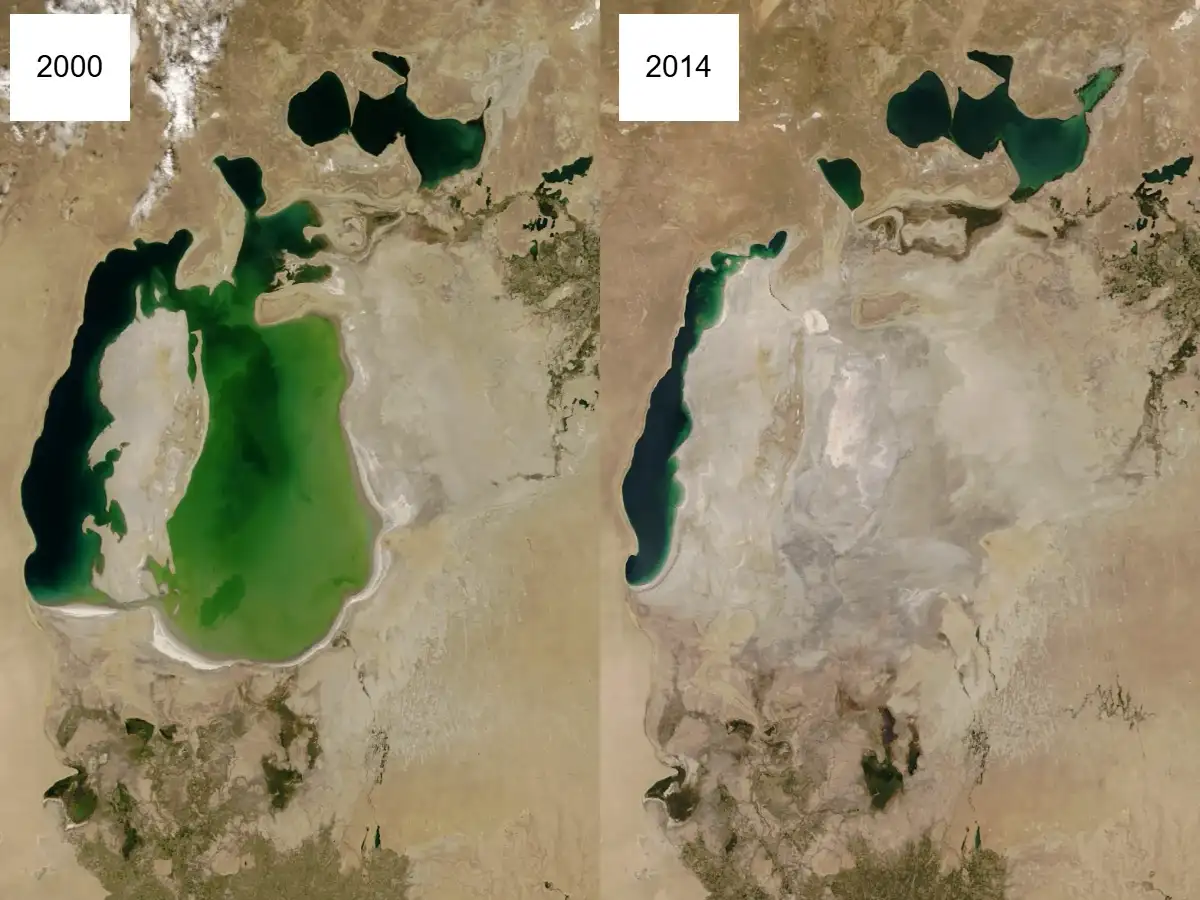
Satellite images gathered by NASA's Earth Observatory, using the Moderate Resolution Imaging Spectroradiometer aboard the agency's Terra satellite, show how dramatically the Aral Sea changed over time. Between 2000 and 2014, the lake that once sprawled across the border of Kazakhstan and Uzbekistan shrank so dramatically that its eastern basin vanished entirely, leaving behind cracked earth, salt flats and drifting dust where fishing boats once sailed. Decades ago, the two rivers that fed the Aral Sea were diverted for irrigation, contributing to the lake's decline. The effects are still being felt across the region, while the satellite record offers a broader reminder of how quickly human activity can alter a landscape.
How a lake the size of a small country disappeared
To understand what happened, go back to the 1960s, when the USSR launched an irrigation project in the dry areas of Kazakhstan, Uzbekistan and Turkmenistan. Two major rivers, the Amu Darya and Syr Darya, carried water from distant mountains across the desert and into the Aral Sea, which was once the fourth-largest lake in the world. The project transformed arid land into fertile ground for cotton and other crops, but each gallon used in agriculture was a gallon not reaching the lake. NASA imagery shows that even by the early 2000s, the Aral Sea had already shrunk considerably and was divided into northern and southern sections.
The southern portion then split further into an eastern and a western lobe, and the connection between them broke completely in 2001. From there, the shallower eastern lobe began retreating rapidly, and NASA's tracking shows that especially large retreats occurred between 2005 and 2009, when drought limited and then cut off the flow of the Amu Darya. By 2014, the eastern lobe had disappeared altogether, turning what had once been open water into a stretch of exposed desert that locals now call the Aralkum. Watching that shift unfold in the satellite record shows how a body of water once large enough to be seen from space faded away over little more than a decade.
Impact went beyond the actual body of water
The destruction of the Aral Sea was not only about the loss of a lake but about the change in a whole way of living in the region. Communities which had been fishing in the lake all along found themselves without their means of livelihood, as the fish were unable to live in water that became more saline year after year. Even more troubling, the dried-up lake bed, polluted with fertilizer and pesticide residues from surrounding farms, became a source of toxic dust. Strong winds lifted this dust from the lake bed and scattered it across the region, contaminating the soil that communities needed to grow food. Finally, the loss of a large water body meant that its climate-moderating role disappeared, making winters colder and summers drier.
In a bid to rescue at least part of the lake, Kazakhstan built a dam known as the Kok-Aral dike, completed in 2005, which separates the northern section of the Aral Sea from the lower-lying southern part. The idea was straightforward: by preventing water from flowing south out of the smaller northern lake, the north could have a chance to recover, even if the larger southern section was left to decline. NASA imagery shows the North Aral Sea began to recover after the dam was completed. Within a year of the dam's completion, water levels in the North Aral Sea rose noticeably, and small, steady increases have continued since, allowing fisheries in that northern area to slowly begin recovering too.