
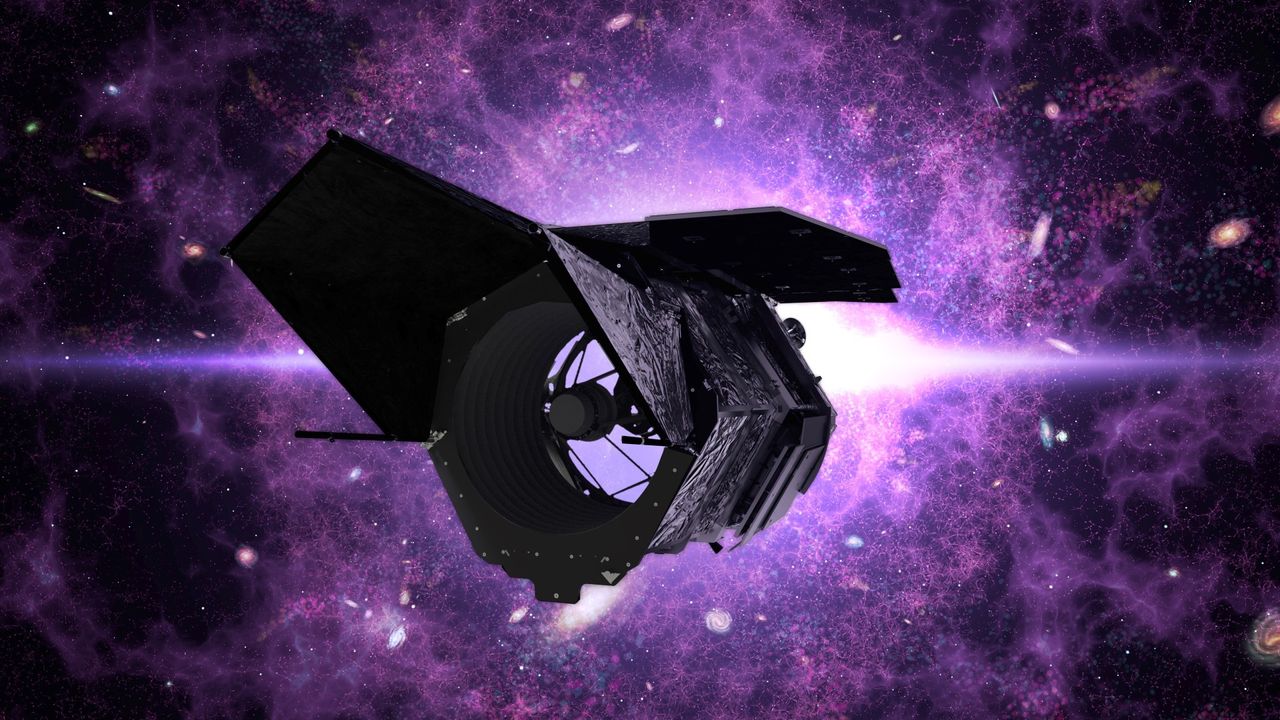
Once NASA's Nancy Grace Roman Space Telescope launches in the next 12 to 18 months, it will be on its way toward outdoing scientists' initial expectations. Researchers have confirmed that Roman should be able to measure enormous seismic waves rippling across the surfaces of more than 300,000 red giant stars.
Roman is a survey telescope, with an 8-foot (2.4-meter) mirror like the Hubble Space Telescope, but a field of view 100 times larger. Besides studying dark matter and dark energy, one of Roman's core surveys will be the Galactic Bulge Time-Domain Survey, in which millions of stars in the central bulge of the Milky Way galaxy will be studied, principally to look for exoplanets. The idea is to use gravitational microlensing as a planet-finding device. Gravitational lensing is a technique often used in astrophysics to study distant objects; due to the way spacetime warps as per general relativity, some huge objects in space (like galaxy clusters, for instance) warp light traveling nearby, therefore magnifying, distorting and duplicating the source of that light as seen through our telescopes. Gravitational microlensing refers to gravitational lensing on smaller scales, like that of a planet.