
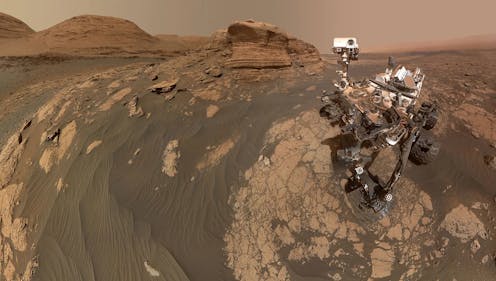
Nasa’s Curiosity Mars rover has detected the largest organic (carbon-containing) molecules ever found on the red planet. The discovery is one of the most significant findings in the search for evidence of past life on Mars. This is because, on Earth at least, relatively complex, long-chain carbon molecules are involved in biology. These molecules could actually be fragments of fatty acids, which are found in, for example, the membranes surrounding biological cells.
Scientists think that, if life ever emerged on Mars, it was probably microbial in nature. Because microbes are so small, it’s difficult to be definitive about any potential evidence for life found on Mars. Such evidence needs more powerful scientific instruments that are too large to be put on a rover.













