Get all your news in one place.
100's of premium titles.
One app.
Start reading
The Conversation
The Conversation
Margaret Landis, Assistant Professor of Earth and Space Exploration, Arizona State University

NASA’s Artemis II plans to send a crew around the Moon to test equipment and lay the groundwork for a future landing

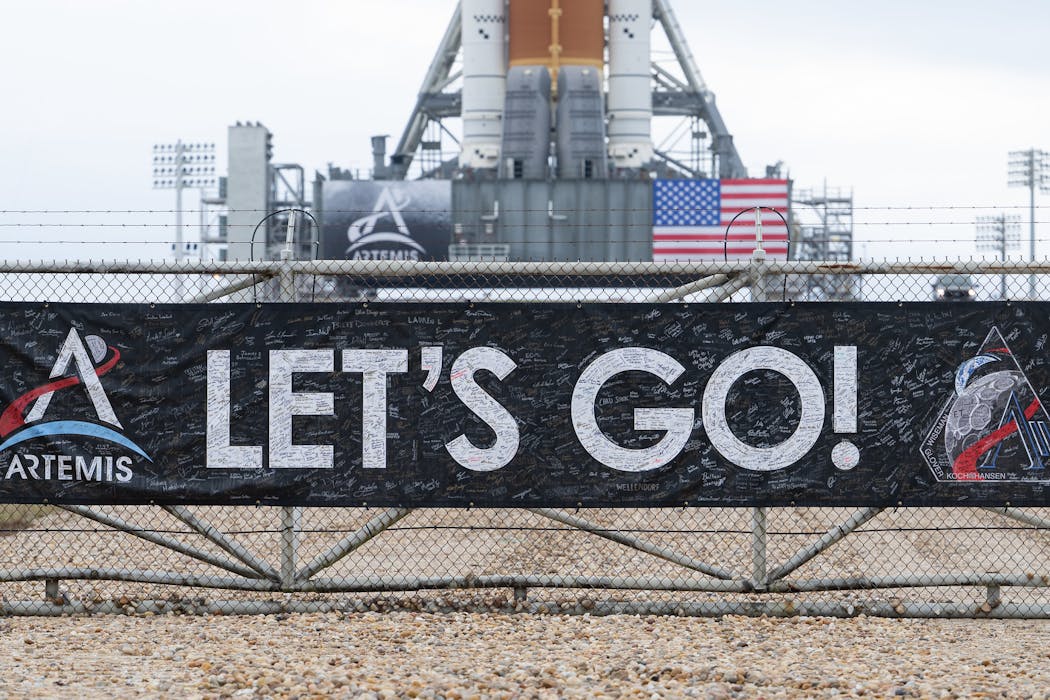
A banner signed by NASA employees and contractors outside Launch Complex 39B, where NASA’s Artemis II rocket is visible in the background. NASA/Joel Kowsky, CC BY-NC-ND

Almost as tall as a football field, NASA’s Space Launch System rocket and capsule stack traveled slowly – just under 1 mile per hour – out to the Artemis II launchpad, its temporary home at the Kennedy Space Center in Florida, on Jan. 17, 2026. That slow crawl is in stark contrast to the peak velocity it will reach on launch day, over 22,000 miles per hour, when it will send a crew of four on a journey around the Moon.

A rocket launch is always at the mercy of a variety of factors outside of the launch team’s control – from the literal position of the planets down to flocks of birds or rogue boats near the launchpad. While Artemis II is currently planned for March 2026, it may not launch until later in April. In fact, March already represents a small delay from the initially estimated February launch opportunity.

Sign up to read this article
Read news from 100's of titles, curated specifically for you.
Already a member? Sign in here
Related Stories
Top stories on inkl right now
One subscription that gives you access to news from hundreds of sites
Already a member? Sign in here
Our Picks
Fourteen days free
Download the app
One app. One membership.
100+ trusted global sources.