
Get all your news in one place.
100's of premium titles.
One app.
Start reading
Tom’s Hardware
Tom’s Hardware
Technology
Jowi Morales

NASA partners with Microchip to build next-generation spaceflight chips with 100x the power of current offerings — chip designed to withstand radiation for extended missions on the Moon and Mars

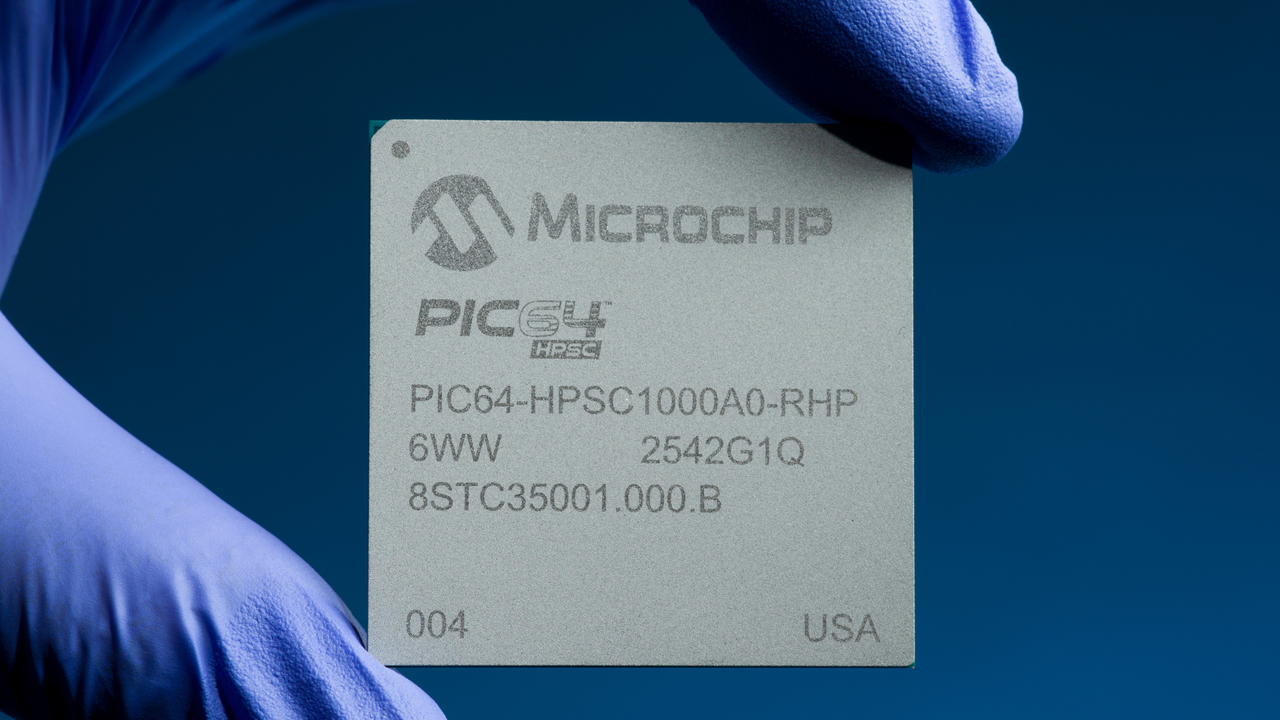
A Microchip SoC built for NASA.

NASA has announced that it has just partnered with Microchip Technology Inc. to build next-generation chips that will power its spacecraft. This project, dubbed High-Performance Spaceflight Computing, aims to build a system-on-a-chip (SoC) that will deliver 100 times the computing capacity of current processors designed for spaceflight. The space agency said that it will come in two flavors — a radiation-hardened version for geosynchronous, deep-space, and long-duration missions and a radiation-tolerant version for low Earth orbit satellites. The former is primarily aimed at supporting missions to the Moon, Mars, and beyond, while the latter is tailored for commercial applications.

The SoC will combine both computing and networking capabilities on a single device, reducing cost and complexity, as well as allowing for better power efficiency. More importantly, it will feature a scalable architecture so operators can turn off unnecessary functions in case they need to conserve energy. We’ve seen NASA selectively turn off instruments on distant spacecraft to reduce power consumption — it executed this procedure on the nearly 50-year-old Voyager 1, which left the solar system in 2012, after scientists noticed an unexpected drop in onboard power levels.

These chips are also designed to scale as multiple units connected via advanced Ethernet. This would give NASA spacecraft massive computing power and even allow for some autonomy, like deciding the speed at which a rover will traverse a landscape or using it to analyze images independently. The Perseverance rover actually used something similar when it paired NASA’s satellite data of the Red Planet’s surface with its panoramic camera and a Qualcomm Snapdragon 801. This allows it to compare what it sees with the information gathered from space so it can determine its location with pinpoint accuracy.

What’s interesting, though, is that NASA envisions that the technology developed from this project will be used in Earth-bound applications, as well. The agency said that its potential applications include “drones, energy grids, medical equipment, communication services, artificial intelligence, and data transmission.” This won’t be the first time that space-borne technology has become ubiquitous on our planet. Several technologies that we use daily were initially built for space exploration, says NASA’s Jet Propulsion Laboratory. This includes camera phones, CAT scans, LEDs, water purification systems, wireless headphones, and memory foam, among others.

Advancements in the semiconductor space have so far been driven by chip makers, like Apple and Nvidia, and fabs such as TSMC. This partnership will allow NASA and Microchip to build technological advancements of their own. But instead of focusing on raw computing power, the two entities will push for reliability, power efficiency, scalability, and security.

Sign up to read this article
Read news from 100's of titles, curated specifically for you.
Already a member? Sign in here
Related Stories
Top stories on inkl right now
One subscription that gives you access to news from hundreds of sites
Already a member? Sign in here
Our Picks
Fourteen days free
Download the app
One app. One membership.
100+ trusted global sources.