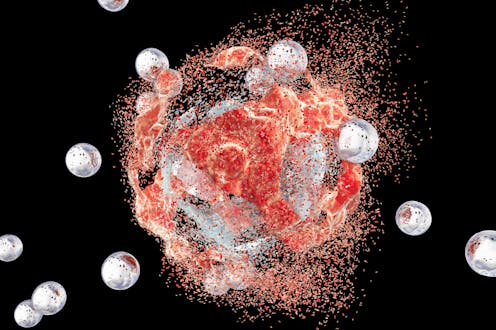
When you hear the word “nanomedicine,” it might call to mind scenarios like those in the 1966 movie “Fantastic Voyage.” The film portrays a medical team shrunken down to ride a microscopic robotic ship through a man’s body to clear a blood clot in his brain.
Nanomedicine has not reached that level of sophistication yet. Although scientists can generate nanomaterials smaller then several nanometers – the “nano” indicating one-billionth of a meter – today’s nanotechnology has not been able to generate functional electronic robotics tiny enough to inject safely into the bloodstream. But since the concept of nanotechnology was first introduced in the 1970s, it has made its mark in many everyday products, including electronics, fabrics, food, water and air treatment processes, cosmetics and drugs. Given these successes across different fields, many medical researchers were eager to use nanotechnology to diagnose and treat disease.