
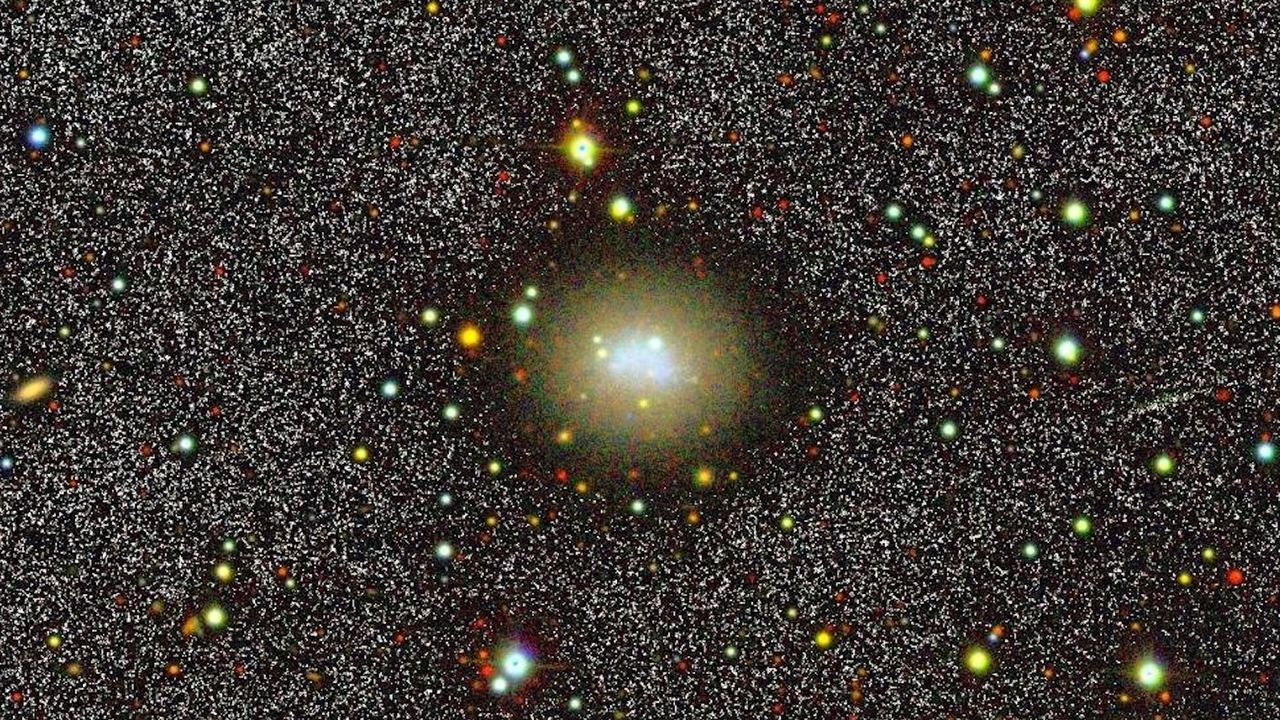
Scientists are puzzled by an"impossible" galaxy that doesn't appear to have the fuel it needs to be growing.
The dwarf galaxy, NGC 6789, is located approximately 12 million light-years from Earth, in an empty region known as the Local Void, and was first described in 1883. However, scientists didn't realize the galaxy was still forming new stars until recently. Observations over the past couple of decades indicate that about 4% of its stellar mass was born in the past 600 million years. But given the dearth of star-forming material or even other galaxies in the region, researchers were baffled as to how it could still be birthing stars.

A team led by Ignacio Trujillo, an astronomer at the Institute of Astrophysics of the Canary Islands, recently tried to find out. Using the Two-meter Twin Telescope at Teide Observatory in Spain, the researchers scanned the outer regions of the galaxy for traces of past mergers with other star clusters, like tidal features, that could explain how the new stars got there. They also probed deep into the galaxy's star-forming core.
Ultimately, though, the team's investigation did not turn up any evidence of mergers; NGC 6789 appeared undisturbed. This means the new stars probably formed inside the galaxy itself.
Its central star forming region, therefore, was most likely fueled by leftover gas from the galaxy's formation, or by pristine gas from outside the galaxy that somehow accumulated inside it and was quickly used up, the researchers wrote in a paper published this month in the journal Research Notes of the American Astronomical Society.

Future observations may shed light on how NGC 6789 has continued to grow with no apparent fuel source, but for the time being, the source of the galaxy's star making remains a mystery.