Round-table interviews with rockstars always carry a risk. You can make the intros. Dim the lights. But if the chemistry doesn’t fire, it can feel like forcing giant pandas to mate.
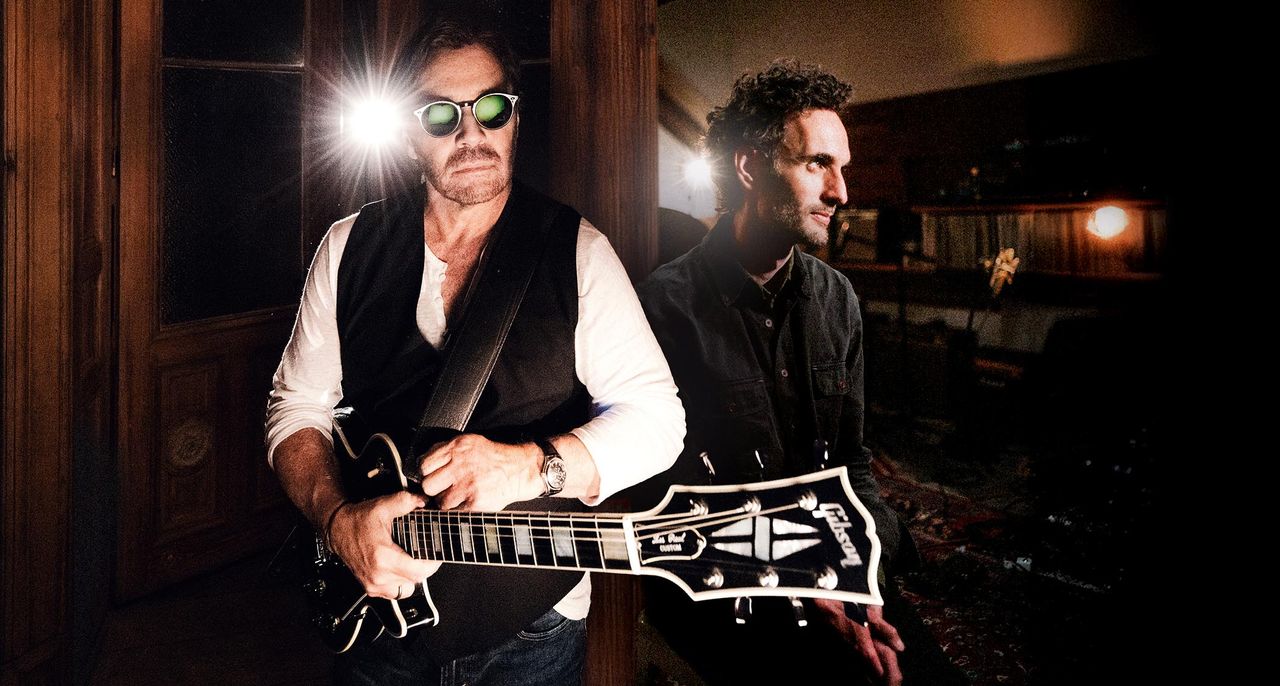
Fortunately, as pan-generational giants of US jazz, Al Di Meola and Julian Lage have long admired each other’s work, and while the 71-year-old Di Meola remains a New Jersey tough-guy with a palpable nostalgia for the old industry, offset by the 38-year-old Lage’s more abstract take on the craft and business, we’re soon off to the races.
All that’s left to do is run the dictaphone, tee up a hot topic – from YouTube shredders to the instrument’s next quantum leap – and catch the flying sparks.
Let’s start with the state of the art. There were once clearly defined new frontiers for guitar, from electric blues right through to shred and beyond. Do you still feel there’s a new frontier for the instrument?
Al Di Meola: Well, there seems to be a whole new generation of great players coming up. But as advanced as a lot of them are, I sometimes feel bad that they’re not in the glory days of the record industry any more. And as great of a record as they make, most of us won’t know about it.
You almost feel like, “Man, you missed out on the best ever,” y’know? The brilliance is unbelievable, but I can’t associate them with an album or piece of music. Unlike when we came up in the mid-’70s, when you’d think of Weather Report and then you’d think of Heavy Weather.
There’s more killers out there than ever before. I’m glad I’m not starting now! It’s a good thing I have a little bit of an accumulation of what could be a legacy, like, 30-something albums, and I’m like, “Okay, phew, I got that done.”
Julian Lage: I think you’re right. Granted, I don’t know what the best days of the recording industry were, and I do think it’s a different topography nowadays, [but] I think everything swings back and forth, y’know? I’m not expecting the record industry to go back to what it was, but the desire to take in music the way we all received it years ago – I think that’s coming back.
What would you say are the big obstacles for guitar players these days?
Di Meola: Here’s the big issue that doesn’t get talked about. Back then, before cellphones and computers, we practised way more. And it was way more focused on the songs. For instance, I made an album about 15 years ago at the Power Station in New York. And I noticed, as soon as we were done with the track, which was killer, everybody ran out in the hallway.
Now, back in the day, everybody would run into the control room to hear their performance. But everybody was on their phone, like, networking, y’know? And I said, “This is not right.” We went as far as to tell the receptionist to hold all calls.
That phone is always right there, within arm’s length. We got addicted to something that we can’t break. But back in the time when we didn’t need it because it didn’t exist, our focus on our work was phenomenal. Like when I did The Guitar Trio with John McLaughlin and Paco de Lucía: the first tour, we were in our hotel rooms practising for the show that night because we knew we had to be up on our game.
There was no “let me check my phone”. And when I listen to those records, I cannot do what the hell I did back then now. Not that I want to, by the way. Velocity isn’t my number one desire. I’ve been devoting more time to composing.
Is it more helpful to have constraints or freedom when you’re creating music?
My record company gave me, on my last record, as much time as I wanted. And I went, “Boy, that’s a good thing and a bad thing”
Julian Lage
Di Meola: My record company gave me, on my last record, as much time as I wanted. And I went, “Boy, that’s a good thing and a bad thing.” Because in the days when they had deadlines for shipments, you had to be done no matter what. In a way, it was good to have that pressure. Otherwise, you start experimenting, doing so many different things, and then you go, “Wait, let me listen to those early takes” – and you already had it.
Lage: I’ve never made a record in more than a few days, ever in my life. It’s always been one or two days, or three days if you really have a big budget and everyone’s available. But I have re-made records. I once made a two-day record, and a month later I realised I wasn’t happy with it – I changed everything about it, and I did another two days. But my perception of what’s a limiting or liberating factor isn’t always accurate.
I can see a situation presenting all these challenges, then in retrospect I look back and realise I had complete freedom. And vice versa: there have been times when I thought, “I have all this freedom, why am I not getting anything I like?” So I can’t say I’m the most solid barometer of what’s helping me and what’s limiting me.
Di Meola: The barometer, Julian, is when you record something, and you want to hear it over and over. I recorded a whole record called The Infinite Desire [1998] and at the end I just didn’t feel like hearing it. So I wound up re-recording the whole record. It took a lot of guts, it took some extra money, whatever, but I gotta like what I do. Then again, I am talking about a different time with better budgets than what we see on our horizon, which is like, “Holy shit.” It looks massively different now.
Guitar virtuosity can be a double-edged sword. What does it mean to you, in its most positive and negative sense?
Di Meola: It’s a balance, man. It’s the variety. It’s the ingredients you put in the soup. If it’s all velocity, it’s overkill. Not that I haven’t been accused of that a few times. But it should be a story within a story. Velocity for velocity’s sake is not the key.
It’s about the lines you play and how they meet one another. There was a big emphasis on velocity back in the ’70s. It was insane, but luckily I was with Chick Corea and playing some meaty compositions in the context of displaying whatever youthful velocity I had at the time.
You need a composition. There’s no two ways about it. If a guy’s only playing licks, they might be phenomenal licks, but what’s it pertaining to? So I have, over the years, been paying less attention to technique and more to developing as a composer because that’s what keeps the attention of the audience. Soloing is an aspect of it, but that’s not going to hold many in the audience.
The worst thing in the world is if you hear [an ambitious part] in your head and it comes out sloppy. So that’s where the ability to play technically – at the moment you hear it in your head – is important. Because there’s nothing worse than sloppy.
What’s your take on the virtuosity debate, Julian?
I hear Julian Bream, and I think that’s the mastery level I dream of
Julian Lage
Lage: I feel the same way about that balance, y’know? My definition of virtuosity has definitely changed over the years. I think, especially in my generation, there’s often a coyness about virtuosity.
Like, you might have the ability to do it, but you don’t because that would be too forward or something. And I’ve had some pitfalls, where I maybe had the ability to play something but didn’t do it at a moment when it would actually have been good for the music. I’ve definitely shifted my perspective on that. Anybody who’s in service of the music, with whatever skills they have at their disposal, I think they’re using it responsibly and beautifully.
And as Al said, it’s as much about space as it is about velocity or density or harmonic complexity, or whatever it might be. You know, I hear Julian Bream, and I think that’s the mastery level I dream of. Or I think Jim Hall is one of the great virtuosos. He was so self-effacing and maybe never thought of himself as ‘that player’, but his mastery over space and time, you can’t tell me that’s not the highest level of virtuosity.
But I don’t think there’s anything offensive about a kind of rudderless virtuosity, either. I just don’t think it does anything for you as a player.
How do you stay in touch with the spirit of music when you play, rather than just mechanically operating the guitar?
Lage: I come from a couple of different traditions of players that really celebrate the kind of kinaesthetic experience of playing the guitar. You think of someone like Derek Bailey, or even Fripp, for that matter. Y’know, players who create sound with an instrument using their gestures, but in an unusual way, and there’s something that feels good about it.
I’ve just never been someone who’s good at warm-ups or ratcheting things up to a certain level. I’m rather rough around the edges in those respects, to be honest. But I play a lot of guitar, and things show up. After an hour of playing, I feel different than after 10 minutes, and different again than after four hours of playing.
If something’s still not coming together, I’ll take a moment and work on it. But not too much. When I was younger, I practised maniacally – and it was good, but I could hear in my own playing, especially on the bandstand, that I was someone who practised a lot, and that was a different thing than the players I was looking up to, who just kind of emanated this thing.
So I made a decision to kind of chill out a little bit, so it didn’t sound like I was preparing all day for something. If I played different music that required it, that would be different. But I’m involved in group improvisation music and songs that are more from the Americana tradition. It’s a different swagger.
You both have a love and appreciation for the acoustic guitar. What do you get from that instrument that you don’t get from the electric?
Di Meola: Well, rhythm is one. The way I’d approach playing rhythm on acoustic guitar is different than with an electric. Electric is more of a voice; it’s like a singer, there’s more lyrical possibilities that you don’t have with an acoustic. But the nature of my compositions signal the necessity of playing with my nylon Spanish guitar because there’s a lot of arpeggiated, rhythmic, syncopated things.
Plus, in some ways, I’ve exhausted the louder electric days. Even though I’m trying to keep it alive, my tendencies over the last 30 years have been going more and more for this acoustic ensemble. Whether it’s a trio or quartet or quintet, it’s just the way it’s gone due to aging and maturity. And the music has gotten deeper as a result.
I’d watch Paco. Not even a spare guitar. He had his cigarettes in his suitcase, one shirt for a tour. One!
Al Di Meola
I feel like I’m more and more into the acoustic camp overall. I got that bug back when I was playing with Paco. With my own band, we had 10 tons of equipment and we’d be rolling up these cases to the airport check-in counter, and they’d weigh it all and at the end they’d charge me $13,000 because it was so overweight.
I’d be crying sometimes, like, “Please, give us a break!” And then I’d watch Paco. Not even a spare guitar. He had his cigarettes in his suitcase, one shirt for a tour. One! I asked him: “Paco, how do you have one shirt?” One day, I caught him in the bathroom, and he had his shirt off and he was taping paper towels under his armpits. I said, “Why are you doing that?” And he said: “One shirt!”
What does the acoustic guitar mean to you, Julian?
Lage: I think of myself as an acoustic player first and foremost. Anything I’ve ever done on electric is kind of an extension of that same sound. But they are different. The electric basically implies that I’m playing with an ensemble, so my role is more one of orchestration – how I contribute to the sound and how I fit between the bass and the drums.
I always wanted to have that experience of an electric being this kind of unleashed voice. But it’s just not my constitution. I don’t like loud sounds
And acoustic is usually more something I would be doing if it was just me, and that is a bit more ‘Technicolor’, frankly. I hear such a wide range of frequencies because nothing’s covering it up. No other sound is there.
So, in my head, acoustic is the louder, more luscious sonic world, and the electric is a little more penned-in, but it kinda threads a needle through an ensemble. I always wanted to have that experience of an electric being this kind of unleashed voice. But it’s just not my constitution. I don’t like loud sounds. I don’t want to play loud.
Julian, you’ve just played in London at the Royal Festival Hall, and Al, you’ll play the Barbican in June. What does the city and its music scene mean to you?
Di Meola: I haven’t been to London in a good five years. So there’s a lot of anticipation for the show. I have a lot of reasons to love London. I once did a tribute record to The Beatles at Abbey Road, and that was one of the highlights of my career.
I felt like a five-year-old at Disney World. It was so great to be in the same environment and tell the engineer: “Pro Tools? No, no, no, I want to go 8-track analogue. Y’know, like the other group that recorded here?”
I once did a tribute record to The Beatles at Abbey Road, and that was one of the highlights of my career
Al Di Meola
I did three tracks and I was very happy with the sound. Like, “Wow, that studio really is something.” Then I went back to New York to try to finish it. But I couldn’t match it sonically, so I knew I had to go back.
But before I went back, I rented a house in the Hamptons to really focus on arranging the rest of the pieces. And it just so happens that my next-door neighbour was Paul McCartney. We got to talking, you know, but I never told him who I was. I had this fear that maybe he wouldn’t know me.
But the next year, I rented the house again and by then I had the finished product. And my wife said, “Why don’t you write him a little note about what The Beatles meant to you growing up?” So I stuck the note in the CD case, and when he pulled into the drive in his brown Rolls Royce, she said, “Go down there, give him the CD.” I said, “Oh no, I can’t.” She goes, “Give me that thing!” She runs down – and I was so impressed that she did that for me. It was just a beautiful memory that will live with me.
- Al Di Meola plays the Barbican in London on June 25. For more information on the guitarists’ latest projects and forthcoming tour dates, visit Al Di Meola and Julian Lage .
- This article first appeared in Guitarist . Subscribe and save .