
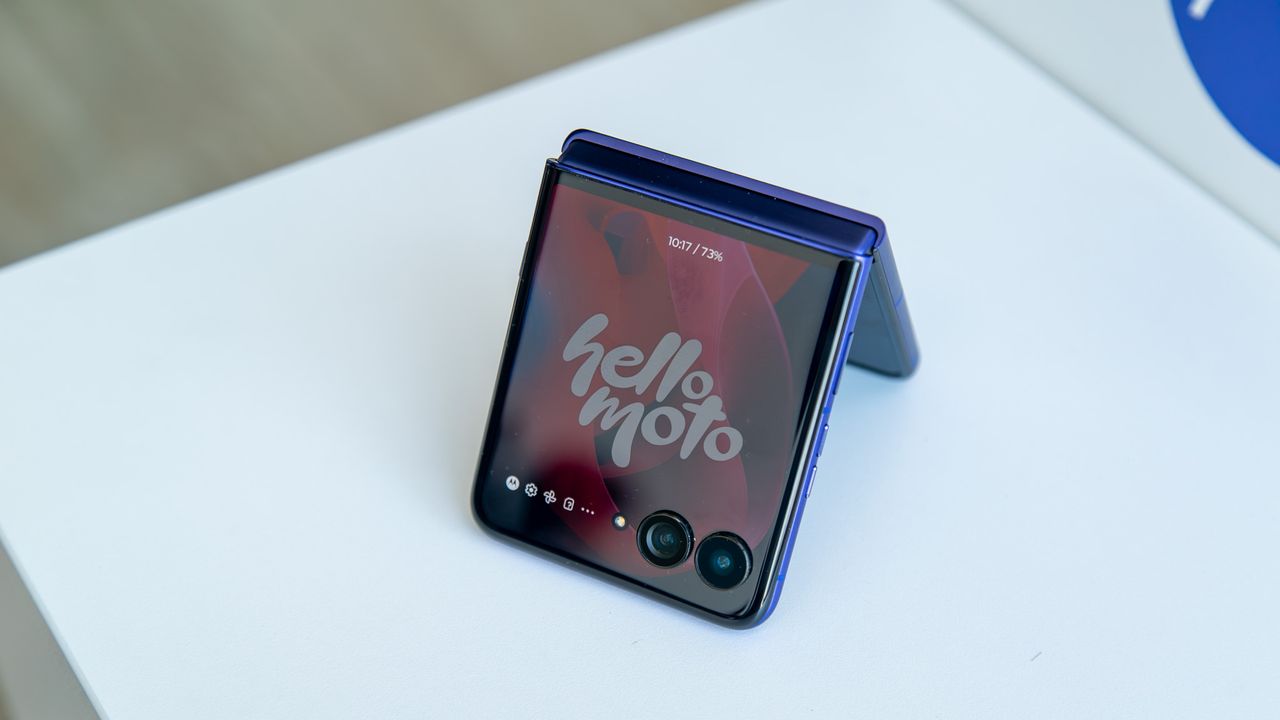
For years, Motorola did what Samsung couldn't — it offered flip phones with expansive and unrestricted cover screens complete with flagship-caliber specs. Flip phones are Motorola's thing, even with the Moto Fold on the way, and it showed. While Samsung might've been inclined to save its best tech for the Galaxy Z Fold or Galaxy S Ultra models, Motorola is incentivized to make the Razr lineup as good as it could be.
That culminated in the Motorola Razr Ultra 2025, a flagship flip phone in every sense of the term. It had Qualcomm's top-of-the-line Snapdragon 8 Elite mobile platform, 16GB of memory, and 512GB of storage. There were two high-quality OLED screens and a trio of 50MP cameras. The price point of $1,299 was high, but the Razr Ultra 2025 commanded it as the most powerful flip phone you could buy in the U.S.

Now, the Razr Ultra 2026 is here, and only some of that is still true. I want to be fair here, so I'll emphasize that a global component shortage is forcing costs to skyrocket industry-wide — this isn't exclusively a Motorola problem. However, the supply chain strains appear to have hit the Razr Ultra 2026 particularly hard. It's $200 more expensive than its already-pricey predecessor while lacking a new processor and major upgrades in general.
It has me wondering whether the better option would've been to skip the Razr Ultra entirely this year, because a $1,499 flip phone is a hard sell, regardless of the exact model or brand.
The Razr Ultra 2026's price is only half the problem

Rising component pricing are going to have some effect on consumers in 2026. The releases we've already seen so far, even excluding the latest from Motorola, is proof of that. Smartphone brands have taken various approaches to handling the market conditions. Samsung simply raised prices on the Galaxy S26 and the Galaxy S26 Plus this year, while Google chose to keep the Pixel 10a's $499 price point intact by reusing the same chip from last year.
Raising prices, making minimal upgrades, or skipping releases entirely are all ways of approaching the volatile market. Choosing one out of the three options is inevitable, but picking two is problematic. Motorola didn't just raise the price — it also reused the Qualcomm Snapdragon 8 Elite processor from the Razr Ultra 2025 in the Razr Ultra 2026.
To be clear, the Snapdragon 8 Elite processor carrying over to the Razr Ultra 2026 isn't the problem. Qualcomm's last-gen mobile platform is more than capable enough to power a flagship flip phone. The newer Snapdragon 8 Elite Gen 5 chip might not have made much of an impact, and due to the overheating concerns in the foldable form factor, Motorola might've had to underclock it anyway.
Motorola told us that the Snapdragon 8 Elite chip is still good enough for the Razr Ultra 2026 and that there were few reasons to upgrade to Snapdragon 8 Elite Gen 5 chip. Again, this makes complete sense. The troubling part is asking buyers to pay $200 more for the same chip that was in the Razr Ultra 2025 a year ago. It's a tough value proposition no matter how you sugarcoat it.
Motorola had other options besides a chip upgrade

The other thing worth noting is that Motorola could've tried to justify the Razr Ultra 2026's higher price by making other changes. I might've been able to give the Snapdragon 8 Elite chip a pass if, say, the Razr Ultra 2026 was thinner or lighter. Samsung is aggressively thinning and lightening its foldable phones, but the Razr Ultra 2026 matches the dimensions of its predecessor.
It's still 15.7mm thick and it still weighs 199 grams. The IP48 rating is solid, although Google set the new standard with IP68 on the Pixel 10 Pro Fold. The point is, there were upgrades to be made besides throwing in a new chip just for the sake of it. The Motorola Razr Ultra 2026 just doesn't make them.
I went hands-on with the Motorola Razr Ultra 2026, and to be clear, there are some changes I absolutely love about it. The new 50MP LOFIC (Lateral Overflow Integration Capacitor) primary shooter should improve dynamic range, add detail, and bring faster shutter speeds to the Razr Ultra 2026. Adopting a silicon-carbon 5,000mAh battery is a groundbreaking move that every other US smartphone brand should be watching closely.
There are improvements here, they just don't come close to justifying the $1,500 price point in my book.
Is the Motorola Razr Ultra 2026 worth the high price?

Motorola, in particular, is known for offering enticing discounts, trade-in deals, and promotions for its smartphones. I wouldn't be surprised if in a few weeks or months, the Razr Ultra 2026 is discounted by a couple hundred dollars, and Motorola is throwing in freebies like a smartwatch or earbuds for good measure. If that proves to be the case — which is unconfirmed at the moment — the value proposition around the Razr Ultra 2026 changes completely.
This is a "wait and see" launch for the Razr Ultra 2026. Once discounts and deals inevitably bring the Razr Ultra 2026 to the old $1,299 price point, the 512GB flip phone will feel like a competitive value again. Until then, $1,500 feels like too much to pay for a small foldable, especially when large models like the Galaxy Z Fold 7 and Pixel 10 Pro Fold are discounted to roughly the same price right now.
I don't blame Motorola for the Razr Ultra 2026's price problem. It's a reflection of market conditions more than anything else. Still, I wonder if one smartphone brand will have the courage to press pause on an annual release in the future. If there was ever a time for Motorola to take a gap year on releasing a new model, it would probably 2026 and the Razr Ultra.
Hopefully, the situation improves for 2027, and the Razr Ultra's price point can be lowered to where it belongs.
Coming soon
The Motorola Razr Ultra 2026 is available for pre-order May 14, with general availability to follow on May 21, 2026. The phone is very similar to its predecessor, down to the chip inside, but there are key upgrades. A new 50MP LOFIC sensor and a 5,000mAh silicon-carbon battery are the highlights.