
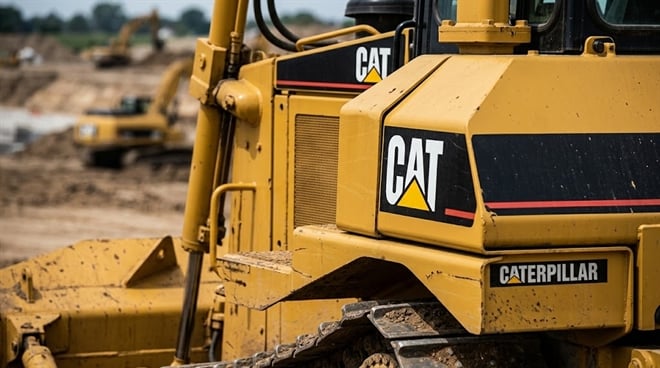
While the market's growth stories often center on software and digital platforms, a powerful and perhaps more durable trend is unfolding in heavy industry. The companies responsible for building the physical world are reaching unprecedented valuations as a significant market rotation into tangible assets gains momentum.
This shift has moved beyond a simple recovery narrative; it’s now driven by accelerating global spending on an expanded definition of infrastructure that includes both traditional projects and the digital backbone of the modern economy.

Caterpillar (NYSE: CAT) is a prime example of this industrial sector's resurgence. With Caterpillar’s stock price climbing about 40% year-to-date and hitting all-time highs, it has significantly outpaced the broader market averages. This performance signals that investors are increasingly rewarding businesses with strong, reliable cash flow and a direct role in constructing and powering global commerce.
For those watching the market, the long-term outlook for heavy machinery appears to be building on a new and remarkably solid foundation.
Performance in a World Under Construction
Sustained demand for Caterpillar's iconic yellow equipment is currently driven by two powerful, parallel economic forces. The first is a global push for infrastructure modernization. This includes not just the high-profile rebuilding of roads, bridges, and airports, but also the critical, less-visible work of upgrading electrical grids and water systems.
The second force is the strategic trend of industrial reshoring. As companies move manufacturing and supply chains back to North America and Europe to increase resilience, the demand for new factories, warehouses, and logistics hubs has created a long-term construction boom. These powerful macro-drivers translate directly into Caterpillar’s exceptional financial metrics, creating a clear link between real-world activity and stock performance.
This cause-and-effect relationship is clearly visible in Caterpillar’s recent results, painting a picture of operational strength:
-
Dominant market performance: Shares of CAT are currently trading just below their 52-week high of $820.20, reflecting over a 170% gain over the past 12 months. This momentum indicates investor confidence in Caterpillar’s strategic direction and its ability to execute.
-
Explosive earnings power: In its most recent quarterly report on Jan. 29, Caterpillar surpassed analyst expectations, reporting earnings per share of $5.16. This result was driven by a 17.9% year-over-year increase in revenue to $19.13 billion—a level of growth not always seen in a mature industrial giant.
-
Exceptional profitability: Caterpillar operates with remarkable efficiency, evidenced by a best-in-class return on equity of 45.76%. This key metric shows how effectively management is using shareholder capital to generate profits, which is a crucial indicator of a well-run company.
CAT’s High-Tech Growth Engine
Caterpillar's modern growth story extends beyond its traditional identity as a construction equipment manufacturer. Several forward-looking catalysts are positioning Caterpillar to capitalize on high-growth industries, directly linking its future success to the evolution of the digital and automated economy.
The most significant of these new drivers is Caterpillar’s Energy and Transportation segment. This division has become a critical supplier of essential backup power generation systems for artificial intelligence (AI) data centers. These massive facilities consume enormous amounts of electricity and require uninterrupted power to function, making industrial-scale generators a mission-critical component. As global AI computing power demand explodes, so too does the need for reliable energy, placing Caterpillar at the very center of the digital infrastructure build-out.
Simultaneously, Caterpillar is making a strategic pivot toward automation and technology-integrated solutions. The recent acquisition of a self-driving tractor startup is a clear signal of this shift. This move is not just about futuristic technology; it's a calculated entry into the higher-margin world of recurring software revenue. By equipping its machines with autonomous capabilities, Caterpillar can transition from one-time equipment sales to long-term service and software subscriptions, boosting customer efficiency and creating a more predictable revenue stream.
This forward-looking growth story is complemented by a deeply rooted commitment to direct capital returns to shareholders, reinforcing its appeal to long-term investors.
-
A member of the Dividend Aristocrats, Caterpillar's ironclad 30-year track record of consecutive dividend increases underscores its status as a reliable dividend compounder that rewards investors across economic cycles.
-
The company's current annual dividend of $6.04 per share is well-supported by a conservative payout ratio of 32.09%, indicating that the dividend is not only safe but has ample room for future growth.
-
An active $20 billion share buyback program approved in mid-2024 continues to reduce the number of shares outstanding, which mechanically increases the value of the remaining shares over time.
Weighing the Opportunity in a Market Leader
The evidence suggests that Caterpillar has successfully evolved from a purely cyclical industrial company into a diversified infrastructure and energy technology leader. Its impressive performance validates the underlying strength of the physical economy and showcases its strategic ability to adapt to new, high-growth sources of demand.
This transformation is increasingly recognized by market experts. While the consensus rating from 24 analysts is a Moderate Buy, recent price target upgrades from major firms such as Truist ($920) and Jeffries ($900) suggest that significant upside could still remain. These targets reflect growing confidence in the durability of the data center and reshoring trends as long-term revenue drivers.
For investors who are considering shares of CAT for their portfolios, it's important to weigh the complete picture. The stock’s beta of 1.52 indicates it has historically been more volatile than the overall market, and its business is still tied to the health of the global economy. However, this risk appears balanced by Caterpillar's powerful operational cash flow and its strategic positioning in sectors with secular tailwinds.
Those looking to add exposure to the industrial economy should recognize Caterpillar’s blend of growth catalysts and shareholder returns, which together present a compelling case. Cautious investors may prefer to monitor the stock for a potential pullback before initiating a position, while those with higher risk tolerances might see the current momentum as a signal of ongoing strength.
Where Should You Invest $1,000 Right Now?
Before you make your next trade, you'll want to hear this.
MarketBeat keeps track of Wall Street's top-rated and best performing research analysts and the stocks they recommend to their clients on a daily basis.
Our team has identified the five stocks that top analysts are quietly whispering to their clients to buy now before the broader market catches on... and none of the big name stocks were on the list.
They believe these five stocks are the five best companies for investors to buy now...
The article "More Than Just Dirt: Caterpillar Is the AI Stock Nobody Saw Coming" first appeared on MarketBeat.