
The Ohio Bangladesh telephonic wedding case I blogged about below mentioned "Mohammedan law," which struck me as unusual and archaic; and indeed a Google Ngrams search supports this. You can right-click on the image below and select "Open Image in New Tab" (or whatever your browser calls that) to enlarge, but basically the red line is for "Islamic law," the dark blue is for "Sharia law," and the light blue is for "Mohammedan law," which started in the lead around 1920 but is now very uncommon. ("Mahometan law" and "Mahomedan law," as you might gather, are even more unusual; "Muhammadan law" is about as rare as "Mohammedan law.")
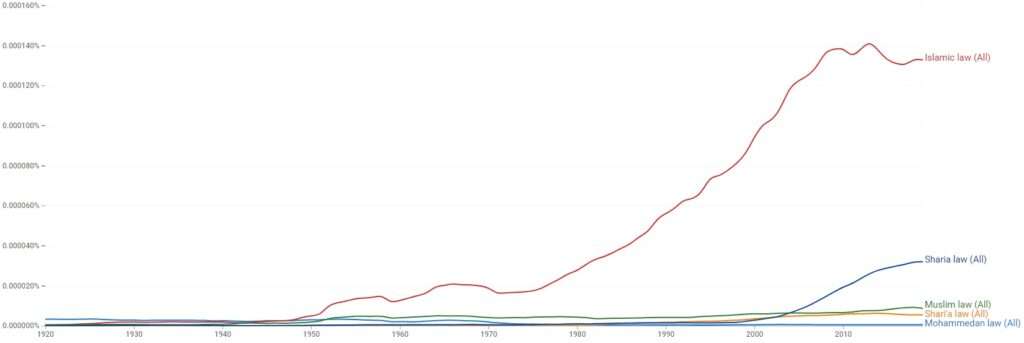
There's nothing, of course, inherently derogatory about naming religious law after a prophet rather than after the formal name of the religion or of the religious law within the religion—portions of Jewish law, for instance, have historically been called "Mosaic law." But it's no longer customary, much as it's no longer customary to use "Hebrew" to refer to Jews as an ethnic group or a religion, though it was once quite normal, and is still reflected in the names of some synagogues and organizations, such as HIAS (Hebrew Immigrant Aid Society). And when such terms become archaic enough, people who hear them might wonder, "What does he mean by that?," even in the absence of specific reason to think they are pejorative.













