KEY POINTS
- Australia seeks more evidence from Israel over UNRWA allegations
- Israeli Air Force says 'hundreds' of aircraft ready to respond should Hezbollah wage all-out war
- IDF says it targeted Hezbollah commander in drone strike that killed at least 3

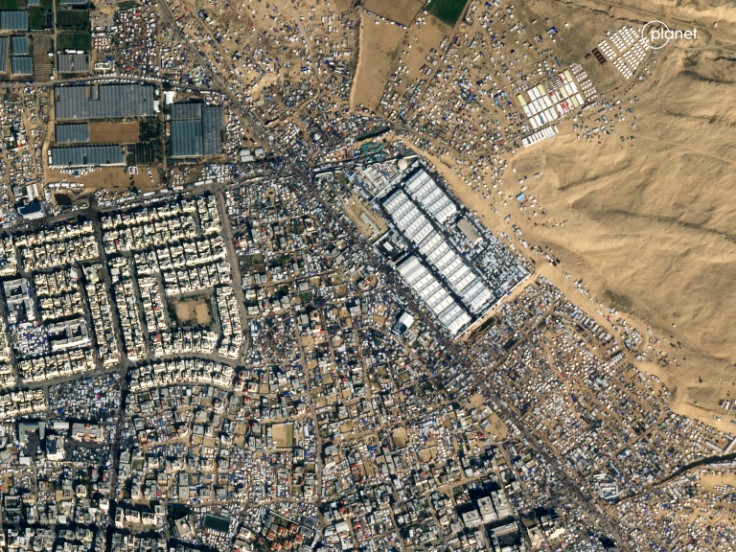
The war in Gaza has entered its 126th day, and cracks are starting to show in the stalwart U.S.-Israel alliance as the White House expressed opposition to an Israeli military campaign in Rafah, saying it would be a "disaster" for over a million civilians in the overcrowded southern Gaza city. The international community remains concerned about tensions in the Middle East as Iranian-backed Houthis refuse to halt attacks on Red Sea ships.
In one of his most significant rebukes of the Israel Defense Forces' (IDF) military campaign in Gaza, U.S. President Joe Biden said he deems the offensive has been "over the top." His comments come as the Israeli army's ground forces move toward Rafah, a city in southern Gaza where thousands of civilians have sought shelter since the war started.
- Meta suspends Facebook, Instagram accounts of Iran's Supreme Leader
- Israel intercepts suspicious target over northern Israeli port city of Haifa: Local media
- Protesters gather at Nitzana crossing in call to block Gaza aid until hostages freed
- Iranian militias reportedly moving weapons to Syrian-Lebanese border
- Israel reportedly conducting strikes in Damascus vicinity: Arab media
Fighting also continues in the Israeli-Lebanese border. Hassan Nasrallah, the leader of Hamas ally and Iran-backed Hezbollah, claimed early Friday that the heavily armed terror group attacked the Israeli army's Biranit barracks in northern Israel.
The U.S. Central Command (CENTCOM) on Thursday conducted new "self-defense" strikes targeting unmanned surface vessels (USVs) and missiles belonging to the Yemeni Houthi rebel militia.
Back in Gaza, the loved ones of 136 hostages still being held in Gaza pile pressure on Israeli Prime Minister Benjamin Netanyahu and the international community to free the remaining abductees, of which 31 have died in captivity.
Netanyahu has rejected a ceasefire plan by Hamas, diminishing hopes for truce negotiations to proceed. His unwavering rejection of Hamas' demand to completely withdraw IDF troops from Gaza as a means of ending the war draws from the violent Israeli-Palestinian conflict that has dragged on for decades.
The deep-rooted conflict erupted on Oct. 7, when Hamas operatives conducted a shock invasion in Israel, murdering more than 1,200 people and dragging some 240 hostages into the Gaza Strip.
UNICEF urges restraint in Rafah, notes 'indiscriminate effects' of military operations
The UN's children's agency, UNICEF, has called on "all parties to the conflict" to refrain from engaging in fighting in Rafah, an overcrowded city in southern Gaza where thousands of displaced Gaza civilians are sheltering.
UNICEF executive director Catherine Russell in a statement appealed on the warring sides to "refrain from military escalation" in the city, saying there are over 600,000 displaced children and their families.
"Military operations in densely populated residential areas can have indiscriminate effects," she warned." She also noted the importance of "taking the utmost care to spare civilians" and meet the essential needs of the Rafah masses.