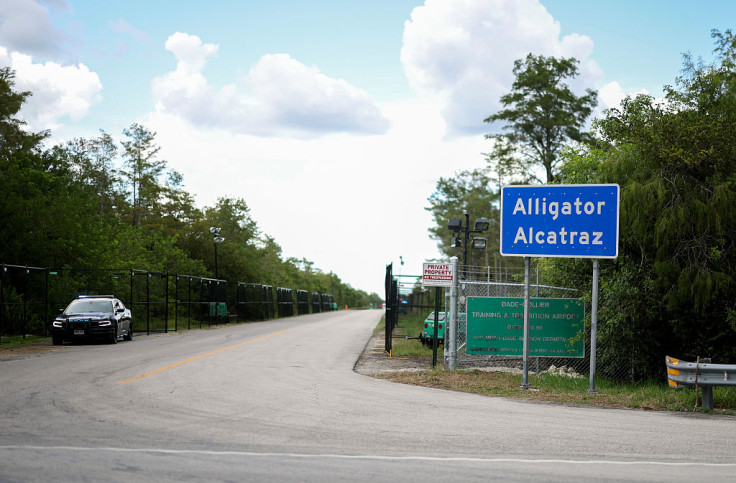
MIAMI - The authorities of Miami-Dade County have officially regained control of the Dade-Collier Training and Transition Airport, ending the state of Florida's temporary use of the remote Everglades property as the immigration detention center known as "Alligator Alcatraz."
Mayor Daniella Levine Cava announced the handover this week, calling it an "important turning point" for Miami-Dade and the Everglades and renewing her push to permanently protect the nearly 25,000-acre property rather than allow another major development there.
"From the beginning, I have said this facility should never have been built," Levine Cava said. "Now, we have a real opportunity to turn the page, permanently protect this land, and restore it as part of the greater Everglades ecosystem for generations to come."
The return comes roughly six weeks after Florida shut down the controversial detention center. In late June, companies hired to operate the facility were instructed to begin a "full demobilization," bringing the project to an end after about a year of operation. Gov. Ron DeSantis subsequently confirmed the facility had closed, saying it had served its purpose.
Today marks an important turning point for Miami-Dade County and the Everglades. We have officially regained control of the Dade-Collier Training and Transition Airport property, the former site of "Alligator Alcatraz."
— Daniella Levine Cava (@MayorDaniella) August 11, 2026
From the beginning, I have said this facility should never… pic.twitter.com/4k7E9rEfZt
The state had taken control of the county-owned airport in June 2025 using emergency powers after Miami-Dade resisted Florida's attempt to purchase the property for $20 million. The DeSantis administration rapidly transformed the airfield into a detention complex designed to support President Donald Trump's mass-deportation campaign.
But the property's history shows that "Alligator Alcatraz" was only the latest in a series of dramatically different ideas for one of South Florida's most unusual pieces of public land.
The site began life in 1968 as the Everglades Jetport, an extraordinarily ambitious plan for what was envisioned as the world's largest airport. Developers imagined a large aviation complex with six runways, highways, and other infrastructure capable of serving the emerging generation of supersonic passenger jets.
After the first runway was completed, construction halted, as the project sparked fierce opposition from environmentalists, scientists and residents concerned about its potential effects on the Everglades and Big Cypress. A landmark 1969 environmental study warned that development associated with the jetport could irreversibly damage South Florida's ecosystem. The National Park Service describes the report as Florida's first environmental impact study.
The battle helped produce the 1970 Everglades Jetport Pact, which halted further construction. The surviving runway was instead allowed to remain for limited aviation training. Four years later, President Gerald Ford established Big Cypress National Preserve, surrounding much of the airport property with federally protected land.
The abandoned megaproject eventually became the Dade-Collier Training and Transition Airport, or TNT.
For decades, its 10,499-foot runway served a far less disruptive purpose: pilot training.
Then came its most radical transformation.
In June 2025, Florida commandeered the airport and began constructing the immigration detention facility that state officials dubbed "Alligator Alcatraz." The state initially envisioned capacity for thousands of detainees and estimated operating costs that could reach hundreds of millions of dollars annually, with Florida seeking federal reimbursement.
The facility opened in July 2025 and almost immediately became the subject of lawsuits, protests and disputes over detainee conditions, environmental protections, government spending and who actually controlled its operations.
Environmental groups and the Miccosukee Tribe challenged construction in federal court, arguing that transforming the airport into a detention complex threatened the sensitive Everglades ecosystem and should have undergone federal environmental review.
By June 2026, however, Florida was preparing to abandon the facility. Its closure revived a much older question: What should ultimately happen to Dade-Collier?
Levine Cava has already proposed an answer.
Before the property was formally returned, her administration announced plans to pursue transferring county-controlled land at Dade-Collier to the National Park Service or other authorized Everglades restoration partners for permanent conservation.