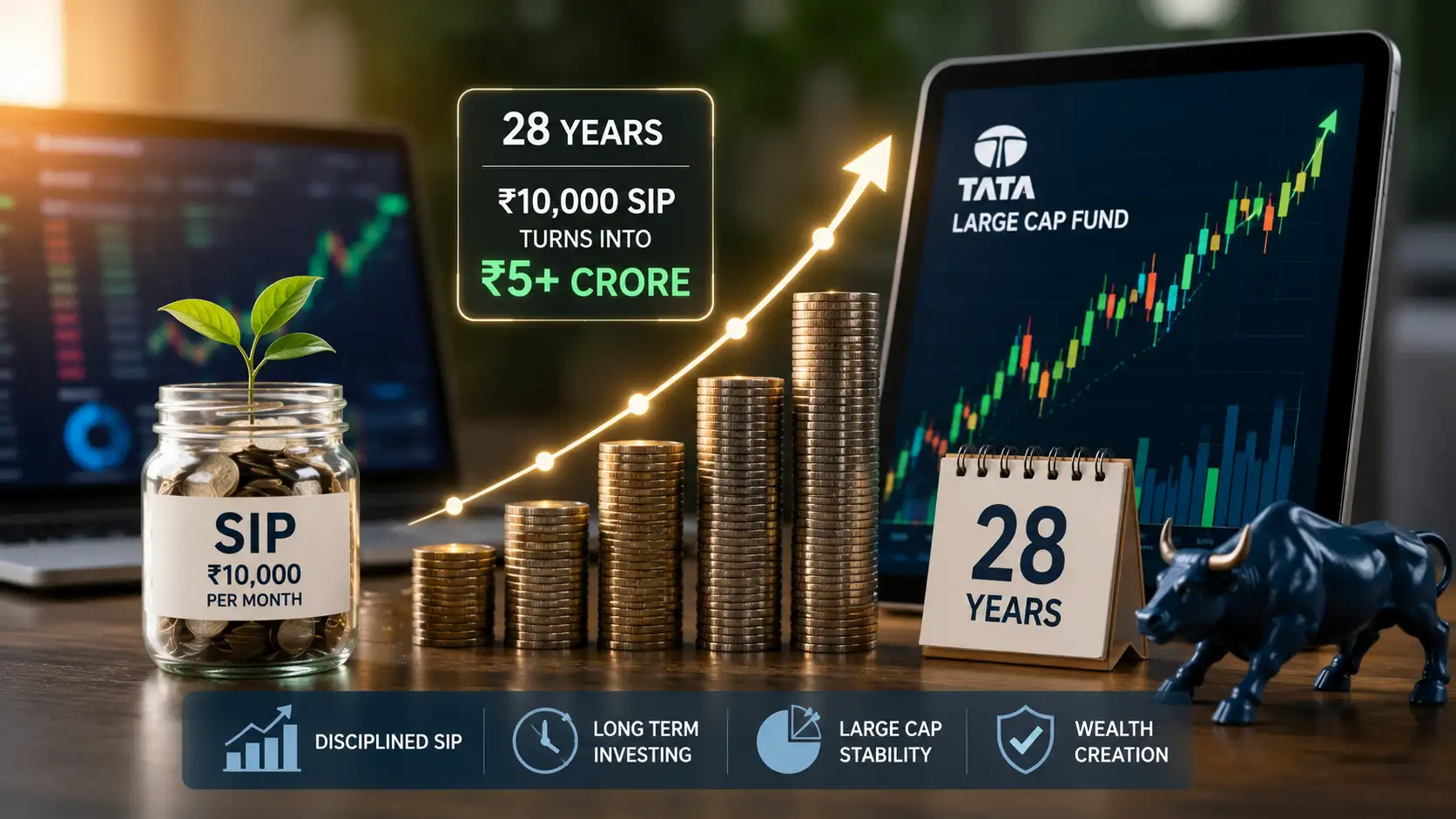
Tata Large Cap Fund turned Rs 10,000 monthly SIP to Rs 5.27 crore in the last 28 years since its inception, an analysis by ETMutualFunds showed.
Launched on May 7, 1998, this large cap fund has completed 28 years recently and is given four star rating by Value Research and three star rating by Morningstar.
Also Read | Rajeev Thakkar and Sankaran Naren see value in IT despite AI disruption concerns
If an investor invested Rs 10,000 in this fund through SIP in the last 10 years, the current value would have been Rs 22.37 lakh with an XIRR of 12.11%. If the investor made the same SIP investment seven years ago, the value would have been Rs 13.12 lakh now with an XIRR of 12.75%.
This large cap fund also turned the lumpsum investment of Rs 1 lakh to Rs 1.09 crore since its inception with a CAGR of 18.25%.
A lumpsum investment made 10 years would have been Rs 3.17 lakh with a CAGR of 12.24%. The similar investment made seven years ago would have been Rs 2.34 lakh now with a CAGR of 12.7%. In the last five years and three years, the value of the same lumpsum investment would have been Rs 1.78 lakh ( 12.23%) and 1.44 lakh (13.07%).
What fund manager say on this large cap fundAbhinav Sharma, Fund Manager: This sustained performance is driven by its disciplined GARP (Growth at a Reasonable Price) investment approach, which provides the fund manager with the flexibility to adapt the portfolio to varying business cycles while avoiding valuation extremes.
The strategy ensures downside protection during market corrections and enables consistent performance across market environments, ultimately resulting in superior long-term outcomes and an enhanced investor experience.
How the expert analyse the performanceShivam Pathak, CFP and Founder of Asset Elixir analysed the performance and told ETMutualFunds that the long-term performance of the Tata Large Cap Fund has been driven by its disciplined bottom-up approach, focus on fundamentally strong large-cap companies, and high-conviction portfolio positioning. Consistent exposure to quality businesses with strong management and reasonable valuations has helped the fund perform across market cycles.
Based on the trailing returns, the fund has managed to outperform its category average and benchmark across all horizons except in the last 10 years. In the last three months, the fund lost 3.55% compared to a loss of 4.20% by the benchmark and a loss of 3.60% as the category average. In the last six months, the fund lost 2.62% compared to a loss of 3.54% by the benchmark and 3.57% as the category average.
In the last one year, the fund delivered a return of 4.18% compared to 3.11% by the benchmark and 2.61% as the category average. The fund posted a return of 13.20% in the last three years compared to 12.79% by the benchmark and 12.87% as the category average.
This large cap fund posted a return of 12.39% in the last five years compared to 12.09% by the benchmark and 11.67% as the category average. The fund delivered a return of 12.40% in the last 10 years against 13.67% by the benchmark and 12.49% as the category average. Since its inception, the fund delivered a CAGR of 18.26%.
Also Read | Navneet Munot, Nilesh Shah, and Kalpen Parekh caution investors against chasing unrealistic returns
According to a report by Motilal Oswal Financial Services, the Nifty-50’s one-year forward P/E stood at 19.1x, 9% below its long-period average (LPA) of 21x.
Being a large cap fund, the fund holds 84.83% in large caps, 6.89% in mid caps, 3.37% in others, and 4.91% in small caps. In comparison to the large cap category, the fund is overweight on small caps.
Can large caps still generate meaningful wealth?Pathak said that yes, large-cap funds can still create meaningful long-term wealth, especially for investors seeking stability with lower volatility and after recent corrections, valuations in parts of the large-cap space have become relatively reasonable, making SIP-based investing attractive.
Risk ratio parameters of fundThe PE and PBV ratio of the large fund were recorded at 31.39 times and 5.44 times respectively whereas the dividend yield ratio was recorded at 1.24 times as of March 2026.
ETMutualFunds analysed the other key ratios of the fund in a three year period. Based on the last three years, the scheme has offered a Treynor ratio of 0.88 and an alpha of 0.03. The sortino ratio of the scheme was recorded at 0.42.
The return due to net selectivity was recorded at 0.02 and return due to improper diversification was recorded at 0.01 in the last three years.
Market experts have been recommending flexi cap funds as they have the option to invest across market capitalisation based on the market scenario. So are large caps better than flexi caps?
Pathak said that large-cap funds offer relatively stable exposure through established businesses. Flexi-cap funds provide greater flexibility across market caps, while index funds are low-cost passive options suitable for long-term investing. A balanced mix can work well for portfolios.
Other large caps and way aheadAround 23 large caps completed 10 years of existence in the market including Tata Large Cap Fund, of which Nippon India Large Cap Fund gave the highest return of 15.13%. ICICI Pru Large Cap Fund, the largest large cap fund based on the assets managed, delivered 14.47% in the last 10 years.
Also Read | Parag Parikh Flexi Cap Fund increase stake ITC, TCS, HDFC Bank and 14 other stocks in April
PGIM India Large Cap Fund delivered the lowest return of around 10.56% in the last 10 years.
Pathak said that the outlook on large caps remains constructive due to better earnings visibility, stronger balance sheets, and relatively better valuation comfort. While returns may be moderate compared to mid and small caps, they are expected to provide stability and consistent compounding over the long term.
One should always consider risk appetite, investment horizon, and goals before making any investment decisions.
(Disclaimer: Recommendations, suggestions, views and opinions given by the experts are their own. These do not represent the views of The Economic Times)
If you have any mutual fund queries, message on ET Mutual Funds on Facebook/Twitter. We will get it answered by our panel of experts. Do share your questions on ETMFqueries@timesinternet.in alongwith your age, risk profile, and Twitter handle