Get all your news in one place.
100's of premium titles.
One app.
Start reading
The Economic Times
The Economic Times
Surbhi Khanna

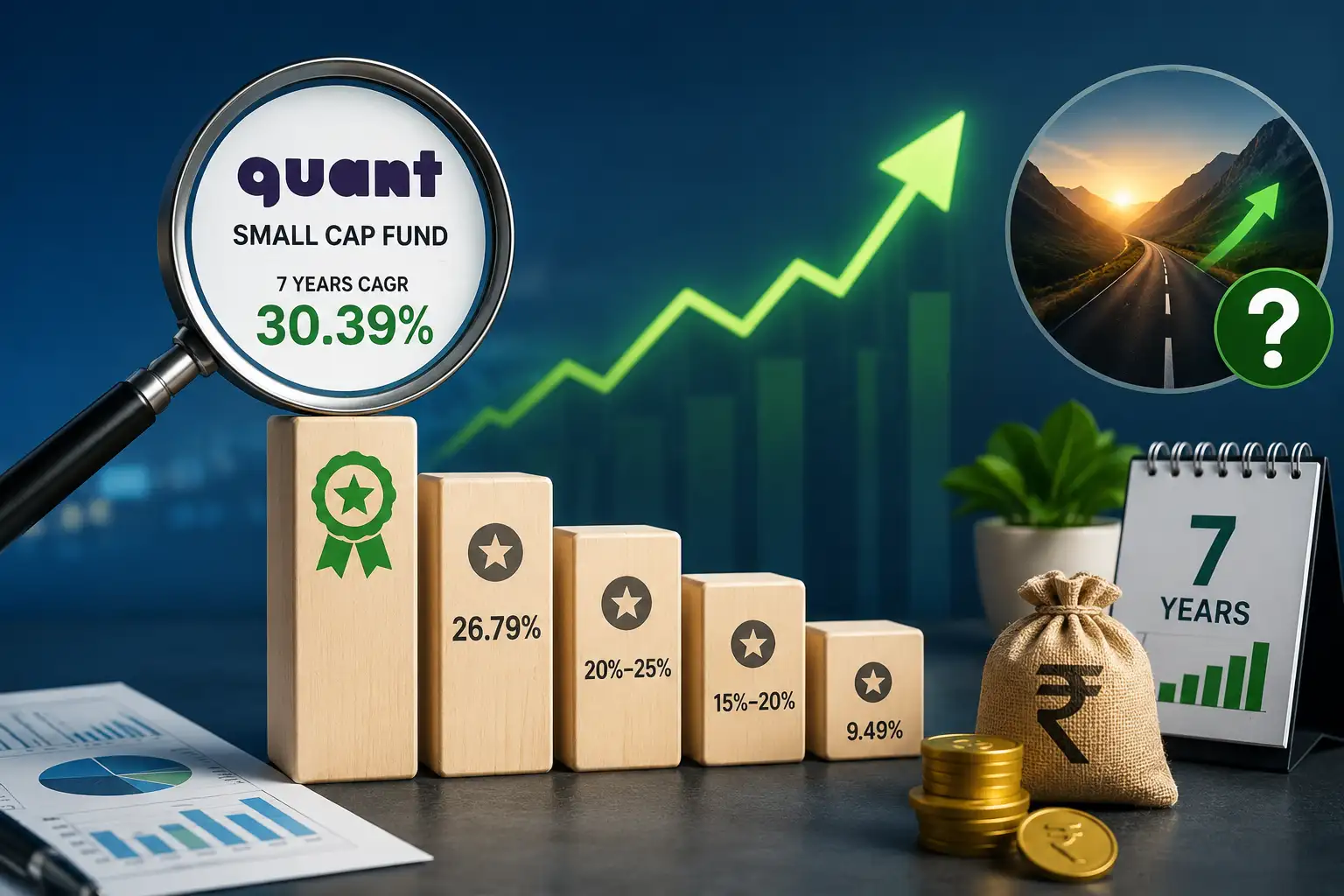
MF Tracker: Quant Small Cap Fund outshines peers in 7 years with over 30% CAGR. Is the rally sustainable?

Quant Small Cap Fund (formerly known as Quant Income Fund), the largest fund managed by Quant Mutual Fund, offered the highest CAGR in the last seven years of around 30.73% among all equity mutual funds excluding sectoral and thematic funds. There were around 185 funds in the mentioned time period, of which this small cap fund outshined.

Launched on October 16, 1996, the scheme is given four star rating by ValueResearch and Morningstar both.

Based on trailing returns, the scheme has managed to outperform its benchmark and category average across all horizons. In the last three months, the small cap fund delivered a return of 18.53% compared to 15.15% by the benchmark and 15.40% as the category average.

Also Read | Sunil Singhania-backed Abakkus Flexi Cap Fund exits Vedanta group companies after demerger and 1 more

The fund posted a gain of 16.56% in the last six months against 12.02% by the benchmark and 13.83% as the category average. In the last one year, the fund posted a gain of 9.21% against 2.57% by the benchmark and 7.35% as the category average.

In the last three years, the scheme offered 20.61% return compared to 19.75% return by the benchmark and 17.97% as the small cap category average. In the last five years, it delivered 19.03% return against 16.55% by the benchmark and 16.78% as the category average.

In the last seven years, the scheme offered 30.73% return compared to 21.26% by the benchmark and 22.22% as the small cap category average.

The fund posted a gain of 20.03% in the last 10 years compared to 15.47% by the benchmark and 16.99% as the category average. Since its inception, the fund has posted a CAGR of 12.38%.

Note, the trailing returns delivered by the scheme in the last seven years were the highest compared to its peers.

How does an expert decode performance?

Rajesh Minocha, a Certified Financial Planner (CFP), Founder of Financial Radiance analysed the performance and told ETMutualFunds that Quant’s outperformance is primarily driven by its high-conviction, actively managed investment strategy, including timely sector shifts and stock rotations.

Minocha further said that Quant’s funds have very high churn and very few stocks; only investors who are comfortable with a long-term horizon should consider them. Overall, strong fund management and supportive market conditions have both contributed to these results. The calls can go wrong, and one should not invest based solely on past returns, as the downside can also be very significant in the short term.

Based on yearly returns for the last 10-years, the scheme has offered a negative return in 2019 of around 23.51%. Note, in 2018 mutual fund recategorisation was done by Sebi. In 2025 the fund delivered negative returns.

In the calendar year 2020, 2021, 2022, the fund offered the highest return among all small cap funds. The fund offered 75.10%, 88.05%, and 9.50% in 2020, 2021, and 2022, respectively.

Also Read | Mutual fund SIP stoppage ratio slows to 91% in June as new SIP registrations outpace closures

An investor with a monthly SIP of Rs 10,000 invested in the fund at the time of its inception would have been 4.84 crore now with an XIRR of 14.48%. A lumpsum investment of Rs 1 lakh made in the fund at the time of its inception would have been Rs 32.19 lakh now with a CAGR of 12.37%.

Continue investing or rebalance portfolios?

Minocha said that investors should continue SIPs if the fund aligns with their asset allocation and long-term goals and rebalance only if recent gains have increased your small-cap allocation beyond your target, rather than reacting to short-term performance.

The small cap fund had 87.87% in equity, 1.35% in debt, and 10.79% in others as on June 31, 2026. In comparison to the small cap category, the scheme is overweight on debt and others and underweight on equity. The category on an average had 93.99% in equity, 0.33 in debt and 5.68% in others.

Being a small cap fund, the scheme invests 14.70% in large caps, 9.07% in mid caps, 12.13% in others and 64.10% in small caps.

The PE and PBV ratio of the small cap fund were recorded at 53.20 times and 5.53 times respectively whereas the dividend yield ratio was recorded at 0.53 times as of June 2026.

ETMutualFunds analysed the other key ratios of the fund in a three year period. Based on the last three years, the scheme has offered a Treynor ratio of 1.66 and an alpha of 0.20. The sortino ratio of the scheme was recorded at 0.54.

The return due to net selectivity was recorded at 0.13 and return due to improper diversification was recorded at 0.07 in the last three years.

According to a market outlook by another fund house, the valuation premium of small caps vs large caps has meaningfully corrected; it has come down to ~18.3% in May 2026 from a high of nearly 21% in June 2025.

Should you invest in small caps now or wait for better valuations?

Minocha said that long-term investors can start a SIP without waiting for the ideal entry point, as market timing is rarely precise and SIPs help average out market volatility.

Given current valuations, consider starting with a moderate allocation and gradually increasing exposure if the market corrects and those not comfortable taking such a high risk by investing in small caps can take a calculated exposure through multi-cap funds that have a minimum 25% allocation to small caps, Minocha further said.

The investment style of the fund is to invest in growth oriented stocks in small cap market capitalisation.

Also Read | Why investors are pouring money into midcap and smallcap mutual funds again

Small caps with 7 year record

Apart from Quant Small Cap Fund, there are 18 funds in the category that have a seven year record. Bank of India Small Cap Fund offered a return of around 27.09%, followed by Nippon India Small Cap Fund which gave 24.97% return.

Aditya Birla Sun Life Small Cap Fund delivered the lowest return of 16.84% in the last seven years.

With many small cap funds available in the market and Quant Small Cap Fund offering good returns, Minocha said that for most investors, allocating 8 to 10% of the equity portion to small caps is sufficient. While small caps offer significant long-term growth potential, they are also highly volatile. They should complement a diversified portfolio rather than serve as its core.

One should always choose a scheme based on risk appetite, investment horizon, and goals.

(Disclaimer: Recommendations, suggestions, views and opinions given by the experts are their own. These do not represent the views of The Economic Times)

If you have any mutual fund queries, message on ET Mutual Funds on Facebook/Twitter. We will get it answered by our panel of experts. Do share your questions on ETMFqueries@timesinternet.in along with your age, risk profile, and Twitter handle.

Sign up to read this article
Read news from 100's of titles, curated specifically for you.
Already a member? Sign in here
Related Stories
Top stories on inkl right now
One subscription that gives you access to news from hundreds of sites
Already a member? Sign in here
Our Picks
Fourteen days free
Download the app
One app. One membership.
100+ trusted global sources.