Get all your news in one place.
100’s of premium titles.
One app.
Start reading
Euronews
Euronews
Javier Iniguez De Onzono

Mexican Navy ships carrying humanitarian aid dock in Cuba as US blockade sparks energy crisis

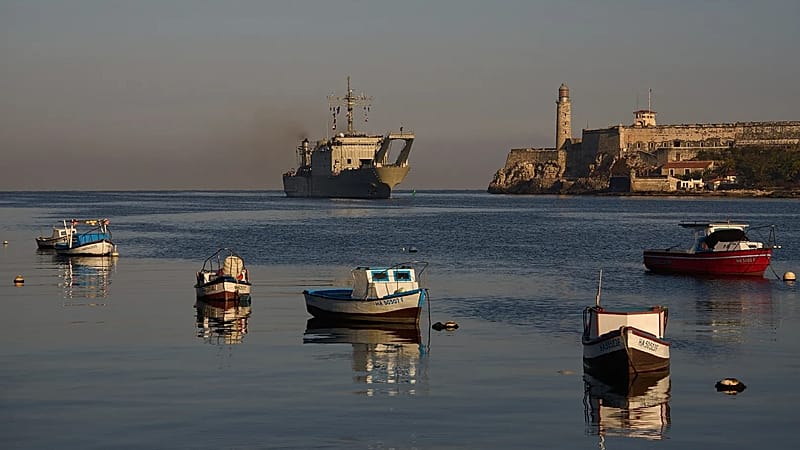
Two Mexican Navy ships carrying humanitarian aid docked in Cuba on Thursday as a US blockade deepens the island's energy crisis.

The ships arrived two weeks after US President Donald Trump threatened tariffs on any country selling or providing oil to Cuba, prompting the island to ration energy in recent days.

The Mexican government said that one ship carried some 536 tons of food including milk, rice, beans, sardines, meat products, cookies, canned tuna, and vegetable oil, as well as personal hygiene items.

The second ship carried just over 277 tons of powdered milk.

Yohandri Espinosa, a 34-year-old engineer, observed the ships arrive with his daughter and took pictures.

"This is incredibly important aid for the Cuban people at this moment," he said. "We are living through difficult times of great need and uncertainty and we don’t know how long we will be like this."

The Mexican Navy ship Papaloapan carrying aid arrives at Havana Bay, 12 February, 2026 (The Mexican Navy ship Papaloapan carrying aid arrives at Havana Bay, 12 February, 2026)

Cuban President Miguel Díaz-Canel has called Trump’s threats an "energy blockade" and said it affects transportation, hospitals, schools, tourism and the production of food.

Cuban aviation officials warned airlines earlier this week that there isn't enough fuel for planes to refuel on the island.

On Monday, Air Canada announced it was suspending flights to Cuba, while other airlines announced delays and layovers in the Dominican Republic before flights continued to Havana.

The cuts in fuel are expected to be another blow to Cuba’s once thriving tourism economy.

"Sometimes you think that things are going to improve, but it's not like that," said Javier González, a Cuban who sat on Havana’s famed seawall watching the Mexican ships arrive.

"We can't stay how we are because it's too hard. We'll have to wait and see."

Mexico's President Claudia Sheinbaum said on Thursday that as soon as the ships return, "we will send more support of different kinds."

Sheinbaum has previously said the humanitarian aid would be sent while diplomatic manoeuvring to resume oil supplies is underway.

She says Mexico has told the United States it seeks to promote peaceful dialogue and ensure Cuba "can receive oil and its derivatives for its daily operations."

Before Trump’s announcement, the state-owned oil company Petróleos Mexicanos had already suspended crude oil shipments to Cuba in January, although it has not clarified the reasons behind that decision.

People walk down a street during a blackout in Havana, 10 September, 2025 (People walk down a street during a blackout in Havana, 10 September, 2025)

Cuba relied heavily on oil shipments from Venezuela that were halted when the US attacked the South American country in early January and arrested its then leader Nicolás Maduro.

Cuba has also reduced bank hours and suspended cultural events, while fuel distribution companies have said that sales only will be made in dollars and limited to 20 litres per user.

In addition to severe blackouts, Cuban officials say that US sanctions, which increased under Trump's second term, cost the country more than $7.5 billion (€6.3 billion) between March 2024 and February 2025.

Sign up to read this article
Read news from 100’s of titles, curated specifically for you.
Already a member? Sign in here
Related Stories
Top stories on inkl right now
One subscription that gives you access to news from hundreds of sites
Already a member? Sign in here
Our Picks
Fourteen days free
Download the app
One app. One membership.
100+ trusted global sources.