
Get all your news in one place.
100's of premium titles.
One app.
Start reading
The Independent UK
The Independent UK
Maroosha Muzaffar

‘Men do not accept us’: The female bikers facing harassment and threats for pursuing their passion in India

One December morning two years ago, Saloni Tyagi was riding on a highway in Gurugram, a satellite city of the Indian capital Delhi, when another motorcyclist repeatedly came close to her bike before hitting it from the side.

She escaped serious injuries. But the crash left her shaken – and changed her relationship with riding.

“I was fully geared. Padded pants, padded jacket, everything. So that saved me. But the trauma was bad,” she tells The Independent.

Tyagi, 42, a Delhi-based stock trader and single mother who goes by Wanderess On Wheels on social media, says she took up motorcycling “as a form of freedom”. But after the crash, she stopped going on long rides alone.

Her experience is far from unique for female bikers in India.

Just last week, Shivani Chauhan, 27, was riding her Aprilia RS 457 in Gurugram when she was allegedly followed and rammed by a man in a car on Golf Course Road.

Footage captured by a camera mounted on her bike saw the incident go viral and helped draw widespread attention to the case.

The man, who was later arrested on an attempted murder charge, denied deliberately hitting Chauhan, saying it was an accident.

Chauhan has since described the psychological impact of the incident and said she has decided to take a break from riding. “I am still very traumatised,” she told her followers

For many female motorcyclists in India, the incident all felt disturbingly familiar.

Priya Mahadik from Mumbai (impriyya/Instagram)

Priya Mahadik, a Mumbai-based HR professional, rides a BMW GS 1250, which weighs about 280kg. She says male riders appear to treat her presence on such a large motorcycle as a personal challenge.

“When a woman rides a superbike, the male riders feel a little bit insecure that a female is riding a big bike, and they start chasing you,” Mahadik, who has been riding for more than 13 years, says.

Riders have cut in front of her at traffic signals, honked, followed her, and even challenged her to race, she says.

Mahadik, 42, stands 5 feet 2 inches tall and she says this sometimes prompts men to ridicule her. “You are so small, why are you riding such a big bike?”

This is meant to make her fearful or cause her to lose control and fall, she suspects, “so they can then claim that see, women cannot handle large motorcycles”.

“I think they feel insecure because they think bikes are meant for boys and not for girls. So that’s the discrimination,” she says. “They will try to see how capable you are of handling the bike.”

Saloni Tyagi is a stock market trader from Delhi who loves riding bikes (@wanderessonwheels/Instagram)

Tyagi agrees. She says women riding motorcycles is often viewed as a challenge or an anomaly rather than a legitimate hobby or mode of transport.

“It’s because we are not accepted,” she says. “We are not accepted by the male riders or drivers.”

This leads women bikers to stay hypervigilant. When Mahadik senses that another rider is deliberately following or provoking her, she slows down and does not engage. If she feels uncomfortable, she heads towards a crowded area.

She also avoids riding in the evenings. When travelling outside Mumbai, she makes sure she reaches her destination before 7pm.

Ankita Arora, 35, marketing head at the motorcycle community xBHP, knows what it feels like when the situation gets out of hand. Three years ago, she recalls, a white car approached her from behind in Gurugram, honked continuously and hit her motorcycle. She was dragged for metres before being thrown off the road.

“My safety gear was completely torn from the back because I got dragged on the road. I did not even feel my legs or hands,” she tells The Independent.

The crash left her shaken. “Whenever I used to see any white car,” she says, “I used to get traumatised.”

Her case is still in a local court three years later.

The experience changed the way she rode. She keeps a camera running because she believes footage can provide crucial evidence when incidents are disputed.

Ankita Arora (@highheelsmotorcyclist/Instagram)

Tyagi says the absence of footage can leave female bikers facing another kind of hostility – online victim-blaming.

“More than 50 per cent of the comments on my posts are saying I’m playing the woman card,” she says. “‘Okay, why were you in this lane?’ I mean, straightaway judgment.”

She encounters a similar attitude on the road. While riding her BMW 850, she says other drivers slow down to look at her, block her path and repeatedly honk. “They are checking out the bike and they are checking out how a girl is riding this bike and all that, blocking my way.”

Bias against female riders on Indian roads, Tyagi says, is “deep-rooted”.

“For boys, it’s very easy,” she says. “Even if they are underage, their families just accept that they will ride one day.” For girls, “it is a challenge”.

“All these girls who are riding bikes today, they wanted to try it. We want to experience this, and then we have to fight. We need consent from our families, friends, and support. That doesn’t come easy for them, they have to earn it,” Tyagi says.

 (@highheelsmotorcyclist/Instagram)
(@highheelsmotorcyclist/Instagram)

Mandeep Merwah, 55, has travelled across the Indian subcontinent since she started riding 10 years ago. She has found a sharp difference between riding in smaller towns and rural areas and navigating major cities.

“If you have a breakdown in the middle of nowhere, you will have people just show up. Whether it is a guy on a bicycle or whatever, he will stop and just want to help you out,” she tells The Independent. “But in cities, I’ve been stranded for two hours alone and just standing by my motorcycle asking for help, and you know the only ones who stop are those who want to create trouble. It’s so bloody unfortunate.”

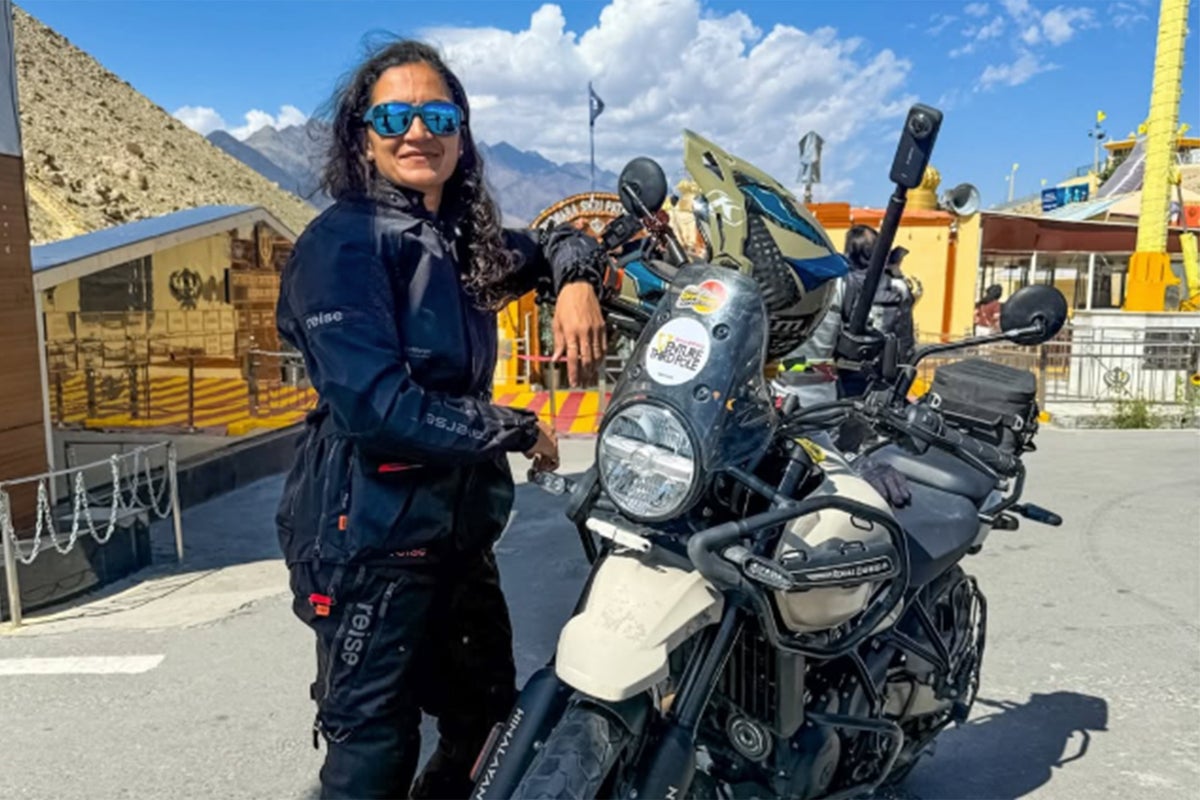
Merwah, who started India’s first training academy for female motorcyclists in 2016, says she doesn’t ride after sunset as a precaution.

Mandeep Merwah (@mandeepmerwah/Instagram)

She complains that female riders are often forced to think about precautions that male riders don’t.

“I keep my hair in the scarf, just not to attract attention,” she says. “But why do I have to even do that? I just feel that’s like such an unnecessary piece of nonsense.”

Many male motorcyclists, Merwah says, are happy to see women riding, offering a “thumbs-up, a wave or a smile”. The bigger challenge, she argues, lies in deep-rooted cultural beliefs about gender, and that will take time to change.

That is why, she says, awareness needs to begin with boys and young men.

Arun Theraja, founder of the Group of Delhi Superbikers, says the problems that female riders face are compounded because dangerous driving doesn’t entail meaningful consequences in India.

“I don’t trust the judiciary and I don’t have faith in the law. Otherwise, these things shouldn’t have been repeated again and again. People get away with it,” Theraja, a doctor, says.

He says stronger enforcement and punishment are necessary to create a deterrent. “That’s a basic fact. You have to punish people.”

A longtime motorcycle enthusiast, Theraja says he has seen harassment and lack of respect for women since his college days in the mid-1980s, but believes the problem has worsened. “It has gone worse and worse.”

Several women ride with his group on the weekends.

Mahadik says men sometimes ridicule her for ‘riding such a big bike’ (@impriyya/Instagram)

Female bikers just want to be left alone and not be harassed or chased, Mahadik says. They don’t want to give up what they truly value because they are wary of going on the road.

Tyagi spent the first 10 years of her marriage largely homebound and did not even go out alone. Motorcycling, she says, is a way of reclaiming her independence and she doesn’t want to leave it.

“We do not get to ride bikes every day. Let us enjoy our ride. You maintain that distance. You maintain that space. Don’t disturb us. Don’t challenge us,” she says.

For Arora, giving up is simply not an option. “I am not leaving my passion behind just because of these bulls*** people,” she says. “They think they can put us down, but they cannot.”

Merwah says riding isn’t about proving anything for her. “It was never about anybody else. It was just about wanting to ride.”

And yet, she says, women are still made to justify that choice.

Riding, she notes, is not like in the movies: you take off your helmet and there shows flowing hair and glowing skin.

“When you have been riding for 6-7 hours, you just have dust and grime in your hair. That’s the reality of it,” she says, laughing.

Still, she lives for that “goofy grin I have the whole time I am riding”.

For female bikers like her, that is perhaps the pull: the freedom of being on the road, of going places and looking at the world slip past the handlebars – despite the barriers on the road.

Sign up to read this article
Read news from 100's of titles, curated specifically for you.
Already a member? Sign in here
Related Stories
Top stories on inkl right now
One subscription that gives you access to news from hundreds of sites
Already a member? Sign in here
Our Picks
Fourteen days free
Download the app
One app. One membership.
100+ trusted global sources.







