Get all your news in one place.
100's of premium titles.
One app.
Start reading
The Independent UK
The Independent UK
Steve Fowler

Meet the British engineer trying to make battery fires a thing of the past

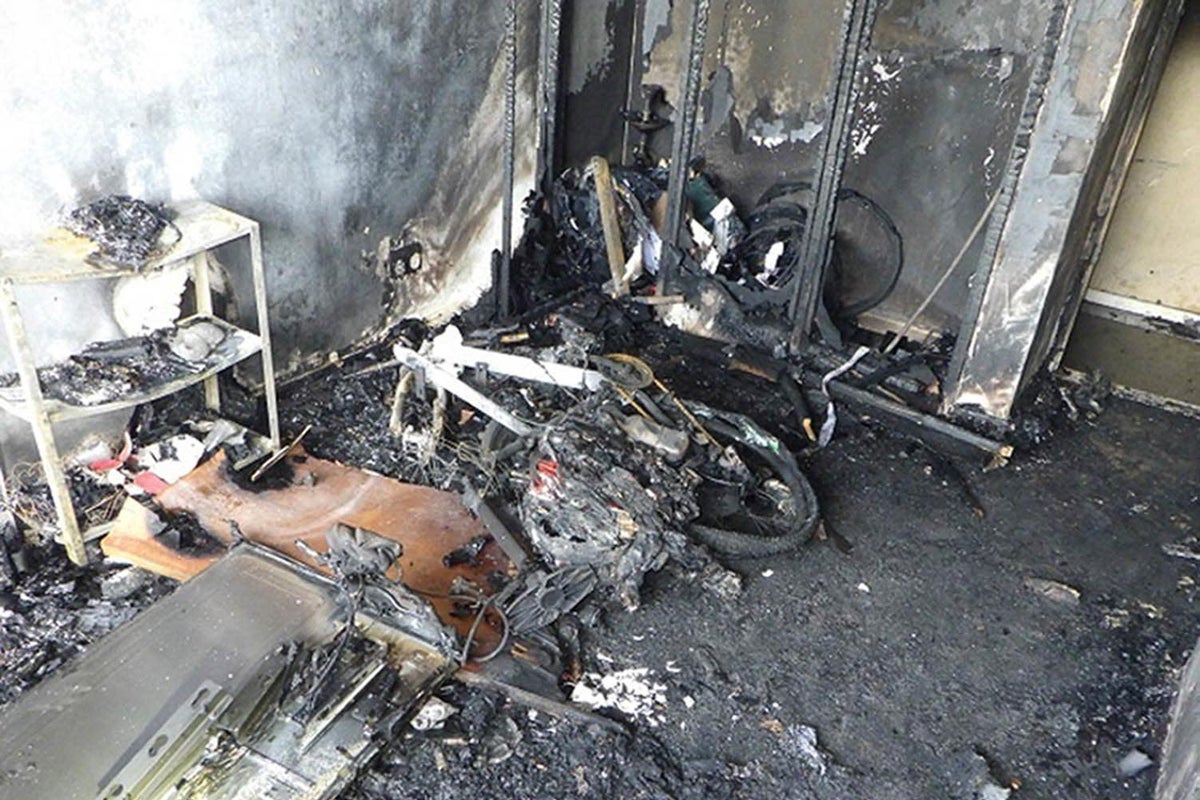
The damage can be widespread, as shown by this fire started by an e-bike (LFB/PA) - (PA Media)

Battery fires are one of those subjects that make people sit up a bit straighter. We’ve all seen the videos: an e-bike battery smoking in a hallway, an e-scooter going up in flames, or the occasional scary headline about an electric car fire.

The reality is more balanced than the social media clips might suggest, especially when it comes to properly engineered electric cars from established manufacturers. But lithium-ion battery fires are a real and growing concern, particularly around cheaper, modified or poorly managed batteries in e-bikes and scooters.

That is where Nick Bailey comes in. Bailey is the founder and CEO of Battery IQ, a British technology company that wants to give batteries something approaching a safety passport, with live monitoring that can flag up problems long before they become dangerous.

The company’s first focus is on e-bikes and e-scooters, where the fire risk has made the most headlines. But Bailey believes the same thinking could eventually stretch from power tools all the way up to electric cars, including the batteries removed from older EVs and moved around the world for second-life energy storage.

Battery IQ founder and CEO Nick Bailey (Battery IQ)

“Fundamentally we’re looking at everything from power tools up to electric vehicles – they’re all things that have caught fire and that’s our scope to try and solve,” Bailey tells The Independent. “And I think we’re on that journey. We’re at a specific point of the journey which we’re having success in a particular area, but I think it will grow over time.”

Bailey’s route into batteries started with bikes. He founded Boost during Covid, building technology to convert bicycles to electric power. He says the idea was to create a UK business that could design and build its own technology, rather than simply rely on off-the-shelf systems.

“I was an engineer before I was anything else,” he says. “I went to university in the workshop rather than studying. I started Boost about five years ago during Covid, which was focused around converting bikes to electric – a UK business that could create that technology. I’m a fan of trying to actually build things in the UK and design things in the UK rather than just relying on the Chinese to do all the design and all the manufacturing.”

Battery IQ came out of that work. Bailey says he became concerned that some generic battery safety systems were not doing everything they should. A project to develop Boost’s own battery management system was paused when the company found a better system from China, but the wider issue did not go away.

“At the beginning of last year it became clear that this battery fire problem wasn’t going away and it was rearing its head in electric vehicles catching fire as well as scooters and e-bikes,” says Bailey.

New figures from business insurer QBE put the scale of the problem in context. UK fire brigades attended 1,760 lithium-ion battery fires in 2025, equivalent to 4.8 a day, and up 147 per cent since 2022. E-bikes accounted for 520 of those fires in 2025, close to a third of the total.

Battery IQ’s answer is a low-cost circuit board that can be built into e-bike and scooter batteries. It can transmit data to a phone, while receivers in buildings or bike parks can scan nearby batteries and check whether they are recognised and behaving normally. The company describes the system as always-on, real-time battery safety, with the ability to show whether a battery is safe, whether it is genuine and how it is being used.

Bailey says the point is not just to inspect a battery once, but to keep watching it. “What that doesn’t do is let you drive into a car park and the car park know that that battery is performing as it should do,” he says of one-off battery health checks. “And I think that’s our broader goal rather than just having a potentially expensive module that gets plugged in at a service center, essentially we want that technology all the time.”

The Boost bike comes with Battery IQ's battery safety tech already installed (Boost)

For building owners, landlords and insurers, that could become important. One of the big problems with batteries in bikes, scooters and other light electric vehicles is that a building manager has no easy way of knowing whether the battery coming through their door is original, damaged, modified or counterfeit.

“At the moment, if you want to put an an e-bike park in your building, either you have to put it in the car park at the end of the car park in a metal box, or you have to put a big fire suppression system in the building,” Bailey says. “And what we are going to try and get to the point of is to say, actually, if we are managing individual batteries, passporting, watching them live, only letting ‘Intel Inside’ batteries into the building, then that is actually a significant risk management for you as an insurer.”

That “Intel inside” idea is a useful way of looking at it. Battery IQ wants its mark to become a visible sign that a battery has been checked, recognised and is being monitored, like how computer buyers understand what they’re getting when they see a “Intel Inside” sticker on the case. Bailey says the company is already talking to insurers, although proving the value of a system designed to stop something from happening is not straightforward.

The technology is already used by Boost, Bailey’s e-bike conversion business. Battery IQ is also working with Zummo, which leases e-bikes to delivery riders, and Bailey says pilots are planned around safer charging and storage, including in Berlin, Germany and Camden, London.

One pilot involves PowerShelter, which makes locker-style charging systems. The concern is simple enough: if a member of the public arrives with what Bailey calls a “battery-shaped object” and puts it into a charging locker, the operator needs to know what it is and whether it can be trusted.

“So we’re looking at a system where that battery has to be onboarded as safe within their platform or our platform so that PowerShelter and Zumba know that that battery is actually what it says it is and is actually safe,” he says.

Battery IQ is also looking at retrofitting radio trackers to batteries that cannot have the full system built in, such as existing mobility devices used in NHS or healthcare settings. Those trackers would not interrogate the battery in the same way, but they could help identify it and link it to a safety record after a battery MOT-style check.

UK fire brigades have seen a 147% rise in lithium-ion battery fires in three years (London Fire Brigade/PA Wire)

“The battery MOT concept has actually really been something that people find very attractive for both the cars and the electric bikes,” Bailey says.

So where do electric cars fit in? Bailey is careful not to overclaim. Battery IQ is not currently selling a car system, but the company is discussing ideas with potential partners. One route could be a plug-in device that uses a car’s OBD port to read battery data and provide an external view of whether the pack is behaving as expected.

“We’re also looking at having the ability to plug a radio device onto batteries that are being pulled out of electric vehicles so that they can be safely transported on things like container ships,” he says.

That second-life battery point could become increasingly important. The earliest Nissan Leafs are now well over a decade old, while battery packs from crashed or scrapped EVs can already be bought online. Many of those packs will be moved into energy storage, repair or recycling chains.

“We’re getting towards the first generation of the Nissan Leaf or second generation,” says Bailey. “Those batteries are starting to be stripped out of 10-year-old vehicles and they’re going to start entering the supply chain. You can already buy packs off Teslas and Nissan Leafs on eBay. I think as a country and a world, we’re going to end up with not really knowing what to do with all these packs.”

That is why Bailey thinks battery passports and continuous monitoring could become part of how batteries are managed across their whole lives, rather than just while they are fitted to a vehicle.

Battery fires themselves, he says, usually come down to misuse, age or poor-quality cells. Problems can build over time if a battery is damaged, exposed to damp, charged or discharged in poor conditions, or repeatedly pushed beyond what it was designed to do. Battery IQ looks for early warning signs, such as cells drifting from where they should be, energy being lost in a particular cell, or humidity changes inside a sealed battery box.

“If someone’s put a nail through their battery or driven their car over their battery, then we might not have much notice of that,” Bailey says. “But when it’s gradual degradation of a battery, we see that months and months in advance.”

Those warnings could then go to the owner, manufacturer or building operator, depending on the application. The aim is not to scare everyone away from battery-powered transport, but to separate properly managed batteries from the unknown, modified or badly handled ones.

“There are a few people doing plugins for when you come to a used vehicle to essentially do an MOT on the battery,” Bailey says. “I mean, that’s quite specific, but what that doesn’t do is let you drive into a car park and the car park owner know that that battery is performing as it should do.”

There is also a British industry angle here. Bailey knows most battery production still happens in China, and Battery IQ itself works with Chinese manufacturers. But he argues that a UK company can provide a layer of trust, traceability and local regulatory understanding that a single battery maker would struggle to offer across the whole market.

Bailey is not presenting Battery IQ as a magic fix for every battery fire. The company is young and its focus is currently e-bikes and scooters; the jump into mainstream electric cars would need partners, standards and industry backing.

But the direction of travel is clear enough. As more of the things we use every day run on lithium-ion batteries, the question is moving from simply how much charge they hold to whether we can prove, in real time, that they are safe, genuine and being used properly.

For electric cars, that could eventually mean battery safety becomes part of a wider health check, along with range, charging performance and long-term condition. For e-bikes, scooters, mobility devices and second-life EV batteries, it could arrive sooner.

And if Bailey gets his way, one day a battery with a recognised safety mark could become as reassuring as a good service history.

Sign up to read this article
Read news from 100's of titles, curated specifically for you.
Already a member? Sign in here
Related Stories
Top stories on inkl right now
One subscription that gives you access to news from hundreds of sites
Already a member? Sign in here
Our Picks
Fourteen days free
Download the app
One app. One membership.
100+ trusted global sources.