Get all your news in one place.
100's of premium titles.
One app.
Start reading
The Economic Times
The Economic Times
Trending Desk

Meet the $500,000 ChatGPT-powered humanoid robots acting as teachers, counsellors and translators in a San Diego school

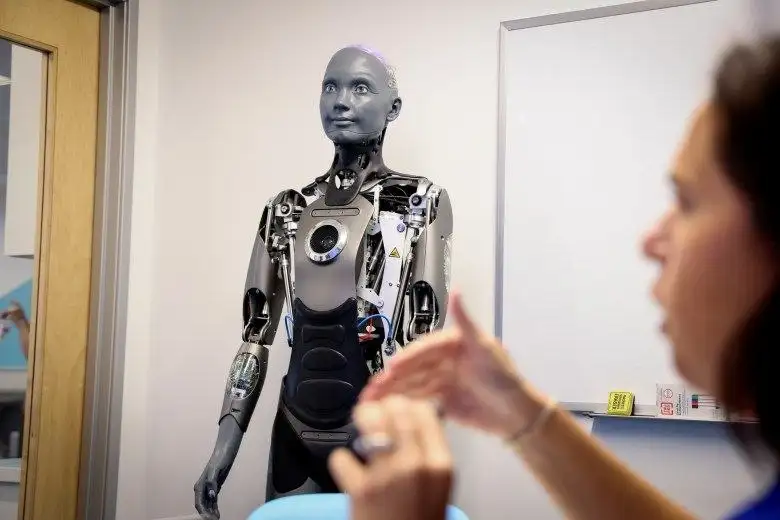
In a first-of-its-kind experiment, a school network in California has introduced two ChatGPT-powered humanoid robots to work alongside teachers and support students.

Altus Schools, a charter school network serving thousands of students across San Diego County, has invested $500,000 in two life-sized Ameca robots. School officials at Altus Schools have hailed Ameca as the “world’s most advanced AI-powered humanoid robot” and say the machines are part of a pilot program exploring how artificial intelligence and robots could one day help educate students. On the other hand, critics have questioned whether such an expensive experiment should be introduced to students, according to The New York Post.

ALSO READ: Family leaves New York, buys $13,000 home in Italy and later purchases a second property

Meet the ChatGPT-powered robots entering classrooms

The robots, called Ameca, were developed by UK-based robotics company Engineered Arts.

Standing about 6 feet 2 inches tall, the humanoid robots can hold conversations, make eye contact, smile, blink and respond with lifelike facial expressions. Their conversational abilities are powered by ChatGPT, allowing them to answer questions, explain concepts and interact naturally with students.

“We are thrilled to be the first school in the world researching the use of physical AI as a teaching partner,” Cathryn Rambo, Altus’ dean of academic studies wrote to the Voice of San Diego.

ALSO READ: Woman loses 7.5 kg in 2 months after giving up rice, chapati and dosa

Four AI roles in one robot

Altus Schools has programmed the robots to switch between four different personas depending on student needs:

1. Classroom tutor

The robot can help explain lessons, answer questions and reinforce concepts taught by teachers.

2. Wellness coach

Students can interact with the robot for conversations about emotional well-being, healthy habits and everyday challenges.

3. College and career guide

The AI can assist students in exploring colleges, scholarships, career options and future planning.

4. Language translator

The robot can help bridge communication gaps between students, families and school staff who speak different languages.

Why the school is testing humanoid AI

School leaders said they want to understand whether students engage differently with a physical robot than with a chatbot on a laptop or phone.

Researchers call this concept "physical AI" or "embodied AI." The idea is that facial expressions, gestures, eye contact and body language could make interactions feel more natural and encourage participation.

The pilot is designed to study whether these human-like features can improve learning experiences and student engagement.

Early tests show promise and limitations

The robots have already participated in classroom demonstrations.

During one session, students asked the robot to role-play as inventor Nikola Tesla while discussing scientific concepts.

While the activity showcased the robot's conversational abilities, it also revealed some challenges. School officials said the robot occasionally interrupted students, spoke too quickly and sometimes required questions to be repeated before giving useful answers.

Administrators described the experience as a work in progress rather than a finished product.

Safeguards are in place

To address concerns around AI use in schools, Altus Schools said students are never left alone with the robots.

All interactions are supervised by staff, and school officials say conversations are not permanently stored. Students are also encouraged to fact-check information provided by the AI, since generative AI systems can sometimes produce incorrect answers.

Can humanoid robots become the future of education?

The experiment comes as schools around the world increasingly explore AI tools for tutoring, language translation and personalized learning.

Supporters believe humanoid robots could provide additional support for students and help schools prepare learners for an AI-driven future.

Critics, however, question whether expensive robots deliver enough educational value to justify their cost and caution that students must continue developing independent thinking skills.

For now, the San Diego project remains an early test. But it offers a glimpse into how classrooms may evolve as artificial intelligence becomes a bigger part of everyday education.

Sign up to read this article
Read news from 100's of titles, curated specifically for you.
Already a member? Sign in here
Related Stories
Top stories on inkl right now
One subscription that gives you access to news from hundreds of sites
Already a member? Sign in here
Our Picks
Fourteen days free
Download the app
One app. One membership.
100+ trusted global sources.