Get all your news in one place.
100's of premium titles.
One app.
Start reading
We Got This Covered
We Got This Covered
Jaymie Vaz

A woman asks a McDonald’s employee why she’s being cursed out, and the answer is just ‘you recorded me’

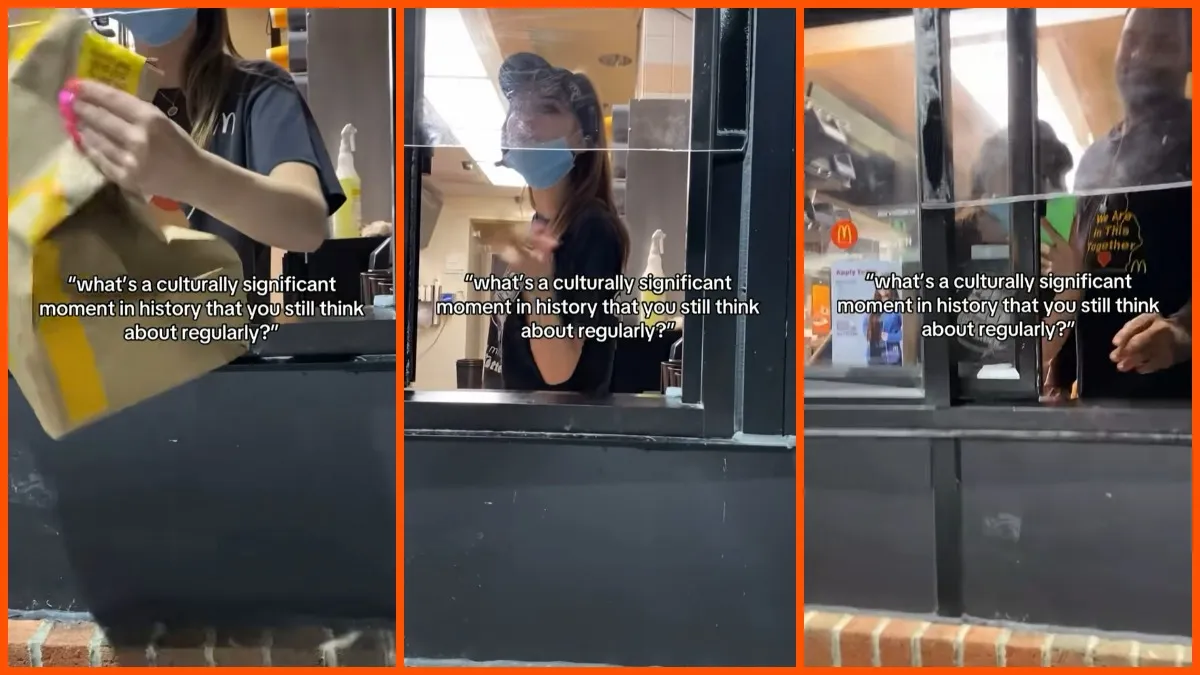
A video recirculating on TikTok has gone viral and sparked a massive debate about the ethics of filming strangers in public. All it took was a customer’s drive-thru interaction with a McDonald’s employee. The post has racked up 16.9 million views and was reposted by TikToker dylangg as part of a series he calls “culturally significant moments” in history. While the original context remains a mystery, the video captures an intense but relatable confrontation.

The video begins with a customer receiving her food at the drive-thru window. After the employee finishes giving some instructions and the customer offers a thanks, the situation takes a sharp turn. The employee responds with a simple, “Yup,” and begins to walk away. Then she leans back into the frame to flash a middle finger at the customer.
When the customer says, “Good,” in a confused tone, the employee waves goodbye and repeats the gesture. The employee then becomes increasingly aggressive. She slams the window shut, yells, makes more obscene gestures, and even calls her manager. She screams at the customer, “Get the f**k out of my drive-thru b***h! F**k is wrong with you! What b***h? Somebody got me heated, b***h!” All of it with one question, “Why are you recording me?”

The customer didn’t get why she was angry

Towards the end of the clip, the customer tells the employees, “You just curse me out up and down.” The employee retorts by repeating her complaint, “You recorded me!” The worker even pulls out her own phone, stating that she can record the customer as well. Dylangg shared the video with the caption, “don’t even need context idc i’m on mcdivas side.” This sentiment resonated with many in the comments.

They took to the comment section in droves. One user asked, “No but why you recording her tho,” while another chimed in, “what is Americans obsession with recording literally everyone.” Others defended the worker, with one person writing, “I’m on the McDonald’s workers side cus the woman in the car recorded her for [no] reason.”

@dylangg

don’t even need context idc i’m on mcdivas side

♬ original sound – Dylan G.

Another commenter agreed, writing, “Leave them workers alone please. We all work hard and need to unite, stop being rude.” Some viewers took a more cynical approach, with one user claiming, “I guarantee you. The girl did something before starting to record to upset the McDonald’s employee.” Another simply dubbed the situation, “McDiva with the McCrashout. Valid tho.”

That being said, some commenters were put off by the employee. One commented, writing, “I hope this employee is fired.”

The surge in people filming others for entertainment has raised important questions about the legality of such actions. According to an explainer by Rosier Law Group, the rules around posting photos or videos of others are not as straightforward as many might think. While it is generally legal to film in public spaces like a street or a beach because people there typically do not have a reasonable expectation of privacy, the landscape changes when audio is involved.

Rosier Law Group highlights that some states are “one-party consent” states. Others, including California, Florida, and Illinois, are “two-party consent” states. In these jurisdictions, you generally need everyone involved in a private conversation to consent to being recorded. If you violate these laws, you could face civil penalties or even criminal charges.

Furthermore, the firm notes that even if a post is technically legal under U.S. law, it might still violate the terms of service of various social media platforms. Most platforms have strict rules against content that invades someone’s privacy, harasses individuals, or targets them without permission. Recently, a TikToker took to the platform to share that it is dehumanizing when fans take videos of her without consent.

The legal risks also extend to the right of privacy, the right of publicity, and defamation. If a video is framed in a way that portrays someone falsely or harms their reputation, the person being filmed could potentially pursue a defamation lawsuit. For example, a TikToker was ordered to pay $10 million in damages for claiming a professor was involved in an Idaho crime.

Rosier Law Group suggests that the best way to stay safe is to get permission before posting someone. Especially if they are clearly the subject of your content.

Sign up to read this article
Read news from 100's of titles, curated specifically for you.
Already a member? Sign in here
Related Stories
Top stories on inkl right now
One subscription that gives you access to news from hundreds of sites
Already a member? Sign in here
Our Picks
Fourteen days free
Download the app
One app. One membership.
100+ trusted global sources.