
Quick Summary
Researchers in Germany have developed a shape-shifting flying robot that can hover and manoeuvre without relying on propellers or constant thrust.

Called Floaty, it uses adjustable flaps and natural airflow to stay stable while consuming a fraction of the energy used by conventional drones.
A big compromise in aviation is choosing between efficiency and control. Drones can hover and move precisely, but their propellers consume a lot of power. Fixed-wing aircraft are far more efficient, but can't stay suspended in one place.
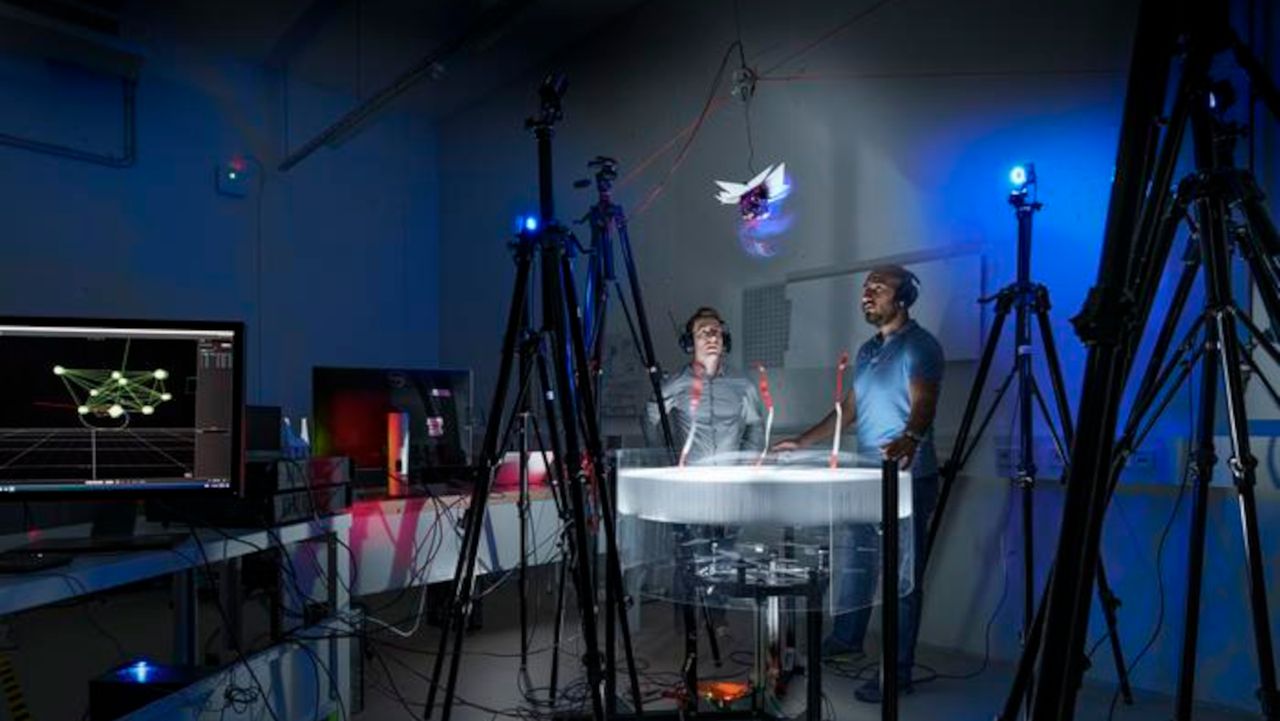
Researchers at the Max Planck Institute for Intelligent Systems and the University of Stuttgart think they've found a middle ground. Their new robot, affectionately called Floaty, uses rising air currents to remain airborne while adjusting four movable flaps to control its position and stability.
Inspired by soaring birds, Floaty doesn't use propellers to stay in the air. Instead, it rides upward airflow and continuously changes its shape to control how air moves around its body.
The robot has been trained using an aerodynamic model developed from extensive wind tunnel testing, allowing it to recover from gusts of wind and even physical pushes without losing control.
Getting the design right wasn't straightforward. Early versions proved unstable, so the team lowered the robot's centre of gravity and redesigned its control flaps to help it automatically correct its position while airborne.
The result is a robot that can hover in vertical airflows of up to 10m/s while remaining very stable.
The biggest advantage is efficiency. According to the researchers, Floaty consumes around 10W per kilogram of weight, roughly an order of magnitude less power than comparable thrust-powered aerial robots.
While it's still a research project, the team believes the technology could eventually be used to inspect industrial chimneys, monitor weather systems or even help control spacecraft and rockets in airflow-rich environments.
If that happens, Floaty may represent a very different future for flight – one where robots work with the wind rather than fighting against it.