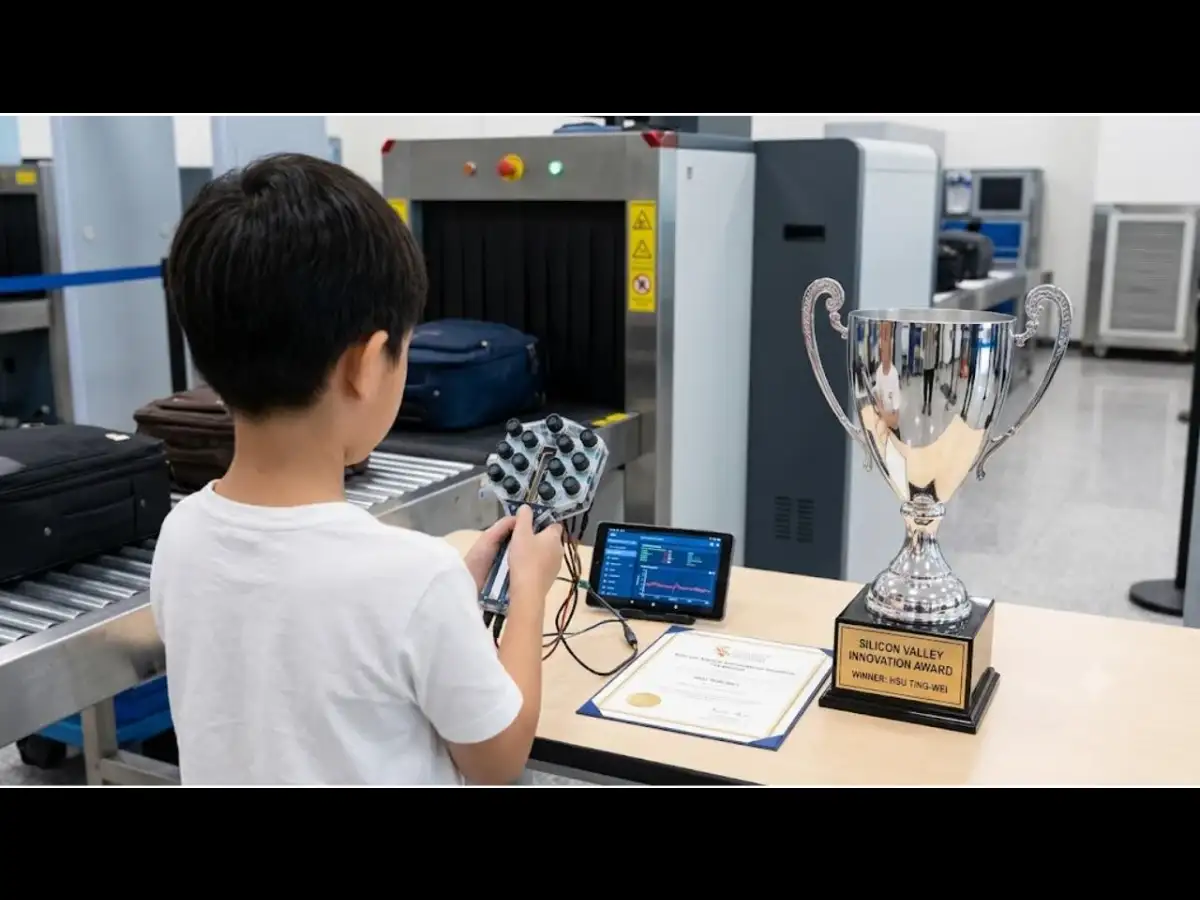
A 10-year-old Taiwanese inventor has won international recognition for an AI-powered “electronic nose” designed to strengthen baggage screening at airports and help detect potentially dangerous substances.
Hsu Ting-wei received a gold medal and the International Federation of Inventors’ Associations’ best invention award at the recent Silicon Valley International Festival (SVIIF) in California. His invention, called the “Novel Artificial Electronic Nose,” is designed to add chemical detection capabilities to existing X-ray baggage screening systems.
The system combines real-time air sampling, gas chromatography-mass spectrometry and AI-based odor recognition. It is intended to be installed behind X-ray baggage screening equipment, allowing authorities to analyze substances associated with screened luggage without direct contact.
Hsu said he hopes the technology can help prevent pork products potentially carrying African swine fever from entering countries and assist US authorities in intercepting drugs such as fentanyl at borders.
'Award not given just to encourage'
According to jury chairman Amin Ghafooripour the award was not simply given because of Hsu’s age.
“Hsu's award wasn't handed out simply as encouragement due to his age, but reflected genuine recognition from the jury, who saw real practical value in the invention and were left with a strong impression by his work.”
Hsu’s achievement was part of a strong showing by Taiwanese inventors at the festival, which featured entries from more than 30 countries across general and youth categories.
Taiwanese students also won the top prize in the Youth Talent Competition for “AllerDetect GO,” a health protection system designed for children, older adults and people prone to allergies. The system combines allergen detection, alerts, record-keeping and smart-home responses to help users identify risks earlier and reduce accidental exposure.
A team from the Affiliated Senior High School of National Taiwan Normal University won second prize in the Youth Talent Competition. In the general inventors category, Baichao Greenergy Tech Co received a special award from the World Intellectual Property Organization.
Taiwanese participants collectively won 24 gold medals, eight silver medals and one bronze medal at this year’s festival. The 24 gold medals represent Taiwan’s highest gold-medal total since it first participated in SVIIF in 2018, with almost every Taiwanese team receiving an award.
SVIIF board committee member Matt Nuccio praised the quality of the Taiwanese entries, particularly those developed by young inventors.
“Taiwan had quite a few great innovations,” Nuccio said, adding that he was especially impressed by the quality of their work given how young many of the inventors were.
Ghafooripour said Taiwanese inventors often focus on using emerging technologies to develop practical solutions.
“Ghafooripour added that Taiwanese inventors tended to focus on applying new technologies toward practical solutions aimed at making everyday life easier for people.”
The festival’s results highlight how young inventors are increasingly using AI and other technologies to address everyday challenges, from food and drug screening to allergy protection and public safety.