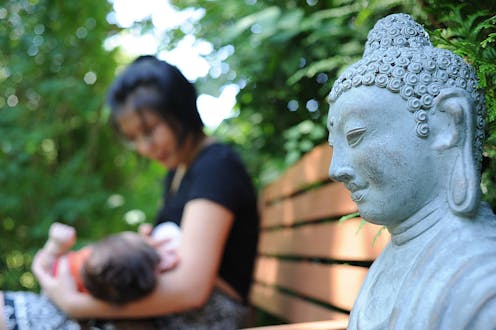
Buddhist saints are often described as maternally compassionate, with the endless patience of a mother who feeds, cleans and cares for children around the clock. In fact, the Theravada branch of Buddhism holds mothers in such high esteem that two men among the Buddha’s chief disciples, Sariputta and Mogallana, are said to be “like the mother giving birth” and “the nurse raising a child.”
Yet in Buddhism, as in some other religions, views of motherhood are complex. Motherlike compassion is idealized – yet so are celibacy and monasticism. Historically, the faith does not have a core ideology that values marriage and procreation as central virtues to be pursued at the cost of spiritual study and enlightenment. However, as a scholar of gender and family in Buddhism, I have noticed shifting views about how spirituality and motherhood can be combined.