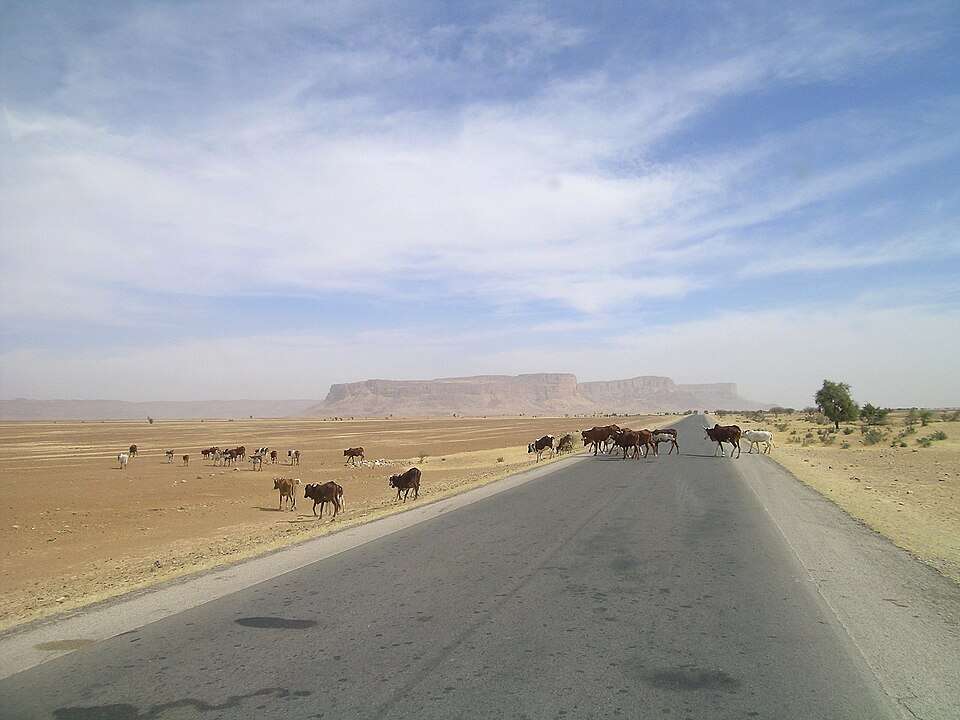
In Mauritania, a forest was planted to protect a road from drifting sand. Along the country’s Road of Hope, shifting dunes were creeping towards the route, threatening to bury sections of a vital transport link. Instead of relying only on machinery to clear the sand, authorities used vegetation as a living barrier, planting trees and shrubs to slow the dunes before they could reach the road.
Get breaking news anytime, anywhere. Download the TOI app now!

According to the Food and Agriculture Organisation (FAO) , the Magta Lahjar project involved a 335-hectare plantation that provided complete and lasting protection against sand encroachment along 6.7 kilometres of road. FAO also identifies the project as part of wider efforts to control moving sand along Mauritania’s Road of Hope.
When shifting dunes threatened the Road of Hope
Mauritania’s Road of Hope stretches eastward from the capital, Nouakchott, towards the country’s interior, connecting the capital with settlements farther east. Parts of the route pass through dry, sparsely vegetated landscapes where shifting sand can gradually spread across the road. As vegetation cover declined under harsh environmental conditions, exposed soil became more vulnerable to wind erosion, increasing the risk of sand encroaching on the route.
The main threat was not simply loose sand crossing the road, but mobile dunes advancing towards and across it. According to the Food and Agriculture Organisation (FAO), some longitudinal dunes were moving southwards by around 10 to 20 metres a year. Once these dunes reached the road, repeatedly clearing the accumulated sand offered only a temporary solution. The more lasting approach was to stabilise the moving sand before it could reach the road.
A forest became a barrier against the dunes
The Food and Agriculture Organisation (FAO) also notes that the Magta Lahjar site received roughly 150 millimetres of rainfall a year, making it one of the drier locations where vegetation was used to control moving sand. A 335-hectare plantation was established there with Prosopis juliflora, Parkinsonia aculeata and Leptadenia pyrotechnica. Getting the trees established was difficult. Young plants had to withstand dry surface conditions, strong winds and shifting dunes that could bury or uproot them. However, the sandy terrain also offered an advantage because dune sand could allow rainfall to penetrate relatively deeply, leaving moisture available to plant roots. The plantation ultimately achieved its intended purpose. FAO reports that the 335-hectare green belt provided complete and lasting protection against sand encroachment along 6.7 kilometres of road, amounting to roughly 50 hectares of plantation for every kilometre protected.
The road needed more than trees to keep dunes away
The Magta Lahjar plantation was not the only experiment along the Road of Hope. In areas with lower rainfall, mechanical barriers could be more practical than relying mainly on trees. The counter-dune was designed to block moving dunes before they reached the road while still allowing loose sand to pass across the landscape. In both experimental sections, the road stayed free of dunes while the protective systems were maintained. But after maintenance stopped, sand eventually returned, showing that dune control was not necessarily a one-time intervention.
The experience also showed that the choice of protection method depended heavily on rainfall. Where annual precipitation was above 100 millimetres, planting vegetation could provide effective protection against moving sand. In drier areas, physical barriers were a more practical option when conditions were too harsh for trees to establish reliably.
The wider programme also highlighted the value of local participation. Communities were involved in protecting vulnerable sections of the road, with technical support from government authorities. This local approach helped make sand-control measures more practical and, in some cases, less expensive to maintain. The lesson from Mauritania was not simply that planting 335 hectares of trees could protect a road from drifting sand. It was that moving sand could be managed when vegetation, physical barriers, maintenance and local participation were matched to the conditions of each site.
Stay updated with the latest news on Times of India. Get all the trending City News, India News, Business News, and Sports News. For Entertainment News, TV News, and Lifestyle Tips, visit Etimes.